
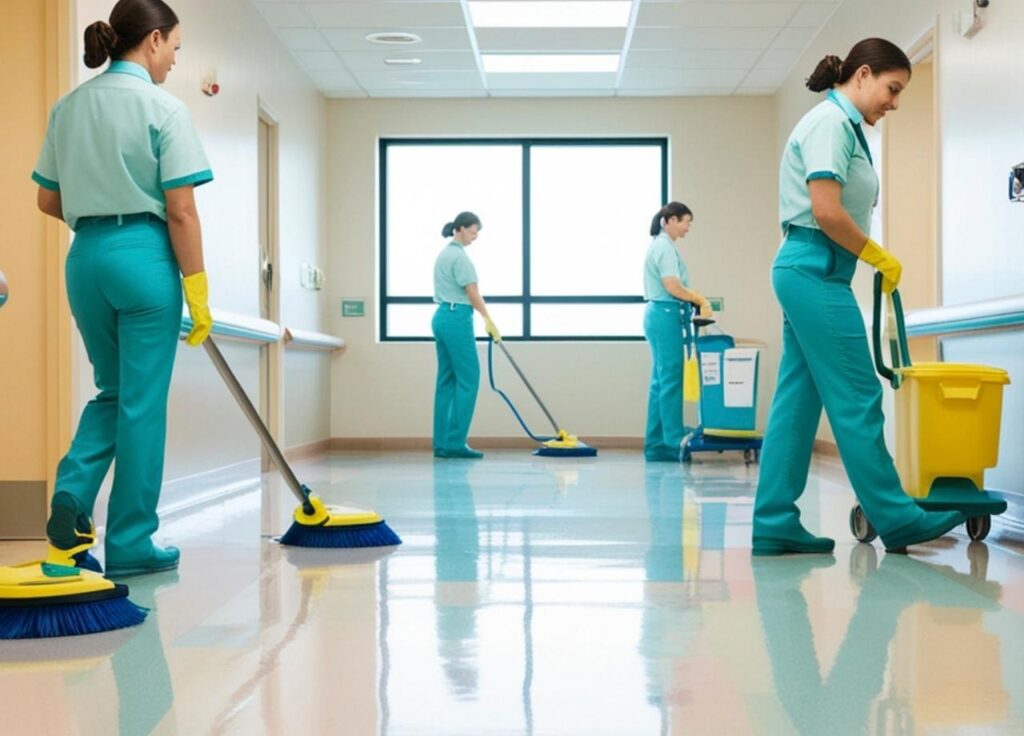
Ask a practice manager in Wollongong, Shellharbour or Kiama what keeps them busy before an accreditation visit and the list is long: policies to update, training records to chase, registers to check. Cleaning rarely tops that list, yet it underpins one of the most practical parts of any assessment, infection prevention and control. More practices are now treating cleaning less as a background service and more as a documented, auditable system, often with help from outside specialists such as the team at B&K Services. The difference between a practice that struggles here and one that sails through usually comes down to records, not effort.
What Accreditation Actually Asks For
General practices in Australia are accredited against the Royal Australian College of General Practitioners’ Standards for general practices. Accreditation under the National General Practice Accreditation Scheme currently uses the fifth edition, where Criterion GP4.1 covers infection prevention and control, including sterilisation. The RACGP released a sixth edition in August 2026, and the Australian Commission on Safety and Quality in Health Care has said accreditation will keep using the fifth edition until a transition is arranged, while encouraging practices to start implementing the new edition now.
Alongside the Standards, the RACGP’s infection prevention and control guidelines set out what good cleaning looks like in a practice. They say practices must have a cleaning schedule that ensures the premises are systematically and appropriately cleaned, and that the schedule should name who is responsible, which surfaces are cleaned, how often, by what method and with which products and equipment. The guidelines also make clear that this applies to contract cleaners as well as practice staff.
In other words, a surveyor is not just looking at whether the waiting room looks clean on the day. They are looking for evidence of a system.
Why Paper Logs Are Becoming a Weak Point
Many practices still track cleaning on a clipboard taped inside a storeroom door. It works, after a fashion, but it has familiar problems:
- sign-off sheets go missing, get wet or fill up and are never replaced
- it is hard to tell whether a tick means the job was done properly or just done
- contract cleaners often work after hours, so nobody from the practice sees the work happen
- pulling together months of records before an assessment takes hours
None of this means the cleaning is poor. It means the practice cannot easily prove it is good, and that is what accreditation is about.
Building a Cleaning Schedule That Works as Evidence
The starting point is the schedule itself. A strong one is detailed enough that a new cleaner, or a surveyor, could read it and know exactly what happens where.
Cover every area
List every room and zone, from reception and the waiting room to consult rooms, treatment and procedure rooms, patient toilets, staff kitchens, corridors and storage.
Name the surfaces and the method
For each area, list the surfaces and items cleaned, the product used and the method. “Clean treatment room” is not enough. “Treatment room benches, sink and taps cleaned with detergent daily; couch cleaned between patients by clinical staff” is.
Set frequencies and owners
Specify whether each task happens after every patient, daily, weekly or periodically, and who does it: clinical staff, administration or the contract cleaner.
Where Digital Tools Help
Practices do not need expensive software to improve their records, but simple digital tools can close many of the gaps that paper leaves open.
Time-stamped sign-off
A shared form or checklist app that records who completed each task and when gives a far more reliable trail than ticks on paper. Many contract cleaners already use apps that log each visit, and practices can ask for those records to be shared.
QR codes in each room
Some practices place a QR code in each room or zone that links to that area’s checklist. Cleaners scan it, complete the tasks and submit, which ties each record to a specific place and time.
Photo evidence for periodic work
For less frequent tasks, such as carpet cleaning or high dusting, before-and-after photos attached to the record are easy to capture and useful to show.
Issue reporting
A simple channel where staff can report a cleaning problem, with the response logged, demonstrates the kind of continuous improvement the Standards look for.
Whatever tools a practice chooses, the principle is the same: the record should be easy to complete, hard to fake and quick to retrieve.
Dividing Responsibilities Clearly
In most practices, cleaning is shared. Clinical staff typically clean equipment and surfaces between patients, such as examination couches, blood pressure cuffs and procedure trolleys, and deal with blood or body fluid spills as they happen. Contract cleaners usually handle routine environmental cleaning after hours: floors, toilets, waiting areas, kitchens and general surfaces in clinical rooms, plus periodic tasks.
Write those divisions into the schedule. If a surveyor asks who cleans the treatment room sink, everyone should give the same answer. Practice managers who want to talk through cleaning records with a provider can contact the B&K Services team at [email protected].
Choosing a Contractor That Supports Your Records
A medical practice is not an ordinary office, and its cleaning provider should understand the difference. Practices looking for healthcare cleaning in Wollongong should ask prospective providers not only how they clean, but how they document their work.
Questions worth asking
- How are your cleaners trained for clinical environments?
- Do you use colour-coded cloths, mops and buckets to prevent cross-contamination?
- How do you avoid handling clinical waste and sharps?
- What records do you provide after each clean, and in what format?
- Can your records be shared with us digitally, and how quickly?
- How do you respond when the practice raises a concern?
Gaps Surveyors Commonly Find
Even well-run practices get caught out by small details:
- a schedule that lists rooms but not methods or products
- contract cleaners who have never seen the schedule they are meant to follow
- no record of who cleaned what, or when
- cleaning equipment stored in a clinical room or beside sterile stock
- the same mops and cloths used in toilets and treatment rooms
- spill kits that are missing, incomplete or out of date
A short internal audit a few months before an assessment, using the same kind of checklist a surveyor would use, is one of the most useful things a practice manager can do.
Preparing for the Sixth Edition
With the sixth edition of the Standards now published, practices have a window to review their systems before assessments move to the new edition. Cleaning records are a sensible place to start. A practice that already has a clear schedule, reliable digital sign-off and a contractor who shares records easily will find any transition far less disruptive than one still relying on a clipboard.
Beyond the Assessment
Accreditation is a moment in time, but infection prevention is constant. Patients notice the condition of waiting rooms and toilets, staff work more safely in a well-cleaned building, and good records make it easier to spot problems early. Treat the cleaning schedule as a living document, review it whenever services or layouts change, and keep talking with your contractor between assessments, not just before them.
Final Thoughts
Cleaning is one of the most visible parts of infection prevention and control, and one of the easiest to evidence well. Illawarra practices that keep a detailed schedule aligned with RACGP guidance, divide responsibilities clearly, use simple digital tools to record the work and choose a contractor who understands healthcare settings will approach their next assessment with confidence, whichever edition of the Standards it uses.
About the Author
This article was written by Ammara, an SEO specialist at B&K Services who writes about commercial cleaning, facilities management and how well-kept spaces support the people who use them. To get in touch with Ammara, email [email protected]. For enquiries about cleaning services, contact the B&K Services team at [email protected].
Previously in Latest News: Poland: False Emergency Report Brings Police to Home of Lawyer for Conservative Journalists and Catholic Bishop