
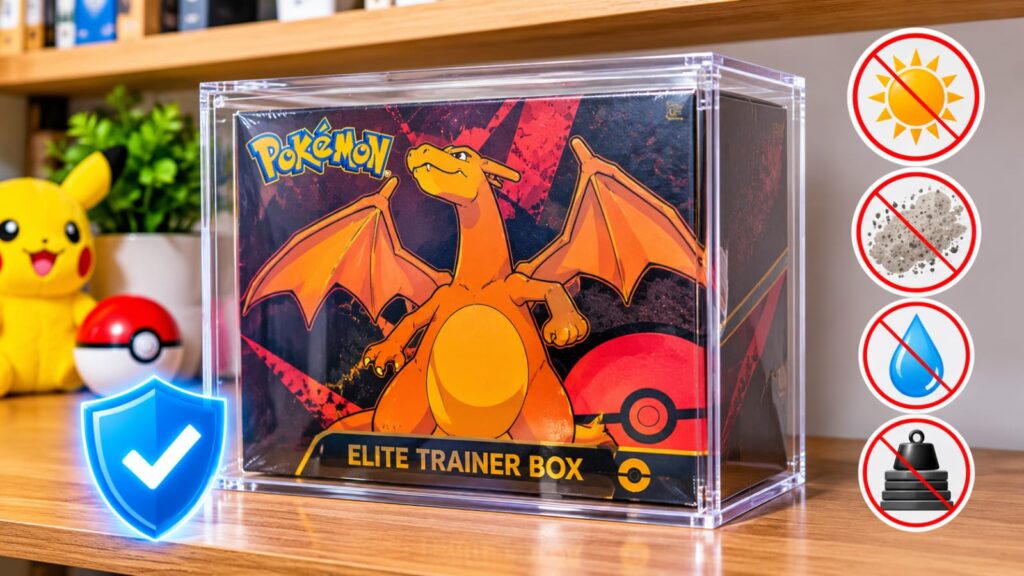
You notice it on a Saturday, not in some dramatic way. You are rearranging a shelf and you pick up a sealed Elite Trainer Box you have had for a while. The wrap is still tight, but the red on the front is not as deep as you remember. Or there is a soft film of dust along the top edge, stuck to the plastic. Or one corner has a crease that was not there when you brought it home. A sealed Pokémon Elite Trainer Box looks sturdy because it is still unopened. It is still just cardboard, ink, and a thin wrap, sitting out in the room.
Why a Sealed Elite Trainer Box Is More Fragile Than It Looks
The seal stops you opening it. It does not stop light, moisture, or weight. The wrap is thin. The art is printed on paperboard. The corners are the first place a knock shows, and once a corner is crushed, you cannot press it back out without making it worse.
It is easy to treat a sealed ETB like a solid block. It is a hollow box with a lid, packed with packs and accessories, and the walls can buckle if something heavier sits on it. That is worth remembering before you start stacking, and it is why a box that has never been opened can still look tired after a year on a shelf.
UV Fading and Where You Put the Box
Sunlight is the quiet one. A shelf that looks fine in the morning can catch a strip of afternoon sun for an hour or two, and that is enough, over months, to pull the colour out of a printed panel. Reds and dark blues are usually the first to look washed. You may not see it until you set a newer box of a similar set beside it.
A window, a skylight, or a desk lamp left on close to the art all count. Bright indoor light, day after day, does some of the same work, just more slowly. If you like having the boxes on display, which most of us do, the answer is not to hide them in a cupboard. It is to think about the light that actually hits that shelf, and to put a barrier between the print and the UV.
Dust, Humidity and the Room Around the Shelf
Dust sounds minor until it sits in the folds of the wrap and along the top of the lid. You can wipe a bare shelf. Wiping a sealed ETB is awkward: too dry and you scuff the plastic, too damp and you risk pushing moisture into a corner. After a few months the box just looks dull, even if the seal is perfect.
Humidity is the less visible problem. A room that runs damp, a wall that feels cold, or a cupboard that never airs out can soften cardboard and encourage warping. In practice it is the slightly steamy spare room, or the box left in a garage, that does the real damage. Keep sealed ETBs in a living space with ordinary, steady air, off the floor, and away from heaters and radiators.
Stacking Pressure and Everyday Handling
This is how most dented corners happen. You have more boxes than shelf space, so one ETB goes on top of another. The bottom box takes the weight on its lid and on the corners. Over time the top panel sags, or a corner folds in a few millimetres, and the wrap starts to look loose there.
Handling does the rest. Pulling a box off the shelf by one end, sliding it against a bookend, setting it down on a slightly raised seam in the wood: none of that feels careless in the moment. Do it twenty times and the same corner starts to look tired. If you like to pick the boxes up and show them to people, that is fair. Just know that the wrap will record every grip.
A few habits help even before you add a case:
- Give each box its own footprint on the shelf, rather than stacking them
- Pick the ETB up with two hands, from underneath
- Keep it off window sills and away from heaters
- Dust the shelf, not the wrap, as much as you can
How an Acrylic ETB Case Encloses the Box Without Hiding It
The reason many collectors keep ETBs sealed is that they like the object: the set art, the shape, the fact that it is still closed. A bag in a cupboard would protect it, but then you never see it. Whatever you put it in has to do both jobs.
An acrylic ETB case is a clear shell that the sealed box sits inside. The artwork stays visible from the front and usually from the sides. The cardboard and the wrap no longer take the dust, the stray knock, or the weight of whatever used to sit on top. You are not opening the ETB, and you are not wrapping it in anything opaque.
If you have been looking for a straightforward fit around a standard sealed box, Dragonscale Supplies is one place collectors go. You slide the ETB in, close it, and put the whole thing back on the shelf. The box is still the thing you see. The acrylic takes the wear.
What to Look For Before You Buy One
You do not need a long checklist. A few details matter.
Thick acrylic holds its shape and takes a bump without flexing into the box. Thin sheets can bow, and a bow is how a corner still gets pressure. UV protection is worth asking about if the shelf gets any daylight; a clear case with no UV filter will still let the print fade, just more slowly than bare wrap. And the closure should be secure, whether that is a snug lid, magnets, or screws, so the ETB cannot slide out when you lift the case or shift it along the shelf.
That is enough. The case should fit the ETB without rattling and without crushing the wrap. If those three things are right, it will do the job.
Conclusion
A sealed Pokémon Elite Trainer Box can look tired without ever being opened. Light fades the art, dust dulls the wrap, humidity works on the cardboard, and stacking or casual handling puts a crease in a corner. None of that is dramatic on day one. It just adds up on a shelf.
If you want the box out where you can see it, an acrylic case is a simple way to enclose it, keep the art on show, and let the hard surface take the wear. Choose one that is thick enough, offers UV protection, and closes securely. Then give the box its own space on the shelf, and leave the seal alone.
Previously in ECommerce: Translating Local Success into International Growth, Korean Skincare Brand Torriden Expands Global Presence with Products Introduced to American Consumers