
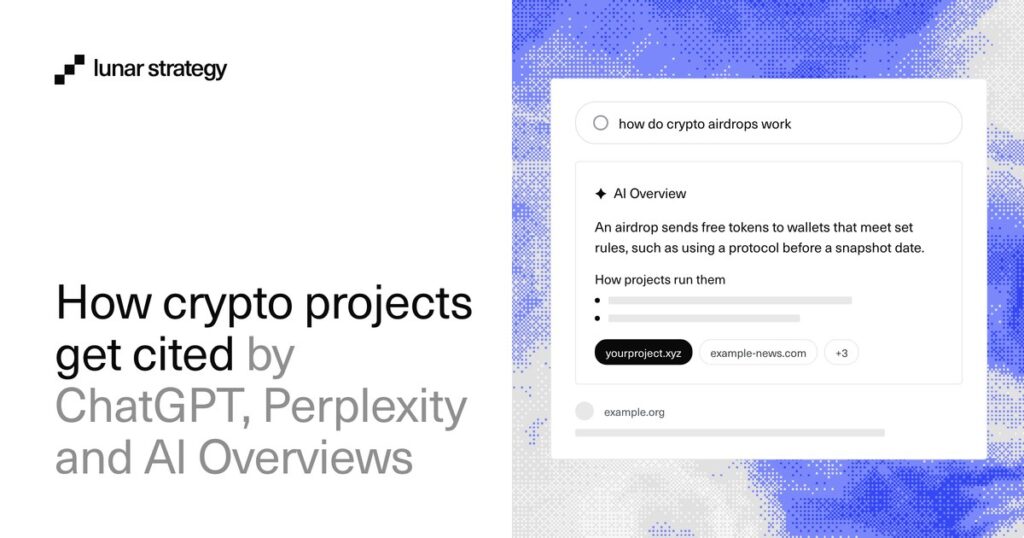
- When ChatGPT, Perplexity or Google’s AI Overviews answer a question with live web results, they show links to the pages they used. Each of those links is a citation.
- All three tools run web searches behind the scenes, read a few pages and pick the passages that answer best. Their own documentation explains how, and none of them sells or guarantees a place.
- Crypto sites are often skipped for technical reasons: firewalls that block AI crawlers, content that only loads with JavaScript, and key facts that live only in Discord or Telegram.
- The fixes are practical: open access to the right crawlers, publish pages that answer specific questions with data, earn coverage on independent sites, and track citations with free tools from Bing and Google.
AI assistants are now a normal first step in research. In September 2026, OpenAI described ChatGPT as a platform with 1.2 billion users. Many of them ask about tokens, wallets and protocols, and they read the answer before they visit any website. The sources linked under that answer get the click and shape what the reader believes.
For a crypto project, this raises a technical question with a business cost. Which pages do these tools pick, and why does a project’s own site so often go missing? This article walks through what the three main AI search tools say about how they choose sources, why crypto sites are often left out, and the changes that make a citation more likely.
What a citation is in an AI answer
A citation is a link that an AI tool places next to its answer to show where a piece of information came from. It is different from a mention, which is when the tool names a project in the text without linking to anything. Both help, but a citation sends traffic and tells the reader which source the tool relied on.
Citations come from live web search. An AI model also has knowledge from its training data, the large set of text it learned from before release, but that knowledge can be months old and usually has no links. When a question needs current information, the tool searches the web first, and that is the step a project can influence. OpenAI’s help center notes that search results and citations “can be incomplete, outdated, or incorrect”, which is one more reason for a project to make sure the correct version of its facts is easy to find.
How each AI tool chooses its sources
Each tool splits a question into smaller searches, reads the results and keeps the passages that fit best. The details differ, and each company documents them.
| Tool | How it finds pages | What the company says about selection
|
|---|---|---|
| ChatGPT | Its own crawler, OAI-SearchBot, plus partner search providers | ChatGPT rewrites a question into one or more targeted queries, ranks results “using multiple factors”, and “placement is not guaranteed” |
| Perplexity | Its own crawler, PerplexityBot | PerplexityBot exists to surface and link websites in Perplexity’s results and does not collect content for training AI models |
| Google AI Overviews and AI Mode | Google’s normal search index | Google may use “query fan-out”, issuing multiple related searches, and a page must be indexed and eligible to show with a snippet |
Crawlers are automated programs that fetch web pages so a search system can index what is on them. The table shows one shared pattern. A page can be cited only if the tool’s crawler can reach it, and it is chosen when one of its passages answers one of the smaller searches clearly. Google states that there are no extra technical requirements for AI Overviews and no special AI text files or schema needed.
Why crypto sites are often left out
The most common causes are technical, and a developer can check most of them in an afternoon.
- Firewalls block the crawlers. Many crypto sites use strict bot protection against attacks. Perplexity’s documentation explains how to allow its bots in firewalls such as Cloudflare and AWS WAF, and warns that Cloudflare’s Bot Fight Mode can still challenge them.
- Content needs JavaScript or a wallet. If the text appears only after scripts run, or only after a wallet connects, a crawler may see an almost empty page.
- Facts live in closed channels. Token updates posted only in Discord or Telegram cannot be read by search tools.
- Pages describe without explaining. A homepage that is mostly a tagline and an app button leaves an AI tool with no passage to use when someone asks how the protocol works.
Changes that make a citation more likely
Start with access. OpenAI separates its search crawler from its training crawler, and its documentation says a site can allow OAI-SearchBot for search while blocking GPTBot from training, and that robots.txt changes take about 24 hours to apply in search. Robots.txt is the public file that tells crawlers which pages they may visit. Allow OAI-SearchBot, PerplexityBot, Googlebot and Bingbot there, and in the firewall.
Next, publish pages built around the questions users ask: what the protocol does, how fees work, who audited the code, which chains it runs on, and how it compares with alternatives. Open each section with a direct answer of two or three sentences, then add detail. Bing’s webmaster team says that “examples, data, and cited sources help build trust” when content is reused in AI answers, so include real figures, dates and links to audits.
Then work on what others say about the project. In a study of 75,000 brands published in May 2025, Ahrefs found that brand mentions across the web had a 0.664 correlation with visibility in AI Overviews, compared with 0.218 for backlinks. Ahrefs itself notes that correlation does not prove cause. Coverage in crypto media, accurate listings on data sites such as CoinGecko and DefiLlama, and creator explainers all add to these mentions. Make sure every one of them shows the same token details, from ticker to contract address, so the AI tool does not have to pick between versions.
This work joins classic SEO and answer engine optimization (AEO, the practice of making content easy for AI tools to quote). For teams that want outside help, the service to look for covers crypto SEO and AI search together, since both depend on the same pages.
How to measure AI citations
Two free tools now report on AI visibility directly. Since February 2026, Bing Webmaster Tools includes an AI Performance dashboard with the number of times a site is cited in Microsoft Copilot and Bing’s AI summaries, and which URLs are cited most. Google Search Console counts appearances in AI Overviews and AI Mode inside its standard Performance report.
Add a manual check each month: a list of 20 to 30 questions about your category and your project, asked in each tool, with a note on whether you are named, linked and described correctly. Answers vary from day to day, so read the trend over several months.
What to expect
Crawler fixes can take effect in about a day, according to OpenAI. New answer pages take weeks to be found and read, and independent coverage takes longest because it depends on other people. No one outside OpenAI, Perplexity or Google controls which source wins a given answer, so judge progress by the trend across your full list of questions.
About Lunar Strategy
Lunar Strategy is a crypto and Web3 growth marketing agency based in Lisbon. Since 2019 it has worked with more than 400 crypto teams on go-to-market, token launches, creator and KOL campaigns, PR, X growth, and SEO and AI search. It is part of Turtle Group and runs Creator Wire, a platform with more than 5,000 crypto creators.