

Know Your Customer (KYC) is a process that businesses utilize for user identification and verification. While it aims to combat fraud and ensure regulatory compliance, traditional KYC systems come with a hefty price tag: user privacy concerns, centralized vulnerabilities, and slow, inefficient procedures. Decentralized KYC platform development comes as a solution to this problem. A blockchain development company can help you design and develop the blockchain infrastructure, smart contracts, and user interfaces for secure and efficient decentralized KYC platforms.
In this blog, we explore decentralized KYC solutions and how they can change the way businesses and institutions do user verification.
Understanding the Issues with Centralized KYC
In the current centralized system, individual financial service providers establish unique specifications for their KYC documents. Consequently, users find themselves obligated to adhere to the distinct KYC requirements set forth by each institution and service provider they engage with.
Additionally, financial institutions and service providers must provide separate notifications for any subsequent updates to user data, further complicating the user experience. The introduction of blockchain technology and the underlying principles behind its KYC implementation seek to address these challenges.
Across various industries, identity verification is paramount, particularly for financial institutions. The KYC protocol serves as a critical tool for companies seeking to ascertain the identities of their customers.
Traditionally, this process involves lengthy procedures wherein specific documents are scrutinized, and background checks or screenings are conducted. The advent of blockchain technology can bring a change to this system by offering a more cohesive and efficient approach to KYC. It promotes seamless interactions while maintaining the necessary rigor in identity verification.
What is a Decentralized KYC Platform
Here are some ways a decentralized KYC platform protects user privacy while streamlining the identity verification process:
- Decentralized Data Storage: User data is never stored on a single server or in a central Instead, it’s distributed across a network of nodes, making it significantly less vulnerable to cyberattacks and data breaches.
- Zero-Knowledge Proofs: This cryptographic technique allows users to prove their identity and eligibility for specific services without revealing sensitive personal A decentralized KYC platform leverages zero-knowledge proofs to verify user attributes like age and address without disclosing the actual values.
- Selective Disclosure: Users have complete control over what information they share with different entities. They can choose to reveal only the specific data required for a particular transaction or service, minimizing the overall exposure of their private
- Encryption: All user data, both at rest and in transit, is encrypted using strong cryptographic This ensures even if malicious actors were to access the data, they wouldn’t be able to decipher it.
- Open-Source Technology: A decentralized KYC platform’s core infrastructure is built on open-source It allows for transparent verification and community scrutiny of its security practices. This fosters trust and confidence in the platform’s commitment to user privacy.
Advantages of a Decentralized KYC Platform
Here are the advantages of a decentralized KYC platform:
Increased User Privacy
Decentralized KYC solutions empower users with greater control over their personal data. Users can selectively choose which information to share and with whom, safeguarding their privacy.
This stands in stark contrast to centralized solutions, where users frequently find themselves compelled to entrust third parties with their sensitive data. It leaves them with limited options for ensuring the confidentiality of their information. The shift to decentralized KYC reinforces the protection of personal privacy in an increasingly interconnected digital world.
Enhanced Data Security
Traditional KYC solutions are susceptible to data breaches due to their centralized nature, storing sensitive information in a single location. In contrast, decentralized KYC solutions adopt a distributed storage model, dispersing data across a network of nodes.
This innovative approach minimizes the risk associated with a singular point of failure and imposes tough challenges for malicious entities attempting to access or manipulate sensitive
information. Implementing a decentralized framework provides enhanced data security, fortifying the protection of confidential data against potential threats.
Cost-Effective and Time-Efficient
Apart from reducing security risks, decentralized KYC solutions quickly and cost-effectively optimize the entire KYC process. Traditional KYC procedures often involve labor-intensive and time-consuming tasks, such as extensive background checks and document verification.
In contrast, decentralized KYC solutions offer a streamlined approach that simplifies and accelerates these processes. This results in significant time and cost savings. The shift towards decentralized KYC fortifies security and introduces a more efficient and economically viable paradigm for identity verification.
Decentralized KYC Platform Integration
The integration of decentralized KYC platforms varies depending on the specific needs of each sector. Here are some common methods:
- API (Application Programming Interface) Integration: Developers can integrate decentralized KYC APIs into their applications for smooth user identity
- SDKs (Software Development Kits): Software development kits provide pre-built functionalities for integrating decentralized KYC features into various software
- Decentralized Identity Wallets: Users can store their verified credentials in
self-sovereign identity wallets and share them with service providers through verifiable credentials, putting them in control of their data.
Decentralized KYC Platforms across Various Industries
Decentralized KYC platforms are finding their way into a diverse range of sectors, offering significant advantages over traditional centralized methods. Here are some of their examples across different industries:
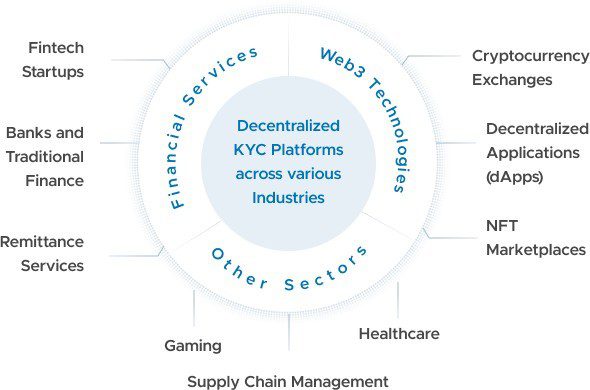
Financial Services
- Fintech Startups: Decentralized KYC platforms eliminate the need for startups to manage their own KYC infrastructure. They enable faster onboarding and lower compliance
- Banks and Traditional Finance: Decentralized KYC platforms can streamline customer onboarding for banks, reduce paperwork, and improve AML/CFT compliance. They also empower banks to collaborate with fintechs for innovative financial
- Remittance Services: Decentralized KYC platforms can address the challenges of verifying identities in underserved regions. They facilitate secure and affordable cross-border money
Web3 Technologies
- Cryptocurrency Exchanges: Decentralized KYC platforms enable exchanges to comply with KYC/AML regulations without holding user data directly, enhancing user privacy and
- Decentralized Applications (dApps): Decentralized KYC platform integration within dApps opens up access to financial services in DeFi and other Web3 applications while maintaining user control over their
- NFT Marketplaces: Decentralized KYC platforms can improve identity verification for NFT creators and They reduce fraud and promote a safer marketplace.
Other Sectors
- Gaming: Decentralized KYC platforms can verify players’ ages and locations to comply with regulations and prevent underage
- Healthcare: These platforms can facilitate secure patient data sharing and access to healthcare services while ensuring medical
- Supply Chain Management: Decentralized KYC platforms can verify the identity and reputation of participants in a supply chain, promoting transparency and ethical
Conclusion
KYC protocols necessitate a shift from traditional, centralized systems to decentralized KYC platforms. Decentralized KYC platforms offer enhanced user privacy, fortified data security, and cost-effective, time-efficient processes. The increasing adoption of decentralized KYC across various sectors signifies a transformative approach to identity verification. It promises a more secure, transparent, and user-centric future in the ever-evolving digital world.
If you are interested in developing a decentralized KYC platform, then connect with our blockchain developers to discuss your requirements.