
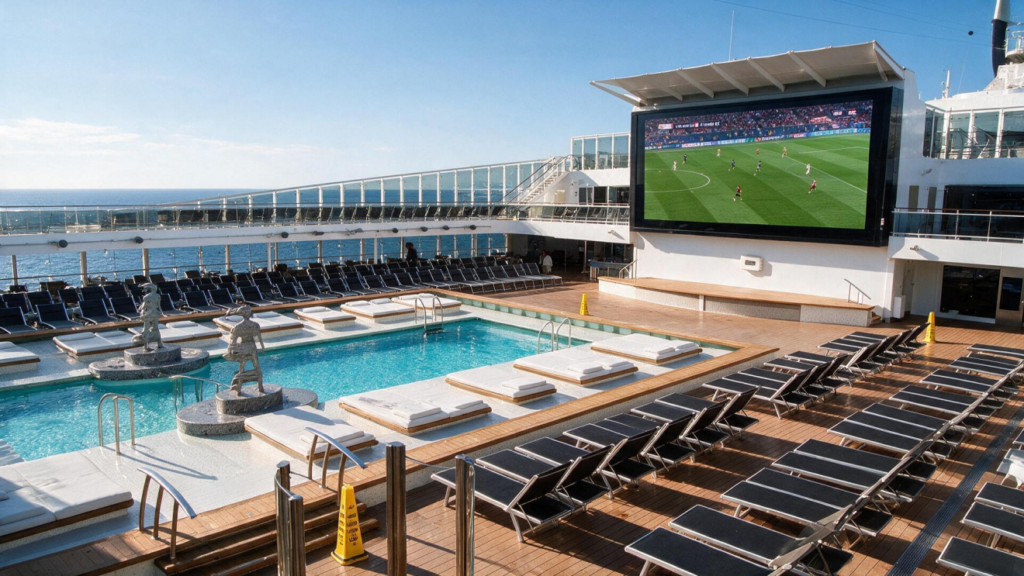
Cruise lines are rethinking what a pool deck can be. What once served as a simple spot to cool off has become a layered entertainment venue, complete with cinema-style screens, ambient lighting, and tiered social zones. This shift mirrors a broader boom in the cruise industry: 37.2 million passengers sailed in 2025, generating $198.8 billion in global economic impact, according to CLIA’s 2026 State of the Cruise Industry report. As more travelers choose cruising over land-based vacations, cruise lines are pouring money into outdoor spaces that feel less like ship amenities and more like destination resorts.
The Evolution of Cruise Ship Pool Decks
Pool decks used to serve one purpose: a place to swim. Early cruise ships offered a single pool, a few deck chairs, and little else. Today’s ships look completely different. Many now feature multiple pools, each designed around a distinct experience, from quiet adult-only retreats to high-energy family zones with waterslides and splash pads.
This transformation isn’t incidental. It reflects where the cruise industry is headed. The number of luxury cruise ships has tripled since 2010, growing from 28 ships to 97 in 2024, with 1.5 million travelers expected to choose luxury cruising by 2028. As the luxury segment expands, cruise lines are under pressure to justify premium pricing with equally premium outdoor spaces. A well-designed pool deck, complete with an outdoor TV setup for watching live events poolside, has become one of the clearest ways to signal that investment to guests.
Why Cruise Lines Are Investing in Premium Pool Deck Experiences
Competition among cruise lines has intensified as the industry has grown. With CLIA reporting that the member fleet surpassed 300 ocean-going vessels for the first time in 2024, standing out requires more than a new paint job or an extra dining venue. Pool decks have become a visible, photographable differentiator that passengers notice the moment they step aboard.
Passenger loyalty data suggests why this investment makes sense. Travel Market Report notes that 82% of people who have cruised before plan to cruise again, and satisfaction scores for ocean cruises averaged 4.2 out of 5, outperforming all-inclusive resorts (3.7) and resort or hotel packages (3.4) in CLIA’s North American Travel Agent Survey from February 2025. Families are also cruising together in greater numbers, with 28% of 2024 cruisers traveling across three to five generations. A pool deck built to entertain toddlers, teens, and grandparents at once has become less of a luxury and more of a baseline expectation.
Technology Integration in Outdoor Pool Spaces
Modern pool decks lean heavily on technology to create atmosphere and function in ways older designs never attempted. LED lighting systems now shift color and intensity throughout the day, turning a sun-soaked pool into a nightclub-like space after dark. Weatherproof display installations let cruise lines screen live sports, movies, and events in open-air settings, giving guests a reason to linger past sunset.
High-speed WiFi, once a weak point on cruise ships, has improved enough to support streaming and social sharing from the pool deck itself. Smart climate control and retractable shade systems round out the picture, letting cruise lines keep outdoor spaces comfortable regardless of weather, which matters when a ship might sail through tropical heat one day and cooler coastal air the next.
The Role of Outdoor Entertainment Technology
Bringing screens into marine environments presents unique challenges. Salt air, high humidity, direct sunlight, rain, and constant water exposure can all damage electronic equipment. This makes proper protection essential for outdoor televisions installed on cruise ships, yachts, and other marine vessels. Enclosure solutions such as the AcrtMatic Outdoor TV Enclosure demonstrate how features like IP65-rated housing, UV-resistant polycarbonate construction, and a 5 mm transparent front panel can help protect televisions from water, dust, and accidental impacts while allowing remote-control operation without opening the enclosure.
However, marine installations require additional considerations beyond standard weather protection. Any outdoor TV enclosure used in these environments should account for saltwater corrosion, vibration, humidity, and changing weather conditions. Effective drainage, secure sealing, cooling systems, and corrosion-resistant materials all contribute to protecting sensitive electronics. For cruise ship installations, verifying marine suitability and resistance to saltwater exposure is particularly important for long-term reliability.
Case Studies: Pool Deck Transformations in Practice
Royal Caribbean’s Icon of the Seas offers the clearest public example of how far pool deck design has come. According to Royal Caribbean Group’s press release, the ship’s Category 6 zone features the largest waterpark at sea, with six record-breaking slides, seven swimming pools including Royal Bay (the largest pool at sea), nine whirlpools, and a dedicated family neighborhood called Surfside. This single zone demonstrates how far cruise lines are willing to go to turn outdoor space into a multi-generational entertainment hub rather than a simple pool deck.
Other major cruise lines are following similar logic, expanding tiered pool areas and integrating entertainment technology into their newest ships, even if specific details vary by vessel and haven’t all been publicly documented. The broader pattern is consistent: cruise lines are treating outdoor space as prime real estate for differentiation, not an afterthought squeezed between dining venues.
The Guest Experience: What Luxury Travelers Expect
Luxury cruise passengers want outdoor spaces that handle two seemingly opposite jobs well: quiet relaxation and active entertainment. A pool deck needs to feel calm enough for an afternoon nap and lively enough for a sports broadcast later that evening. High-quality viewing experiences in open-air settings matter more as cruise lines compete for younger passengers, too. CLIA’s 2024 data shows that 36% of cruisers were under 40, with the average cruiser age at 46.5, a notable shift toward a demographic that expects both strong WiFi and shareable, photo-ready spaces.
First-time cruisers are also a growing share of the market. Travel Market Report notes that 31% of cruisers in the past two years were sailing for the first time, up from 27% in 2023 and 24% in 2019. For cruise lines, an impressive pool deck often serves as the first impression that convinces a newcomer to book again.
Future Trends in Cruise Ship Outdoor Entertainment
Sustainability is becoming a bigger factor in how cruise lines design outdoor amenities, with energy-efficient lighting and climate systems increasingly standard rather than optional. Some cruise lines are also exploring virtual reality and other immersive entertainment formats to extend what a pool deck can offer beyond swimming and sunbathing.
Personalization is likely to play a growing role as well, with mobile apps potentially allowing guests to reserve poolside cabanas, order food, or customize their entertainment options without leaving their lounge chair. As CLIA forecasts continued passenger growth, reaching 41.9 million by 2028, cruise lines have a clear incentive to keep investing in outdoor amenities that set them apart from both competitors and land-based resort alternatives.
Setting a New Standard for Life at Sea
Pool decks have moved from functional afterthought to central selling point in the span of a couple of decades. Cruise lines are blending design, technology, and data-driven passenger insights to create outdoor spaces that justify premium pricing and keep guests coming back. As the luxury cruise segment continues its rapid growth, expect pool decks to keep evolving, borrowing engineering lessons from weatherproofing solutions like outdoor TV enclosures that already solve similar problems in home and marine settings, and setting new benchmarks for what guests expect from a day at sea.