
The clearest change in Indian consumer behaviour over the last four years isn’t what people buy. It’s where they’re buying from.
A pharmacy student in Pune pays a UK tutor directly through UPI. A couple in Jaipur books a Prague Airbnb without ever touching a travel agent. An amateur chess player in Chennai subscribes to a Lithuanian training platform most Indians have never heard of. Ten years ago, none of this worked. The payment part broke, if the service itself hadn’t already blocked Indian cards at checkout.
Then two things happened at once. India built one of the world’s fastest real-time payment systems, and a quiet layer of fintech plumbing emerged to turn that domestic rail into a global one.
The problem that used to kill these transactions
Indian consumers trying to pay a foreign business historically ran into four walls. The merchant didn’t accept Indian cards. The card worked but got declined by the issuing bank on fraud rules. The transaction went through but the FX markup made it absurd, in some cases well above the interbank rate. Or the whole thing landed in RBI’s Liberalised Remittance Scheme paperwork, which is fine for buying property in Dubai but overkill for a small monthly subscription.
The result was predictable. Indian demand existed for thousands of foreign services, but the payment layer couldn’t carry it. Those markets stayed closed to Indian buyers, and Indian buyers stayed invisible to those markets.
What changed isn’t a single product. It’s the stack.
UPI going international, piece by piece
NPCI has been signing bilateral agreements for cross-border UPI acceptance since around 2023. UPI now works for merchant payments in several international markets, including the UAE, Singapore, Mauritius, Nepal, Bhutan, and France, with more countries reportedly in the pipeline. The exact current list is best checked on NPCI’s own site, as it has expanded over time. The direction of travel is unmistakable.
The more interesting development, though, isn’t official UPI expansion. It’s fintechs using UPI as a settlement layer under their own cross-border products. A platform collects INR via UPI from the consumer, converts at a competitive rate using treasury partners, and settles in USD, EUR, or GBP to the end merchant. The user sees a familiar UPI prompt. The merchant sees a foreign-currency wire. Everyone gets what they wanted.
Platforms like Vested (US stocks), Hubble (foreign currency savings), and Niyo (travel cards with low FX markup), along with dozens of smaller specialists, have been growing without ever asking users to understand foreign exchange.
The concierge model and why it’s grown
Alongside the direct-payment tools, a second category has quietly scaled: platforms that buy things on your behalf.
The classic example is foreign shopping, services that give you a US or UK address, receive your Amazon order, consolidate shipping, and send it to India. ShopUSA, PPOBox, and similar operators have been around for years, but the newer wave extends the model well beyond physical goods.
Education concierges handle applications and fee payments to foreign universities, including the SWIFT remittance under LRS. Investment platforms let Indians buy fractional US equities without needing a US brokerage account. Lottery messenger services such as WeLoveLotto give Indian users a route into foreign draws like US Powerball and EuroMillions, routing orders to local offices in the lottery’s home country where representatives purchase an official ticket on the user’s behalf. Niche subscription services that normally wouldn’t take Indian cards get routed through virtual-card providers that present as US-issued at checkout.
Each of these niches is small on its own. Together they represent a meaningful shift. Indian consumers no longer need to live near a foreign relative or hold a foreign bank account to participate in global markets. The intermediary absorbs the complexity.
What makes this work now, specifically
Three technical changes made the concierge and direct-payment models viable at scale.
The first is programmatic FX. APIs from Wise, Airwallex, Nium, and domestic players like Zolve let any fintech plug in near-interbank conversion rates. The large card markup that used to kill small foreign transactions can now be compressed substantially (the exact figures vary by provider and transaction type), which opens up low-ticket foreign purchases that were previously uneconomic.
The second is virtual card issuance. A fintech can issue a foreign-domiciled Visa or Mastercard on demand, use it for a single transaction, and close it. The foreign merchant sees a card from the issuing country and doesn’t necessarily know India was ever involved. This has solved the “we don’t accept Indian cards” problem in a way that regulators have been slower to catch up with.
The third is RBI’s clearer LRS framework. The outbound remittance limit under LRS (currently around $250,000 per individual per year, as per RBI guidelines) was always generous for individual consumers, but what was missing was the plumbing to use it efficiently. Platforms now handle Form A2 submissions, PAN mapping, and TCS calculations automatically. For users, foreign remittance has become something you tap through, not something you file.
The niches that have grown fastest
Based on what’s visible in app-store rankings and funding announcements over the last 18 months or so, four categories appear to have moved most. (Exact user counts and market shares for private platforms are hard to verify from outside, so these are directional observations.)
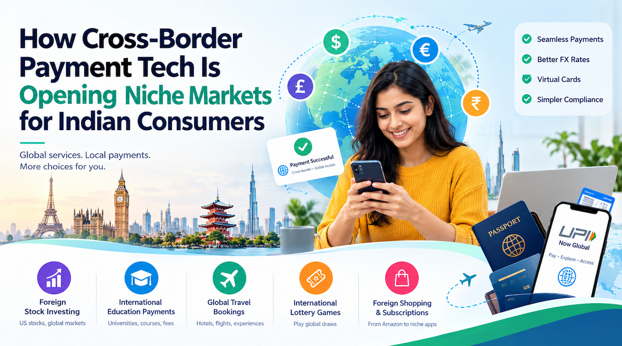
Foreign stock investing has gone from a specialist product to a near-mainstream one. Platforms like Vested, INDmoney, and Appreciate have collectively onboarded a very large number of Indian retail investors to US equities, with each company reporting user bases in the hundreds of thousands or more.
International education payments have shifted off bank branches almost entirely. Flywire and similar services now handle a significant share of tuition remittances for Indian students at US and UK universities. The branch visit, once a week-long ordeal, has become a two-day process on an app for many families.
International travel bookings have fragmented away from the OTAs. Direct bookings on Booking.com, Airbnb, and foreign airline sites, paid via international debit or UPI-linked FX cards, appear to take a larger share than they did pre-pandemic. The OTA markup finally has a real alternative.
International lottery games have emerged as a smaller but genuine niche, enabled by the same payment infrastructure that powers the rest. Indian users can now take part in US Powerball, EuroMillions, and other foreign draws through messenger platforms that handle ticket purchase, custody, and winnings transfer. The payment side, once the hard part, now works the same way a foreign SaaS subscription does.
Where this still breaks
For all the progress, three friction points remain.
Chargebacks and dispute resolution for foreign transactions are still slow and inconsistent. Indian banks don’t always treat a foreign-merchant dispute with the same urgency as a domestic one, and users often have to escalate through the fintech intermediary rather than the issuing bank.
The TCS regime for LRS transactions above certain thresholds (the current threshold is approximately ₹7 lakh, though this is worth checking against the latest Union Budget updates) continues to confuse users, even when platforms calculate it correctly. The deduction is refundable at tax filing but shows up as an immediate dent, which creates its own behavioural barrier.
Regulatory uncertainty hasn’t gone away. The Promotion and Regulation of Online Gaming Act, 2025 reshuffled what cross-border consumer services can and can’t do in gaming-adjacent categories. The pattern of a national framework arriving later than the market the private sector has already built out will likely keep repeating.
What this points to
The direction of travel is clear enough. Indian consumers, who were historically excluded from many global digital services, are becoming one of the better-served international consumer bases. Not because foreign businesses adapted to India, but because Indian fintechs built the layer that lets Indian consumers reach them.
The companies that’ll build enduring businesses in this space probably won’t be the ones chasing the big obvious markets. They’ll be the ones serving the niches that are small enough to be ignored by generalists but large enough to sustain a focused operator. International stocks worked that way. Foreign education payments worked that way. The next ones will too.
The payment tech is finally boring enough that the business questions get interesting again.
Previously in Technology: Top 10 Wireless and Portable Microphones for Speaking and Singing