
For years, agency owners filled their calendars the same way: cold email, LinkedIn connection requests and referrals. Those channels still work, but they are crowded. Inboxes are filtered harder than ever, and LinkedIn feeds are full of templated pitches that buyers have learned to scroll past.
A growing number of B2B agencies are quietly adding another channel to the mix: Instagram direct messages. It sounds unusual for B2B, but the logic is simple. Many founders, coaches, e-commerce owners and local business owners run their brand from Instagram. They check their DMs every day, often personally. A short, relevant message there can reach a decision-maker faster than an email that sits behind a gatekeeper or a spam filter.
Here is how agencies are turning Instagram DMs into booked sales calls in 2026, and what separates the ones that succeed from the ones that get ignored or restricted.
Why Instagram works for B2B outreach now
Three things have changed.
- Decision-makers live on the platform. Owners of small and mid-sized businesses often manage their own Instagram accounts. A DM lands with the person who signs the contract, not an assistant.
- Cold email got harder. Since 2024, Google and Yahoo have required bulk senders to authenticate their domains and keep spam complaints low. Email still works, but the technical bar and the deliverability risk are higher than they used to be.
- Context is built in. Before you write a single word, a prospect’s profile shows what they sell, how active they are, how they speak to customers and what they posted this week. That context makes real personalization possible.
The result is that a DM which references a prospect’s latest post or offer feels like a conversation, not a campaign.
The five-step workflow agencies use to book calls
1. Define a tight ideal customer profile. The agencies that win don’t message every business account they find. They pick a niche where they already have results, such as fitness coaches, Shopify brands, dental clinics or real estate agents. Then they filter by signals: how often the account posts, its follower range, whether it runs ads, and whether the link in bio points to a booking page or a store.
2. Research before writing. A good DM starts with 60 seconds on the profile. Look at the bio, the last few posts, the highlights and the offer. Find one specific thing your agency could improve.
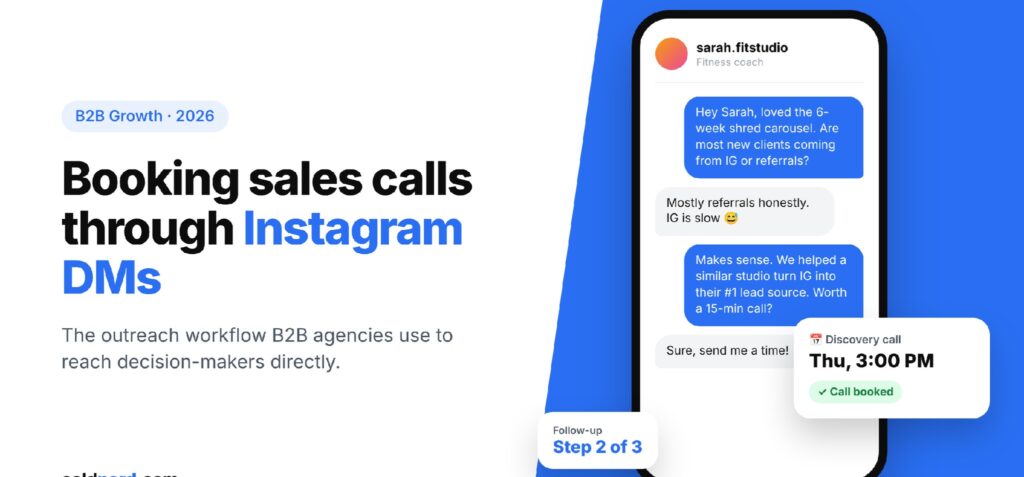
3. Open with relevance, not a pitch. The first message should be short, specific and end with an easy question. For example: "Hey Sarah, saw your reel on the 6-week shred program. The before-and-after carousel is strong. Quick question: are most of your new clients coming from Instagram or from referrals right now?" There is no link, no calendar and no wall of text.
4. Follow up like a human. Many replies come after the first message, not on it. A sequence of two or three touches over one to two weeks, each adding something new (a quick idea, a short client result, a useful resource), gets far more replies than a single message. Stop as soon as someone says no.
5. Move to a call only when there is interest. Once the prospect engages, ask permission: "Would a 15-minute call to walk through what we did for a similar studio be useful?" Only then send the booking link.
Where manual outreach breaks down
This process works well at 20 messages a day. It breaks at scale. Researching profiles, writing personal openers, tracking who replied and remembering follow-ups across several accounts quickly outgrows a spreadsheet. Follow-ups get missed, and warm leads go cold.
The bigger risk is account safety. Instagram watches for patterns that look automated: a sudden spike in messages from a new account, identical copy sent to hundreds of people, or perfectly regular timing. Agencies that blast copy-paste messages from a fresh account tend to get restricted fast, sometimes losing the account altogether.
How AI is changing Instagram outreach
A new generation of tools handles the repetitive work while keeping each message personal. Platforms such as ColdNerd find prospects that match a target profile, use AI to analyze each profile, and write an opener based on what the prospect actually posts. They then run the follow-ups automatically and track every reply in one dashboard.
The safety side matters as much as the writing. When comparing tools, look for:
- Gradual account warmup for new or quiet accounts
- Daily send limits and adaptive rate limiting
- Randomized delays between messages
- A secure OAuth connection, so you never hand over your password
These features keep an account’s activity closer to how a real person uses Instagram.
Agencies running outreach for several clients also need multi-account support and separate client workspaces, so each client’s campaigns and results stay apart. If you are evaluating options, choose software built specifically for Instagram cold outreach. General chatbots and comment auto-reply tools are designed for inbound conversations, not for prospecting.
Mistakes that kill reply rates
- Pitching in the first message. Lead with relevance and a question instead.
- Generic compliments. "Love your content!" signals a mass message.
- Links in the first DM. They look like spam and lower trust.
- Scaling too fast. A new account sending hundreds of DMs on day one is a red flag.
- No follow-up. A single message leaves most of the potential replies on the table.
- Counting sends instead of conversations. Volume means nothing if no one replies.
The metrics that matter
Track the numbers that lead to revenue: reply rate, positive reply rate, calls booked per 100 messages, call show rate and closed deals. Test one variable at a time, whether that is the opener, the niche or the offer, and keep what works.
Final thoughts
Instagram DMs won’t replace email or LinkedIn for every agency. But for agencies selling to owner-led businesses, they are one of the most direct routes to a decision-maker in 2026. Treat each message as the start of a conversation, follow up consistently, protect your account, and let AI handle the volume without losing the personal touch.