
With mainstream support for SAP ECC ending in 2027, enterprises across industries are accelerating their move to SAP S/4 HANA. For many organizations, this is the largest ERP transition in decades.
Migration programs are structured around timelines, infrastructure sizing, custom code remediation, and cutover planning. All is necessary. But a more fundamental risk often goes unaddressed: Regulatory continuity. That’s where Archon Data Store plays a critical role.
SAP ECC systems that went live in the mid-2000s now contain 15 to 20 years of financial postings, tax records, procurement activity, HR data, and custom objects. Much of this data is governed by statutory retention requirements that outlast the lifecycle of any single ERP system.
Board-Level Questions Before S/4 HANA Go-Live
Before approving final cutover, executive leadership should be clear on four strategic risks:
1) If regulators initiate an audit five years from now, can we demonstrate uninterrupted data retention integrity across the ECC-to-S/4 HANA transition?
2) What is the long-term financial impact of our data strategy; are we locking ourselves into higher HANA licensing and infrastructure costs by migrating data that does not need to be operational?
3) After ECC is decommissioned, does our compliance posture depend on continued SAP platform access, or is it architecturally independent?
4) If our ERP landscape changes again in 7–10 years, will our historical records remain defensible without another large-scale remediation effort?
If these questions do not have clear, documented answers, migration risk remains understated.
Choosing the Right Data Strategy for S/4 HANA
Migration programs are engineered for cutover success. They prioritize:
- Data conversion accuracy
- System performance
- Functional continuity
- Timeline adherence
SAP ECC ERP to S/4 HANA migration is not simply about moving data from one system to another. It is about deciding what remains operational, what becomes historical, and how regulatory evidence will be preserved once legacy systems are retired.
SAP S/4HANA programs typically follow one of three transformation paths:
- Brownfield conversion – technical system conversion of ECC into S/4 HANA
- Greenfield implementation – fresh S/4 HANA deployment with redesigned processes
- Selective or hybrid transition – combination of data transformation, consolidation, and redesign
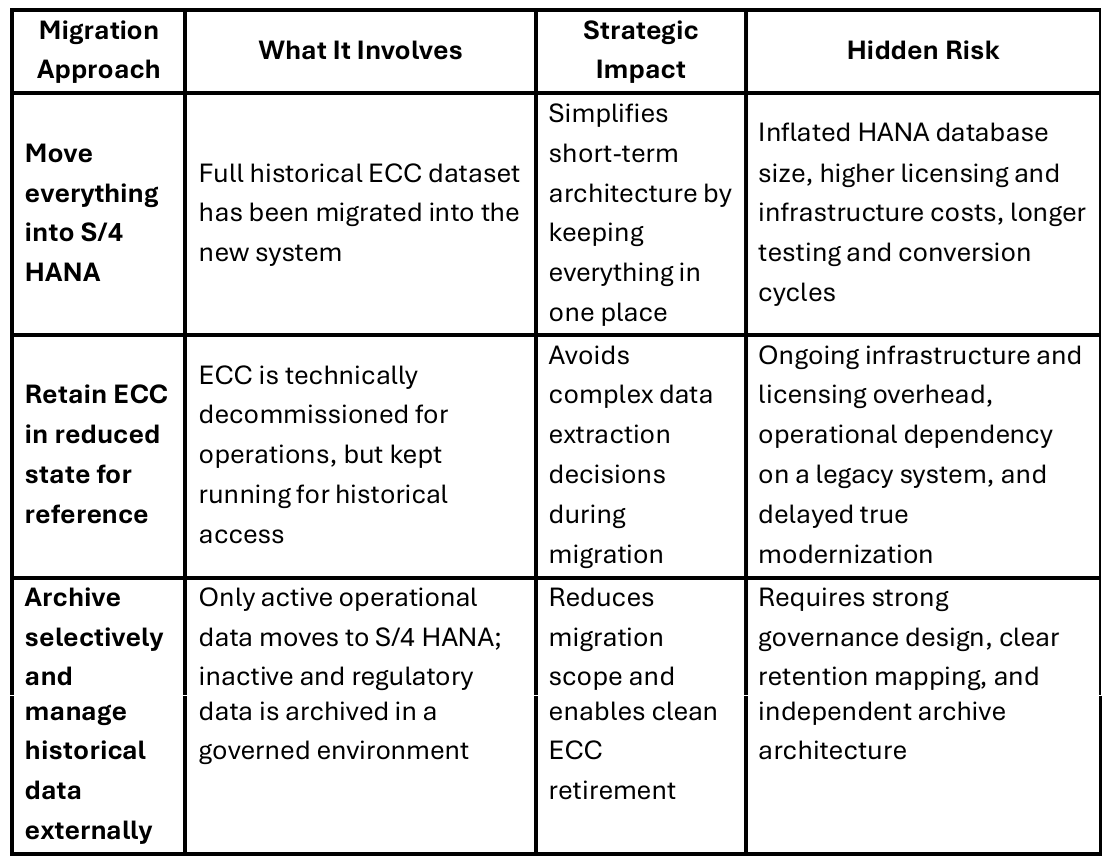
Regardless of the chosen path, one architectural decision remains constant: how historical ECC data will be handled.
Enterprises generally converge on three data strategies:
From Data Volume Management to Compliance Resilience
General-purpose archiving discussions often focus on performance and storage optimization. Those are valid concerns. But during an ECC to S/4HANA transition, compliance archiving plays a larger role.
Compliance archiving means:
- Historical SAP records remain accessible independent of the originating system • Retention rules continue to apply consistently after migration
- Legal holds remain enforceable
- Audit trails are preserved with business context intact
- Legacy systems can be retired without weakening regulatory posture
Without this layer, organizations risk replacing one ERP system while quietly fragmenting their compliance foundation.
Native SAP-bound Archive vs External Compliance Archive
SAP provides native archiving capabilities through the Archive Development Kit (ADK) and standard archiving objects, which are stable, well-integrated, and widely adopted across SAP landscapes. These components handle the technical process of moving inactive data out of the production database into archive files.
SAP Information Lifecycle Management (ILM) complements this foundation by introducing governance controls, including retention policies and legal hold management. Together, ADK and ILM enable structured data reduction within the SAP environment.
SAP native archiving is designed to manage data within the SAP application lifecycle. Archived data is organized according to SAP-defined archiving objects and is typically accessed through SAP-aware processes.
This approach works effectively when SAP remains the long-term system of record, and archived data continues to be accessed within the SAP landscape.
When SAP Native Archiving is typically sufficient:
- The organization plans to retain SAP as the long-term system of record
- Historical data will continue to be accessed through SAP transactions
- Retention governance is scoped primarily within SAP applications
- Infrastructure continuity for SAP environments is acceptable
When enterprises evaluate an extended archival architecture:
- ECC systems are being fully decommissioned
- Regulatory access must extend beyond the lifecycle of a specific SAP instance
- Historical records must be accessible alongside non-SAP systems
- Long-term cost control and platform independence are strategic considerations
- Future ERP transitions are anticipated
In such scenarios, organizations often introduce an additional archival layer designed to preserve historical records while allowing ERP systems to evolve.
In this model:
- Structured historical datasets are transitioned into a governed archival repository
- Relevant metadata and business context required for audit defensibility are retained
- Retention policies can be managed as part of an enterprise-wide governance strategy
- Historical records remain accessible even as legacy operational systems are retired
The distinction is architectural. Native archiving manages data within the SAP lifecycle. An extended compliance archive focuses on preserving regulatory continuity across application changes.
How Archon Data Store Enables Compliance Independence
Archon Data Store works alongside native SAP archiving practices to transition inactive ECC data into a governed archival environment aligned with defined retention policies.
Historical datasets can then be retained in a governed, searchable repository, enabling organizations to decommission legacy ECC environments without compromising regulatory access.
Before migration, Archon supports structured assessment of historical data volumes and retention obligations, identification of regulated datasets that do not require migration into S/4HANA, and policy-driven extraction planning aligned with governance requirements
Following extraction, datasets are retained within a governed archival framework designed for long-term preservation. Retention controls remain visible and enforceable within the archival environment, and historical records remain accessible for audit and regulatory review as legacy operational systems are decommissioned.
Beyond 2027
The ECC end-of-support milestone is a forcing function. But regulatory obligations extend beyond that date.
As enterprises transition to S/4HANA, the real differentiator will not be who migrates first, but who modernizes responsibly.
Organizations that align their archiving strategy with long-term governance goals will not only streamline migration. They will build an ERP landscape capable of withstanding future regulatory scrutiny and technological change.
To learn how Archon Data Store supports SAP transformation programs, visit: https://www.archondatastore.com/