
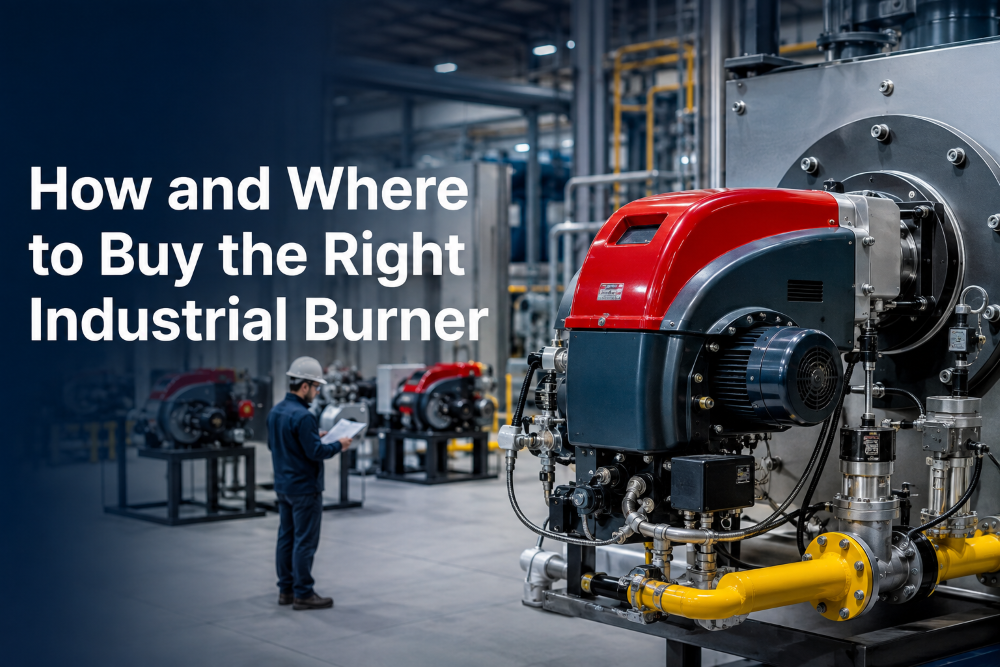
`Buying the right industrial burner is not simply a matter of finding a model with enough heating capacity. The burner must work with the fuel available at your facility, fit the heating equipment, respond to changing process loads, and provide stable combustion under actual operating conditions.
A poor match can result in unstable temperatures, frequent burner cycling, unnecessary fuel consumption, difficult maintenance, or problems meeting local safety and emission requirements.
A better purchasing approach focuses on two decisions: select the right burner for the process and choose the right burner manufacturer for long-term technical support.
Understand Your Application and Constraints
Unlike buying standard mechanical components, selecting an industrial burner involves multiple interdependent variables: fuel type, combustion chamber design, process load variation, emission compliance, and safety control logic. A mismatched burner affects not only efficiency—it can compromise product quality, increase fuel costs, and create regulatory risks.
Before comparing burner models, clearly define what the heating process requires. This gives the supplier enough information to recommend an appropriate burner rather than simply matching a model to a maximum kW rating.
1. Clarify Your Heating Process
Start by identifying what equipment the burner will serve and how heat is transferred to the process.
Industrial burners may be used with:
- Steam, hot-water, and thermal-oil boilers
- Industrial ovens and dryers
- Textile stenters and drying machines
- Food roasting, baking, and drying equipment
- Incinerators
- Metal melting and heat-treatment furnaces
- Coating and pretreatment lines
Consider whether the process is direct-fired or indirect-fired, the required operating temperature, the combustion chamber dimensions, and whether chamber pressure changes during operation.
Flame characteristics should also suit the heating equipment. A long flame may work well in one furnace but cause flame impingement or uneven heating in a compact chamber.
2. Quantify Heat and Process Requirements
The next step is to calculate or estimate the actual heat demand.
Provide the burner supplier with:
- Required heat input
- Normal operating load
- Maximum and minimum load
- Startup heating requirement
- Target temperature and temperature range
- Process throughput
- Expected daily operating hours
- Furnace or chamber pressure
Do not size a burner only around peak demand. Equipment often operates for long periods at partial load, so the minimum controllable output can be just as important as maximum capacity.
Oversized combustion equipment may cycle frequently when demand is low, while a properly selected modulating system can respond more smoothly to load changes. Frequent short cycling can also reduce operating efficiency in boiler applications.
3. Consider Operational and Business Constraints
The technically ideal burner still needs to make sense for the facility.
Check local fuel availability and cost first. Natural gas may be practical where pipeline infrastructure exists, while LPG or light oil may be more suitable for sites that require independent fuel storage.
Also evaluate electrical supply, available installation space, existing control systems, local emission requirements, maintenance capability, project budget, delivery time, and spare-parts availability.
These practical constraints can quickly narrow the list of suitable industrial burner systems.
Check Key Industrial Burner Specifications
Once the application requirements are clear, compare candidate burners using their technical specifications rather than price alone.
1. Burner Capacity, Rating, and Turndown
Confirm that the burner operating range covers both maximum demand and the lowest expected process load.
For variable-load applications, pay particular attention to the turndown ratio. A burner with a wider controllable range can reduce output without repeatedly shutting down and restarting.
Control type matters as well:
- Single-stage burners operate at one firing rate and suit relatively simple, stable loads.
- Two-stage burners switch between low and high firing rates.
- Modulating burners adjust output across a wider range and are useful where heat demand changes frequently.
The right option depends on how stable or variable the process is.
2. Fuel Type, Combustion Technology, and Flame Characteristics
Confirm exactly what fuel the burner can use. An industrial gas burner may be designed for natural gas, LPG, biogas, or multiple gaseous fuels, while a light oil burner may support diesel, kerosene, or specified biofuel blends.
Do not assume that burners described as “multi-fuel” can use every fuel without changing components or settings.
Also review:
- Required gas or oil pressure
- Fuel consumption range
- Premix or nozzle-mix combustion
- Oil atomization method
- Flame length and diameter
- Furnace pressure capability
- Ignition method
- Flame stability across the firing range
These characteristics should be evaluated together with the combustion chamber design.
3. Efficiency, Emissions, and Control System
Good burner performance depends on maintaining the correct relationship between fuel and combustion air. Excessive air carries additional heat into the exhaust, while insufficient combustion air can contribute to incomplete combustion.
For this reason, evaluate how the burner controls fuel and airflow across different loads. Combustion tuning and air-fuel ratio control can have a meaningful effect on boiler efficiency.
Where applicable, also compare NOx and CO performance and determine whether the burner configuration can meet local emission requirements.
Safety and automation features may include flame detection, ignition sequencing, gas or oil pressure monitoring, air-pressure switches, valve control, emergency shutdown, and communication with the main PLC or burner management system.
4. Installation, Integration, and Maintenance
A burner that looks suitable on paper still has to fit the actual equipment.
Before purchasing, check:
- Mounting flange dimensions
- Burner head length
- Overall burner dimensions
- Fuel connections
- Electrical requirements
- Blower arrangement
- Control interfaces
- Access for inspection and servicing
For retrofit projects, provide the manufacturer with drawings or dimensions of the existing furnace or boiler.
Maintenance should also influence the decision. Ask how easily technicians can access filters, nozzles, electrodes, ignition components, valves, motors, and flame sensors, and whether replacement parts are readily available.
Where to Find Industrial Burners
There are four main channels to source industrial burner systems. Each has its advantages depending on your project scale and requirements.
1. Buy Direct from Burner Manufacturers
Purchasing directly from an established manufacturer offers the best combination of customization, technical support, and factory-direct pricing. You work with the engineering team that designs and builds the equipment, ensuring precise specification matching.
Career Burner is one such manufacturer worth considering. Based in Foshan, China, and operating since 1994, Career Burner has over 30 years of experience in designing and producing oil and gas burners, backed by ISO 9001-certified quality management.
Career Burner’s product portfolio covers a wide power range (from 30 kW to 7000 kW) and includes several key series:
- GX Series Gas Burners: Industrial gas burners supporting natural gas and LPG, available with single-stage, two-stage, or modulating control. Models like the GX12A offer up to 120,000 kcal/h with single-stage control. Suitable for steam boilers, hot water boilers, and thermal oil heaters.
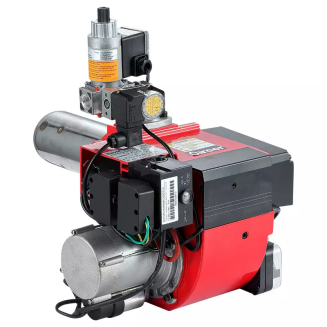
Career Burner GX12A industrial gas burner
- CX Series Oil Burners: Cost-effective light oil burners for diesel and bio-fuel applications. Models like the CX40-2 deliver up to 408,000 kcal/h. This series—alongside the GX Series—is a reliable choice for industrial boilers.
- BX Series Process Heating Burners: Featuring a 40:1 turndown ratio, these burners are ideal for textile drying, stenter frames, and applications requiring dynamic heat adjustment.
Career Burner serves a wide range of industries, with proven applications in industrial boilers, textile drying and finishing, waste incineration (animal carcass and medical waste), and food processing (nut roasting, coffee drying). Beyond standard models, the company offers OEM/ODM customization, full-process technical support, and factory-direct responsiveness, exporting to over 50 countries.
2. Local Distributors and Engineering Companies
Local burner distributors often stock popular models and can provide faster delivery for standard replacements. Engineering firms may offer value-added services like system integration and turnkey installation. However, they typically have limited customization options and may not offer the same depth of technical support as the original manufacturer.
3. Industrial B2B Platforms and Marketplaces
Platforms like Alibaba, Made-in-China, and industry-specific marketplaces list a wide range of burner manufacturers. These can be useful for initial research and comparing prices, but exercise due diligence on supplier credentials, certifications, and customer references.
4. OEMs and System Integrators
If you are building new equipment (e.g., a boiler, oven, or dryer), the original equipment manufacturer often supplies the burner as an integrated component. This simplifies procurement but ties you to the OEM’s chosen brand. Ensure you understand the burner specifications and support arrangements.
How to Vet the Burner Manufacturer
Choosing the burner is only half of the purchasing decision. The manufacturer must also be capable of supporting the equipment after delivery.
1. Reputation, Experience, and References
Look beyond the number of years the company has been operating.
Ask whether the manufacturer has experience with your actual application. A supplier experienced with industrial boilers may not automatically understand the combustion requirements of food dryers, textile stenters, incinerators, or metal furnaces.
Relevant case studies and project references are therefore more useful than general claims about experience.
2. Product Quality, Certification, and Standards
Ask how burners are manufactured, assembled, inspected, and tested before shipment.
Review the manufacturer’s quality-management certification and request any product-level certificates required in the destination country.
Remember that ISO 9001 relates to the manufacturer’s quality management system; it does not automatically demonstrate compliance with every local burner safety or emission regulation.
3. Technical Support and After-Sales Service
A capable burner supplier should do more than ship equipment.
Useful support can include application assessment, burner sizing, configuration recommendations, installation guidance, commissioning assistance, troubleshooting, maintenance advice, and spare-parts support.
For international purchases, determine how technical problems will be handled remotely and which critical spare parts should be stocked locally.
4. Costs, Contracts, and Long-Term Value
Compare the total cost of ownership rather than simply the purchase price.
Fuel consumption, maintenance frequency, spare-parts availability, downtime, technical support, and equipment life can have a greater long-term impact than a small difference in initial price.
Before ordering, confirm quotation scope, delivery terms, payment terms, warranty coverage, technical documentation, commissioning responsibilities, and spare-parts pricing.
Practical Burner Manufacturer Vetting Checklist
Before selecting a supplier, ask:
- Have you supplied burners for this application before?
- What information do you need to size the burner?
- What are the minimum and maximum firing rates?
- What turndown ratio is available?
- Which fuels and fuel pressures are supported?
- What are the flame dimensions?
- Can the burner operate under the required furnace pressure?
- Which combustion and safety controls are included?
- What NOx or CO data is available where required?
- Can the burner integrate with the existing control system?
- Can the burner be customized for the equipment?
- What commissioning support is available?
- Which spare parts should be kept on site?
- What does the warranty cover?
- How is after-sales technical support provided?
Conclusion
The best way to buy an industrial burner is to start with the process requirements and work backward to the burner specification.
Define the heat load, fuel, operating range, combustion chamber, flame requirements, controls, installation conditions, and applicable local requirements first. Then compare burner capacity, turndown, fuel compatibility, combustion technology, safety controls, maintainability, and lifecycle cost.
Finally, evaluate the manufacturer as carefully as the product. Whether the burner is purchased directly from a manufacturer such as Career Burner, through a local distributor, an industrial marketplace, or a system integrator, the goal is the same: select an industrial burner system that fits the real application and is supported by a supplier capable of keeping it operating reliably over the long term.