
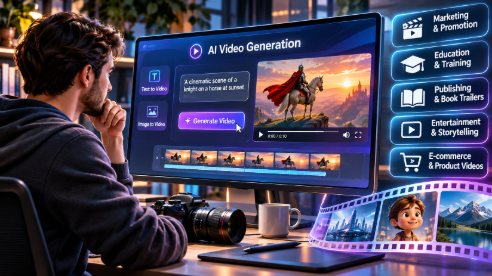
Artificial intelligence is changing how individuals, businesses, and creative professionals produce video content. Traditional video production often requires specialized equipment, technical expertise, extensive editing, and considerable financial resources. AI video generation offers an alternative approach by allowing users to transform written descriptions and static images into moving visuals.
From social media campaigns to educational materials and cinematic storytelling, these technologies are creating new opportunities for digital communication while making video production more accessible to a wider audience.
Understanding How AI Video Generation Works
AI video generators use machine learning models to interpret user instructions and produce sequences of visual frames. These systems learn patterns involving movement, lighting, composition, textures, and relationships between objects. By applying these patterns, they can generate video clips based on written prompts or visual references.
Two common approaches are text-to-video and image-to-video generation. Text-to-video technology converts written descriptions into animated scenes, while image-to-video generation introduces movement into existing photographs, illustrations, or digital artwork. Both approaches provide creative flexibility and can reduce the time required to develop initial visual concepts.
Exploring the Emerging AI Video Generation Landscape
As generative technology continues to develop, creators are exploring different tools and platforms to support their production workflows. Those interested in emerging AI video generation solutions can explore MAGI-2 alongside other available resources to better understand the evolving landscape of automated video creation.
When evaluating an AI video generator, users should consider output quality, motion consistency, rendering capabilities, customization options, and applicable licensing conditions. Selecting a suitable tool depends on individual project requirements rather than popularity alone. Testing short clips before committing to larger projects can help creators identify which solutions best complement their creative objectives.
The Importance of Effective Prompt Writing
The quality of AI-generated video often depends on how clearly users communicate their creative intentions. A well-structured prompt should describe the subject, environment, movement, lighting, camera perspective, and desired visual atmosphere.
For example, instead of requesting a video of a forest, a creator could describe a slow cinematic camera movement through a mist-covered woodland illuminated by soft morning sunlight. Providing relevant visual details helps establish a clearer creative direction.
Experimenting with different prompts and refining instructions based on generated results can improve visual consistency. This process is particularly valuable for projects involving recurring characters, connected scenes, or specific artistic styles.
Practical Applications Across Different Industries
AI video generation has practical applications across marketing, entertainment, education, publishing, and e-commerce. Businesses can develop product demonstrations, promotional campaigns, and social media content without organizing extensive physical production sessions.
Educators can transform complex concepts into engaging visual explanations, while independent filmmakers can experiment with storyboards and preliminary scene compositions. Authors and publishers can also use generated visuals to develop book trailers and introduce fictional worlds to potential readers.
These applications demonstrate how artificial intelligence can complement existing creative processes rather than completely replace conventional production methods.
Maintaining Quality and Visual Consistency
Despite its advantages, AI-generated video can present challenges involving character consistency, unrealistic movements, inaccurate details, and unexpected visual distortions. Human supervision remains essential for identifying and correcting these issues.
Using consistent reference images, maintaining detailed character descriptions, and generating individual scenes separately can help establish stronger visual continuity. Professional editing software can further improve generated footage through color correction, sound design, transitions, and carefully timed cuts.
Creators should also consider copyright, consent, commercial usage rights, and transparency when developing AI-generated materials, particularly when incorporating recognizable individuals or protected creative assets.
The Future of AI-Powered Video Production
As artificial intelligence continues to evolve, video generation technologies are likely to offer greater creative control, improved motion accuracy, and more sophisticated storytelling capabilities. Integration with traditional editing workflows could make production more efficient while expanding opportunities for independent creators and businesses.
However, compelling video content will continue to depend on human creativity, thoughtful storytelling, and effective artistic direction. AI video generation is most valuable when treated as a creative resource that supports original ideas, enhances productivity, and helps transform imaginative concepts into meaningful visual experiences.
Previously in Technology: AngelEye Camera: A Holiday Gift for Those Who Never Want to Miss a Moment