
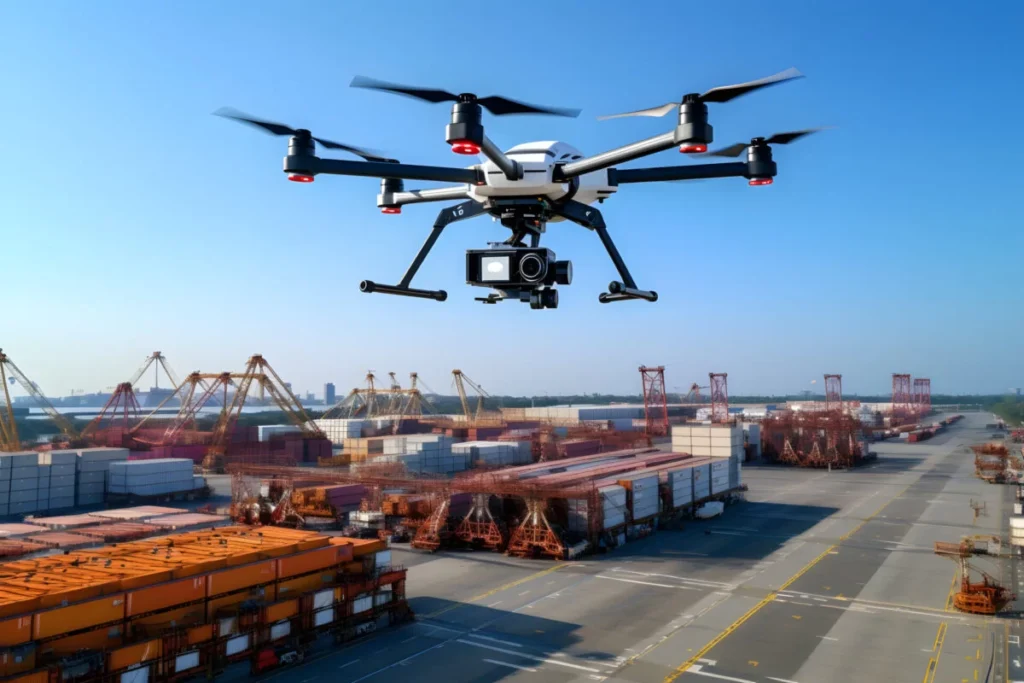
Manual drone inspections used to mean long hours, risky climbs, and a mountain of raw footage to sort through.
Not anymore.
With AI in the mix, inspections are becoming faster, sharper, and far less dependent on human guesswork. Drones can now spot micro-defects, build digital twins, and even generate reports – all on their own.
We’ll break down how AI is reshaping drone inspection across industrial sectors.
Key Notes
- AI transforms manual inspections into automated, real-time processes with 50% cost savings.
- Computer vision enables micro-defect detection and 3D digital twin creation.
- Predictive analytics shift maintenance from reactive to data-driven preventive approaches.
- Autonomous navigation eliminates human risk in hazardous industrial environments.
What Is Drone Inspection in Industrial Settings?
Drone inspection refers to the use of UAVs (unmanned aerial vehicles) equipped with imaging and sensing technologies to assess the condition of assets, infrastructure, and equipment.
In industrial settings, this includes structures like wind turbines, bridges, storage tanks, pipelines, and rooftops.
Key components of a drone inspection system:
- Drone hardware: Includes quadcopters or fixed-wing UAVs with GPS, obstacle avoidance, and automated navigation.
- Imaging tech: Cameras (visual, thermal, multispectral), LiDAR sensors, and 3D mapping systems.
- AI software: Computer vision, predictive analytics, and NLP reporting tools that automate detection and analysis.
Why AI Matters in Drone Inspection
Artificial intelligence has changed the equation.
Traditional inspections are time-intensive, labor-heavy, and inherently risky. AI enhances drone workflows by enabling automation, precision, and predictive power.
| Aspect | Traditional Inspection | AI-Driven Drone Inspection | Benefit |
| Safety | Humans enter hazardous zones | No human presence needed | Reduces risk |
| Speed | Manual, slow, scheduled | Automated, real-time | Inspections done in hours, not days |
| Accuracy | Subject to human error | Computer vision detects micro-defects | Consistent, high-fidelity data |
| Cost | High labor + equipment | Lower logistics + predictive ROI | Up to 50% savings |
| Maintenance | Reactive or scheduled | Predictive, data-driven | Extends asset life |
AI makes drone inspection repeatable, scalable, and smarter. Teams can act on issues before they escalate, rather than after the fact.
Core AI Capabilities Powering Drone Inspections
Here’s what AI brings to the table:
- Automated Navigation: Drones autonomously follow mapped flight paths, avoid obstacles, and revisit the exact same route for consistency.
- High-Resolution Visual & Thermal Imaging: Cameras and sensors capture crack-level detail and detect heat anomalies.
- Defect Recognition: Deep learning models classify defects like corrosion, cracks, leaks, or structural fatigue at scale.
- 3D Modeling & Digital Twins: Drones build accurate 3D replicas of bridges, turbines, or towers for long-term tracking.
- Real-Time Reporting: Dashboards process data on the fly, surfacing actionable insights without delay.
- Predictive Maintenance: AI identifies patterns across inspections to forecast when and where failures may occur.
- Natural Language Processing (NLP): Some platforms auto-generate inspection summaries and reports for stakeholders.
AI Enhances Defect Detection & Quality Control
Defect detection is where AI-powered drones shine. They’re not just capturing data but interpreting it.
- Accuracy: AI-driven inspections routinely hit 99% detection accuracy. High-res imaging and thermal analysis catch flaws the human eye might miss.
- Early Detection: Drones allow for more frequent, lower-cost inspections. This enables earlier identification of wear and degradation.
- Hazardous Access: Drones reach locations like wind turbine blades, offshore rigs, or storage tanks without putting human lives at risk.
- Richer Data Sets: Combine visual, thermal, and 3D data into centralized systems that support both current and future analysis.
- Maintenance Planning: AI trends defects over time, helping teams plan interventions before a small crack becomes a catastrophic failure.
Industry Applications: Where AI Drone Inspection Delivers
Energy & Utilities
- Monitor transmission lines, wind turbines, substations
- Identify overheating, vegetation encroachment, or component fatigue
Manufacturing & Industrial Plants
- Inspect rooftops, tanks, pipe racks
- Spot leaks, corrosion, and structural defects without halting operations
Infrastructure & Construction
- Bridge inspections, facade checks, project progress
- Create digital twins and flag misalignment or concrete cracks
Aviation & Transport
- Automate aircraft safety inspections pre/post flight
- Reduce downtime with real-time visual assessments
Agriculture & Mining
- Detect crop stress, monitor irrigation, inspect machinery
- Enhance yield while reducing input waste and operational cost
Public Safety & Emergency Response
- Rapid assessment after disasters, fire detection, search and rescue
Logistics & Defense
- Use drones for inventory tracking, site security, BVLOS operations
Inside the AI Stack: What’s Powering It All
AI models used in drone inspections include:
Computer Vision:
- Object detection: Cracks, corrosion, welds
- Semantic segmentation: Isolate and outline problem areas
- Thermal & multispectral imaging: Detect heat loss or insulation failure
Machine Learning & Anomaly Detection:
- Identify trends across datasets
- Spot anomalies that don’t conform to baseline behavior
Predictive Analytics:
- Forecast maintenance timelines
- Optimize inspection intervals
Autonomous Flight AI:
- Plan safe, efficient, repeatable flight routes
NLP for Reporting:
- Auto-generate reports with flagged defects, timestamps, and geo-coordinates
Data Security & Compliance in Regulated Industries
Compliance is non-negotiable. Companies deploying AI drones must:
- Follow Drone Laws (FAA, EASA, DGCA) including BVLOS permissions
- Comply with Data Protection Regulations (GDPR, CCPA)
- Secure Data End-to-End:
- AES encryption during storage and transmission
- Edge computing for on-device analysis
- Blockchain for immutable data logs
- Conduct DPIAs: Especially where personal data or sensitive infrastructure is involved
- Maintain audit trails and documentation for internal and regulatory review
Industries like oil & gas and utilities are leading the way in implementing multi-layered compliance strategies.
Frequently Asked Questions
How long does it take to train an AI model for drone inspection?
Training time depends on the complexity of defects being detected and the volume of quality-labeled data. For a focused application (e.g. corrosion on pipelines), models can be trained in weeks, but refining for scale and accuracy can take several months.
Can AI drones operate indoors or in GPS-denied environments?
Yes, with the right tech. Indoor inspections require drones equipped with LiDAR, SLAM (Simultaneous Localization and Mapping), or vision-based navigation systems instead of GPS.
How do you validate the accuracy of defect detection algorithms?
Most teams benchmark AI models against human-inspected datasets or use field-verified defect libraries. Validation includes precision-recall metrics and real-world pilots to ensure consistency before deployment.
What’s the battery life of drones used for industrial AI inspections?
Typical flight time ranges from 20 to 45 minutes depending on payload, weather, and flight conditions. For extended coverage, operators use swappable battery systems or schedule overlapping drone missions.
Conclusion
AI has pushed drone inspection far beyond basic aerial footage. We’re now looking at systems that can navigate complex sites on their own, detect cracks down to the millimeter, and flag problems before they cause downtime.
From energy grids to construction sites, AI-powered drones are making inspections faster, safer, and more precise. Teams don’t have to wait for scheduled checks or risk sending workers into dangerous environments.
Instead, they’re getting real-time data, predictive alerts, and better planning tools – all from a single flight.
Whether you’re managing turbines, tanks, or towers, one thing’s clear: AI is becoming the standard for smarter, more scalable inspections.