
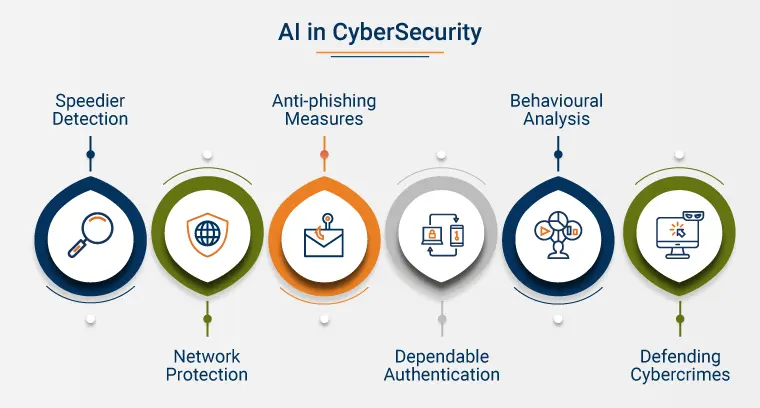
AI is reshaping cybersecurity from the ground up. It’s not a future trend. It’s happening now, across threat detection, incident response, phishing prevention, fraud detection, and vulnerability management. Here are the core ways AI is transforming cybersecurity, with real-world examples.
- Threat Detection and Anomaly Identification
AI helps security systems detect threats faster and with more accuracy by identifying unusual behavior in real time.
- Darktrace uses machine learning to analyze network traffic and flag abnormal patterns. For example, if an employee in finance suddenly begins transferring large amounts of data to an external server at midnight, Darktrace will raise an alert.
- Microsoft Defender for Endpoint uses AI to analyze trillions of signals every day. It identifies zero-day threats and advanced persistent threats (APTs) that evade traditional detection.
- IBM QRadar integrates AI to correlate log and network activity across hybrid environments. It prioritizes incidents automatically, reducing analyst fatigue.
- Automated Incident Response
AI accelerates response time by automating investigation and remediation steps.
- Cortex XSOAR (by Palo Alto Networks) uses AI-powered playbooks to handle repetitive tasks like isolating compromised devices, resetting credentials, or updating firewall rules.
- CrowdStrike Falcon Fusion lets teams define conditional logic to trigger responses without human intervention. For instance, if a process starts encrypting files rapidly, Falcon can automatically shut it down and block the user.
- Phishing Detection and Email Security
AI analyzes emails for subtle indicators of phishing that humans often miss.
- Google Workspace uses deep learning to block a significant number of phishing emails daily. It identifies indicators like mismatched domains, embedded malicious links, and writing tone anomalies.
- Abnormal Security builds behavioral baselines for each employee and flags deviations. If a finance executive receives a payment request from someone impersonating the CEO, it detects that as anomalous and quarantines it.
- Malware and Ransomware Prevention
Traditional signature-based antivirus software can’t keep up with polymorphic malware. AI looks at behavior, not signatures.
- SentinelOne uses AI to detect fileless malware and behavioral anomalies. It monitors runtime activity and halts attacks mid-execution.
- Sophos Intercept X leverages deep learning to identify malware based on characteristics rather than known patterns. It stops zero-day attacks before traditional engines even recognize them.
- Fraud Detection and Identity Protection
AI flags identity fraud in real time by detecting suspicious login or transaction behavior.
- BioCatch analyzes user behavior—such as typing speed, mouse movement, and swipe patterns—to detect account takeover attempts and synthetic identities in fintech and banking apps.
- Okta’s ThreatInsight uses machine learning to assess risk before authentication. If a login attempt originates from a TOR node and includes unusual device fingerprints, it will block or challenge the login.
- Vulnerability Management and Patch Prioritization
AI helps teams prioritize which vulnerabilities actually matter, based on exploitation likelihood and business context.
- Kenna Security uses predictive models to score vulnerabilities based on how likely they are to be exploited in the wild. It integrates threat intelligence, exploit databases, and asset value to produce actionable priority lists.
- Tenable’s Predictive Prioritization sorts through thousands of CVEs and tells you which 3% need action today.
- Supply Chain and Third-Party Risk Monitoring
AI continuously monitors the digital behavior of vendors and partners to detect supply chain risks.
- SecurityScorecard uses AI to monitor external digital assets and rate third-party security posture. It alerts companies when a vendor’s score drops, such as after a leaked credential or ransomware attack.
- RiskRecon evaluates the security health of suppliers based on open-source intelligence and alert signals without requiring intrusive scans.
- Insider Threat Detection
AI watches for subtle shifts in employee behavior that indicate malicious or negligent actions.
- ObserveIT (from Proofpoint) detects behavioral shifts like a user accessing files outside their role or using unauthorized USB drives.
- Forcepoint Insider Threat uses machine learning to flag abnormal actions based on context—such as an engineer downloading large volumes of proprietary code the day before resigning.
Conclusion
AI is not just an enhancement to cybersecurity. It is becoming foundational. The tools that lead the industry now all integrate AI to scale human expertise, reduce response times, and uncover threats that would otherwise go unnoticed. Organizations that fail to integrate AI-driven cybersecurity will be outpaced by both attackers and defenders.