

A family may begin by arranging help with meals or bathing, then face a need for nursing visits months later. An entrepreneur considering a local care business sees the same progression from another angle: each change in need requires the right people, services and oversight. In 2026, home-based care appeals to both groups because it can adapt around a person’s daily life rather than require every form of support to take place in an institution. Yet “care at home” covers several distinct services, and neither the family decision nor the business decision is simple. Understanding those distinctions is the starting point for better choices.
Why Aging in Place Appeals to Many Seniors, but Not to Everyone
For many older adults, remaining at home means keeping familiar routines, neighbors and a sense of control over the day. Support can be shaped around specific needs: a caregiver might help with dressing in the morning, while family members continue to share meals and visits. That flexibility can preserve independence without expecting someone to manage every task alone. It also matters emotionally. Accepting help in a familiar setting may feel different from making an immediate move to a residential facility, especially when the person receiving care can help decide when and how assistance is provided.
Still, home is not automatically the safest or preferred setting for everyone. A peer-reviewed analysis of older adults’ care preferences, published in 2018 using earlier survey responses, found substantial interest in both home-based arrangements and assisted living or continuing care communities. It illustrates an important point without serving as a measure of preferences in 2026: older adults do not all want the same thing. Mobility, the suitability of the home, medical needs and the availability of reliable help all affect what is practical. Families get further by asking what a particular person wants and needs than by assuming that aging in place is the only good outcome.
What Makes Healthcare Franchise Opportunities Worth Evaluating
The appeal of a home-care business is closely tied to that demand for individualized support. For prospective owners, healthcare franchise opportunities offer a way to enter a service sector where relationships with families and local care teams matter as much as a recognizable name. The Signal Health Group Franchise is one example connected to a provider whose services span personal care, home health, wellness and hospice. Its people-first emphasis points to an operating principle with consequences on both sides of the business: patients need respectful, dependable care, while owners need teams capable of delivering it consistently.
Demand, however, does not make a franchise recession-proof or guarantee a viable location. A prospective operator has to examine the local population’s needs, existing providers and whether qualified caregivers and clinicians can be recruited and retained. State licensing requirements, supervision, scheduling, quality controls and the costs of running a location deserve the same attention as the services it hopes to sell. Payment sources and the timing of payments can also differ across personal care, skilled services and hospice. The stronger business question is not whether people need care in general, but whether a particular team can meet specific needs responsibly and sustain that work over time.
The Care Continuum Runs from Daily Help to Hospice
Home health care services are often discussed as though they were interchangeable, but a family looking for companionship is making a different arrangement from one seeking skilled nursing. Companion or personal care can help with everyday activities, social connection and routines that have become difficult to manage. Skilled home health involves clinical services, such as intermittent nursing or therapy, under a care plan. When a person’s condition changes, coordination matters: relatives should know who is responsible for assessing new needs, which services must be ordered by a clinician and how information will pass between caregivers and medical professionals. A broad service range can make those conversations easier, but it does not remove the need for an individual assessment.
Coverage follows its own rules. Medicare home health services generally require a person to be homebound and to need part-time or intermittent skilled care ordered by a provider. Medicare does not cover round-the-clock care at home, and it does not pay for personal care when that is the only help needed. This distinction matters when a family plans a schedule: an approved nursing visit cannot be treated as a substitute for daily assistance with bathing, meals or supervision. Care plans work best when the household identifies both the clinical need and the hours of practical help required between visits.
Hospice care at home addresses a different stage of illness. Under the Medicare hospice benefit, a physician must certify a life expectancy of six months or less if the illness follows its usual course, and the patient elects comfort-focused care rather than treatment intended to cure the terminal illness. Hospice can include nursing, symptom-management medications, counseling and support for the family; palliative support more broadly does not always mean hospice. Signal Health Group brings personal care, home health, wellness and mental health, and hospice services under one brand. For families, the value of that range lies in being able to discuss changing needs clearly, while checking which services and teams are available locally.
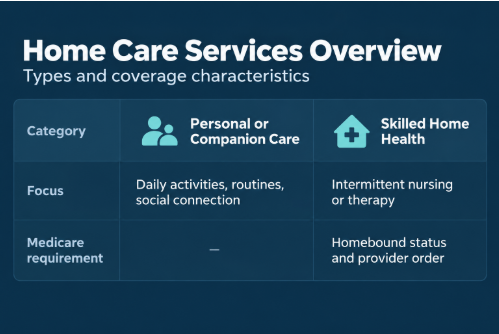
Infographic: Types of home-based care, from daily assistance to skilled services and hospice.
Veteran Home Care Depends on Need, Eligibility and Local Availability
Veterans may have care needs shaped by chronic illness, disability, isolation or the demands placed on a family caregiver. Veteran home care can involve everyday assistance, clinical treatment or both, so the first step is to distinguish a provider’s services from benefits administered by the Department of Veterans Affairs. VA Home-Based Primary Care brings a multidisciplinary medical team to eligible veterans whose health needs make clinic-based care difficult. The VA’s Homemaker and Home Health Aide program addresses help with daily activities. Clinical criteria, local availability and possible copayments affect access to VA services.
Signal Health Group offers veteran-focused home care for veterans and their families. A provider’s veteran-focused services and a VA-funded care arrangement are nevertheless separate matters. Families can make a clearer plan by identifying the assistance needed at home, reviewing applicable VA options and confirming who will coordinate care when medical and everyday needs overlap.
A Better Decision Starts with Clear Questions
Families can begin with a practical description of the day: which tasks are difficult, when help is needed and what might change if a condition progresses. From there, they can ask whether the proposed service is personal care, skilled home health or hospice, who supervises the team and how each part will be paid for. Prospective franchise owners face a parallel test of clarity. They need to understand which services a location can provide, the qualifications and oversight those services require, the available workforce and the support needed to run a dependable local operation. In both cases, the most useful promise is a care plan that matches real needs with real capacity.