
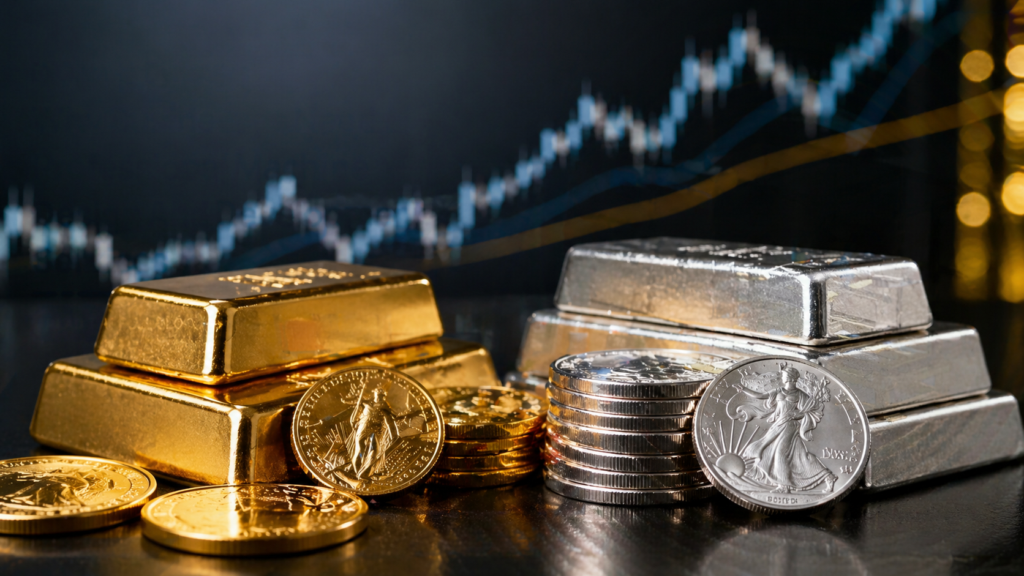
Gold and silver have always held a certain significance, both financially and psychologically. Long before modern financial markets existed, they were used as currency, stored as wealth and relied upon during uncertain times. That sense of trust has not disappeared, it has simply adapted to the way people invest today. Instead of dealing with physical coins or bars, many investors now choose Gold ETFs and Silver ETFs as a more practical way to gain exposure. There is no need to worry about storage, safety or authenticity. It is a simpler and more flexible approach, especially for those who prefer convenience.
Key Takeaways
- Gold and silver serve different roles in a portfolio.
- Gold is mainly for stability and risk reduction.
- Silver is more linked to growth and industrial demand.
- Gold ETFs are relatively stable and defensive.
- Silver ETFs are more volatile but offer higher upside potential.
- Both can be used together depending on risk preference and goals.
- Focus should be on how they fit into a portfolio, not on choosing one winner.
What Are Gold ETFs and Silver ETFs?
Gold ETFs and Silver ETFs are exchange traded funds listed on stock exchanges, designed to closely track the market prices of gold and silver, much like how individual stocks are traded. They are designed to follow the price of gold and silver in the market. Instead of buying physical gold or silver, you can invest in these ETFs. This means you don’t have to worry about storing the metal, keeping it safe or checking its purity. When you buy a Gold ETF, you are indirectly investing in real gold. These funds usually hold high-purity gold (at least 99.5%) that is safely stored with trusted custodians. Silver ETFs work in a similar way, but they invest in silver. You can buy and sell ETF units anytime during market hours, making them easy to access and fairly liquid
Why Precious Metals Still Matter in Modern Portfolios
With so many investment options available today such as stocks, mutual funds and even cryptocurrencies, it is natural to wonder whether gold and silver still have a place. They do and the reason is simple balance. Precious metals tend to behave differently from most financial assets. They do not always move in the same direction as equities and that difference can help smooth out the overall performance of a portfolio, especially during uncertain times.
1)A Buffer Against Inflation
As the cost of living rises, the value of money can decline. Over time, gold has shown an ability to hold its value better than cash in such environments. While it does not generate income, it can help protect purchasing power.
2)A Sense of Stability in Uncertain Times
During periods of economic stress, geopolitical tension or market volatility, investors often turn to gold. It has long been viewed as a relatively stable store of value when confidence in other assets weakens.
3)Stronger Diversification
No single asset performs well in every market condition. Gold and silver often move independently of stocks, which means they can help reduce overall portfolio risk when included alongside other investments.
That said, gold and silver are not identical. Each responds to different factors and plays a unique role within a portfolio. This becomes especially important when deciding how to allocate between them.
Gold ETF – The Steady Anchor
Gold ETF provide exposure to gold without the need for physical ownership. They are mainly used by investors who want stability, inflation protection and lower overall portfolio risk. Gold prices are driven by macroeconomic factors such as inflation, interest rates, central bank policies and global uncertainty. Demand for gold typically rises during periods of economic stress or financial instability. Unlike industrial commodities, gold is valued more for its role as a store of value than for consumption use.
- Gold ETF generally show lower volatility compared to equities.
- Price movements are usually gradual and reflect broader economic conditions rather than short term market fluctuations. Because of this, they are often used as a stabilising element in a portfolio.
- Gold ETF are most suitable for investors focused on capital preservation, long term wealth protection and reducing exposure to market volatility. In a portfolio context, gold primarily acts as a defensive asset rather than a growth driver.
Silver ETF – The Growth Driver
Silver ETF provide exposure to silver without requiring physical ownership. They are typically used by investors who are comfortable with higher volatility in exchange for greater growth potential. Silver plays a dual role in the economy. It is both a precious metal and an industrial material. This makes its price behavior different from gold. Along with investment demand, silver is strongly influenced by industrial usage.
- It is widely used in sectors such as electronics, solar energy, electric vehicles, and healthcare equipment. Because of this, silver prices respond not only to investor sentiment but also to real economic and industrial activity.
- Compared to gold, silver is more volatile. Prices can move sharply in both directions depending on demand conditions and broader economic trends. This higher fluctuation is why silver is often viewed as a higher risk but also higher reward asset.
- Silver ETF are generally suitable for investors who are comfortable with short term price swings, want exposure to growth driven sectors such as renewable energy, and are aiming for higher return potential over time.
In a portfolio context, silver acts more like a growth component, adding momentum alongside more stable assets like gold.
Gold vs Silver – Not a Competition
You do not really need to choose between gold and silver. They are not rivals and do different jobs in a portfolio.
Gold = Stability
- Tends to hold its value during uncertain or stressful market conditions
- Often used to protect wealth and reduce overall risk
Silver = Growth potential
- Moves more with economic activity and industrial demand
- Can perform better when the economy is expanding
Gold usually does better when markets feel uncertain.
Silver tends to do better when growth is picking up.
That is why many investors do not pick one over the other. They use both, since they behave differently and can balance each other out over time.
Conclusion
Gold and silver are not competing choices. They are different tools used for different purposes in a portfolio. Gold is mainly used for stability and protection during uncertain market conditions. Silver is more linked to economic activity and tends to move with industrial demand and growth cycles.
Gold ETFs help investors get exposure to gold in a simple way while focusing on preserving value and reducing volatility. Silver ETFs offer exposure to a more volatile asset that can benefit from periods of economic expansion and rising industrial demand.
The key idea is not to choose one over the other but to understand what each brings to a portfolio. Gold helps reduce risk. Silver adds growth potential. Together, they can create a more balanced approach to investing in precious metals.
Disclaimers
Investors may consult their Financial Advisors and/or Tax advisors before making any investment decision.
These materials are not intended for distribution to or use by any person in any jurisdiction where such distribution would be contrary to local law or regulation. The distribution of this document in certain jurisdictions may be restricted or totally prohibited and accordingly, persons who come into possession of this document are required to inform themselves about, and to observe, any such restrictions.
MUTUAL FUND INVESTMENTS ARE SUBJECT TO MARKET RISKS, READ ALL SCHEME RELATED DOCUMENTS CAREFULLY