
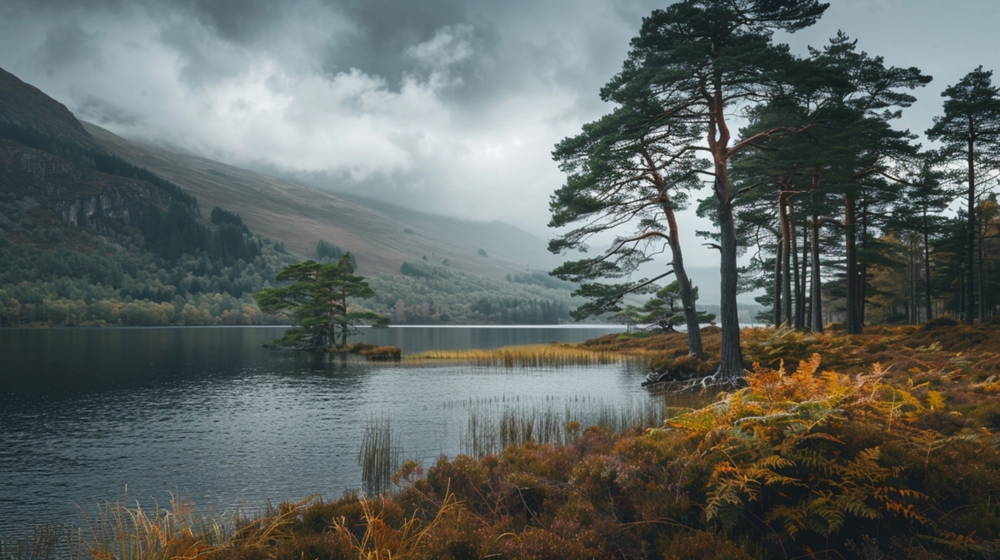
I am George Rist, a Monmouth-based Management Consultant with a particular focus on energy security, sustainable development, and operational excellence. What do we mean when we say “rewilding”. The British Isles have been continuously inhabited by humans long before the advent of written history. Unlike the wildernesses of other regions, no part of Britain today can truly be considered “wild” in the modern sense. When the term “wilderness” emerged in Middle English during the late 12th or early 13th century, it referred to land that was “wild or uncultivated.” Yet even what we perceive as ancient woodland today is relatively new, defined in Britain as dating back continuously to 1600 (1750 in Scotland).
Prehistoric Britain, much like Continental Europe, was largely forested and swampy. This began to change during the Neolithic period when forests were cleared for farming. By the Medieval era, this process had significantly accelerated, and the large-scale drainage of the Fens began in the 17th century, culminating in the 19th century.
But can we define these transformations—clearing primeval forests and draining wetlands—as “successful” by the standards of modern rewilding?
After all, such interventions led to the destruction and degradation of natural habitats to accommodate human needs, a notion that runs counter to the principles of ecological restoration. Had the Neolithic farmers adhered to these principles, the fields that eventually became Blake’s “green and pleasant land” might still be the “lost rainforests” Guy Shrubsole describes.
This highlights a tension between human needs and the environment’s continued viability. Some even label humanity as an invasive species whose activities drive catastrophic impacts on ecosystems. According to the World Wide Fund for Nature, human activity is behind the “sixth mass extinction,” with much of the blame falling on land conversion for food production.
So how do we reconcile rewilding efforts in Britain, particularly in southern England, with our agricultural demands?
Defining Rewilding: Key Questions
Rewilding Britain defines rewilding as “the large-scale restoration of nature until it can take care of itself—and us—again. It’s about restoring nature’s remarkable web of life, including habitats, natural processes, and, where appropriate, missing species.” This raises several important questions:
- What constitutes “large-scale” restoration?
- How do we determine when restoration allows nature to “take care of itself—and us”?
- Is it possible to restore ecosystems while continuing to use the land?
- How should rewilding be implemented in practice?
- How do we measure the success or failure of a rewilding project?
- Should the criteria for success evolve over time?
- Who decides what constitutes good practice?
- Finally, is rewilding even desirable?
The last question is particularly significant. As a project manager specialising in transformational programmes, I have often observed organisations (and, arguably, nations are organisations in their most advanced form) embark on ambitious initiatives—like rewilding—without fully understanding their requirements. These include scope (how much land, how long, how much effort, and how much funding) and success metrics. While it’s one thing to preserve Red Squirrel habitats in Cumbria and Northumberland, it’s another to propose widespread culling of Grey Squirrels across Britain to achieve this.
Rewilding in Action: Examples
Rewilding Britain provides illustrative examples of rewilding practices, such as:
- Protecting, expanding and connecting ancient woodlands to enable a diverse range of wildlife to establish and disperse, and increasing carbon storage
- Reducing high populations of grazing animals to help trees and other vegetation grow
- Removing fishing pressure and creating proper marine protection to stop dredging and bottom trawling so that sea life can recover and flourish
- Restoring wetlands and introducing beavers to boost biodiversity, store carbon and help flood prevention
- Bringing back missing species to plug crucial gaps in the ecosystem, and re-forge key relationships between species (for example, between predators and prey and scavengers)
- Restoring key marine ecosystems such as kelp forest, seagrass and oyster beds to boost biodiversity, suck in carbon and get natural processes working
- Removing dams so that fish can move freely and the forces of erosions and deposition are allowed to re-establish themselves
- Reconnecting rivers with floodplains, restoring their natural course to slow the flow, easing flooding and creating habitats for fish and other aquatic and wetland wildlife
- Connecting up habitats and providing wildlife bridges so wildlife can move and disperse naturally, helping them adapt to climate change and build resilience.
- Setting aside large areas for nature so that nature can truly evolve on its own terms, maximising biodiversity, carbon storage and essential eco benefits
- Creating a wildlife-friendly garden and helping wildlife move through it to help nature on a smaller scale
While these initiatives sound idealistic, land use is often a zero-sum game. If a field in East Anglia is developed for housing, it cannot also grow hops. Similarly, reforesting a hillside in Wales to expand woodlands precludes its use for grazing livestock, impacting food production. Reducing grazing animals affects yields of meat, dairy, and other agricultural products.
Reintroducing Missing Species
Reintroducing species is perhaps the most visible aspect of rewilding. While adding Wood Ants or European Sturgeon to ecosystems may be straightforward, bringing back apex predators like lynx, wolves, or bears raises public concerns. Wild Boar, for instance, are labelled “free-living,” though they’ve gained notoriety for their strength and destructive behaviour, often wreaking havoc on gardens and cars.
Balancing Ideals with Practicality
The list of rewilding initiatives often leans toward idealism, but the practicalities remain complex. Who determines the criteria for “setting aside large areas for nature”? In Britain, what’s considered large might correspond to an entire ranch in Montana. Finally, suggestions like creating wildlife-friendly gardens seem less contentious but represent only a fraction of what’s needed.
In the end, rewilding must balance ecological ideals with the realities of land use, human needs, and cultural landscapes—a delicate act requiring careful thought, planning, and collaboration.
About George Rist
I’m George Rist, a Monmouth-based Management Consultant, dedicated to helping organisations achieve transformative change through strategic, sustainable, and measurable solutions. With expertise in digital transformation, project management, and operational excellence, I’m passionate about making a positive impact across industries.