
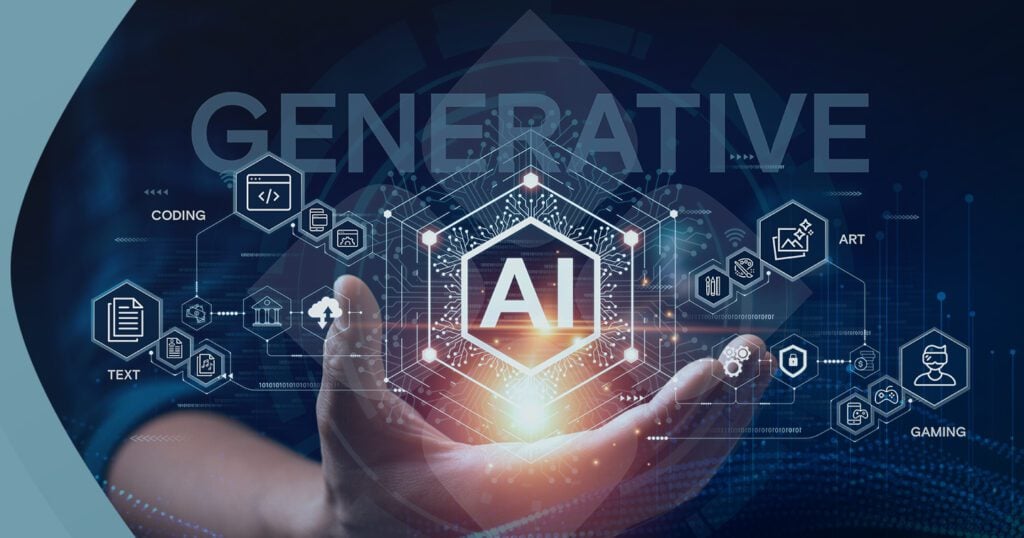
Generative AI has become widely popular with the use of various tools such as ChatGPT, DALL-E 2, and Synthesia. Businesses are embracing generative AI to create autonomous digital-only businesses that can interact with people without human intervention. Several prominent generative AI platforms, including DeepMind’s Alpha Code, OpenAI’s ChatGPT, DALL-E, WebMidJourney, Jasper, and Stable Diffusion, are widely used.
A brief on generative AI
Generative AI is an artificial intelligence technology that can generate images, text, or music that are similar to the dataset on which it was trained. Unlike traditional AI models that focus on recognizing patterns and making predictions based on existing data, generative AI employs algorithms and models specifically created to generate new content.
GAN – General Adversarial Network
Generative Adversarial Networks (GANs) belong to the category of deep learning models utilized for generative purposes, like creating new images, music, or other forms of content. GANs are composed of a generator and a discriminator. The generative neural network produces outputs by learning patterns from available data, with the discriminative neural network helping it improve. During training, the generator takes random noise as input and tries to generate data similar to the training set. The discriminator assesses both real and generated samples and distinguishes between them. The generator uses the discriminator’s feedback to enhance its samples, while the discriminator adjusts its weights to better differentiate real and generated data. This iterative procedure continues until the generator is able to generate samples that cannot be distinguished from real data.
Transformers
Transformers are generative AI models that can create impressive results. It processes data sequences instead of single data points, which is more efficient when context is important. Transformers use an encoder/decoder architecture. The encoder extracts features from an input sentence, and the decoder uses them to create an output sentence. The encoder component of the transformer is composed of several encoder blocks that process the input sentence, and the output of the last block is then used as the input feature for the decoder. Meanwhile, the decoder comprises multiple decoder blocks, each receiving features from the encoder.
Components of a comprehensive tech stack in building effective generative AI systems
A comprehensive tech stack is essential in building effective generative AI systems. It includes various components, which are mentioned below:
- Machine learning frameworks: Machine learning frameworks like TensorFlow, PyTorch, and Keras are crucial for generative AI, offering tools, APIs, and pre-built models for image, text, and music generation. They also provide flexibility to customize models for accuracy and quality.
- Programming languages: Programming languages like Python is widely used because of its simplicity, readability, and library support. R and Julia are also used in some cases.
- Cloud infrastructure: Generative AI requires significant computing power and storage to train models. Cloud infrastructures like AWS, GCP, and Azure allow for scalability and flexibility in deploying these systems.
- Data processing tools: Data processing tools like Apache Spark and Apache Hadoop are necessary to efficiently preprocess, clean, and transform large datasets. These tools offer data visualization and exploration capabilities to identify patterns.
An overview of the generative AI tech stack
A generative AI tech stack comprises these three fundamental layers:
- Applications layer: This layer consists of end-to-end apps or third-party APIs integrating generative AI models into user-facing products.
- Model layer: It consists of proprietary APIs or open-source checkpoints that power AI products and need hosting solutions for deployment.
- Infrastructure layer: This layer involves cloud providers and hardware makers who handle the training and inference workloads for generative AI models.
Things to consider while choosing a generative AI tech stack
The points listed below must be considered as part of project specifications and features while creating a generative AI tech stack:
- The type of data you intend to generate, such as images, text, or music, will influence your choice of generative AI models/algorithms/techniques (e.g., GANs for images and RNNs for text/music).
- Project complexity may impact the choice of generative AI model; complex projects may require advanced frameworks and powerful hardware.
- Choose a scalable generative AI tech stack such as cloud-based solutions like AWS, Google Cloud Platform, or Azure for large projects.
- Accuracy is crucial in generative AI models for some applications. Choose high-accuracy techniques like VAEs or RNNs.
- Choose a generative AI tech stack that prioritizes speed, such as using lightweight models or optimizing the code for performance.
Conclusion
Integrating a comprehensive generative AI tech stack is vital for organizations incorporating AI into their operations. It enables unlocking the full potential of generative AI models, automating tasks, and delivering customized outputs tailored to specific business needs. Leveraging specialized processors, storage systems, and cloud computing services at scale becomes feasible. Open-source frameworks like TensorFlow, PyTorch, or Keras empower developers to create customized generative AI models for unique use cases, driving industry-specific solutions and achieving targeted goals. Businesses nowadays embrace generative AI’s potential to stay competitive, fostering growth, innovation, and profitability with a robust tech stack.
Previously in Artificial intelligence: MyShell, a Multi-Modal Chatbot Platform, Revolutionizes the Interactive Frontier for Multimedia Experiences