
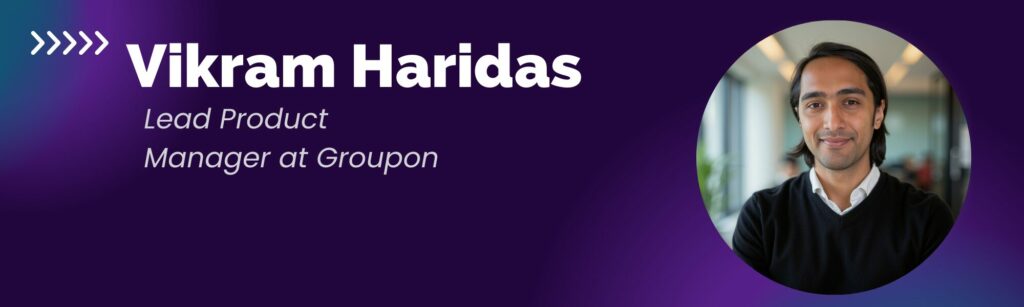

We are delighted to welcome Vikram Haridas, a product manager with extensive experience in AI, FinTech, and scaling companies. Vikram’s journey, from founding a product consultancy in India to leading product teams at Groupon, showcases his diverse expertise and innovative approach. Let’s dive into our interview with this accomplished professional.
How has your experience as an entrepreneur in India’s startup ecosystem influenced your approach to product management at larger companies like Groupon?
Working in the fast-paced, high-energy environment of startups really taught me how to cut through the noise. In startups, you’re forced to focus on what truly matters—what will move the needle—and that’s something I’ve carried with me into larger companies like Groupon. One thing I’ve noticed is that big organizations often get bogged down in long processes and release cycles that can stretch into months. By the time a feature is ready to launch, the market may have already shifted. My background in Agile and Lean methodologies has helped me respect necessary processes but also find ways to streamline things and push for faster releases when needed. It’s about finding that balance.
Can you elaborate on your role in championing AI utilization in large companies? What challenges and opportunities have you encountered?
I’ve been working with large companies that are often weighed down by repetitive, manual tasks. Over the last few years, we’ve been exploring how AI can step in and handle some of that grunt work, especially the daily, mundane tasks that don’t require much human intervention. We always start with a hypothesis, build a quick MVP, and test it in the wild. These MVPs help us validate our ideas and, at the same time, manage expectations with stakeholders and business partners.
One of the big challenges, though, is this belief that you can just “drop in AI” and it will magically solve everything. In reality, it takes a lot of work to build the right support architecture around AI and account for edge cases. Even if 95% of your cases are covered, 5% of 25 million users is still a huge number. I talk about this in my presentation—Cautious Optimism in the Age of AI. It’s about recognizing the power of AI, but also being mindful of its limitations.
You’ve managed a line of business worth $200M. What key strategies did you employ to achieve and maintain this level of revenue?
The key lesson I’ve learned is that the small wins add up. When you’re managing a large, mature business, you’re not always going to find opportunities for massive innovations or game-changing breakthroughs. What you can do is focus on those 1% improvements. It might seem small, but over time, they accumulate. By continuously identifying and acting on those small opportunities, you can create meaningful, sustainable growth.
How do you approach the integration of AI and machine learning into financial technology solutions, particularly in terms of balancing innovation with user needs?
I always refer back to the Gartner Hype Cycle for AI innovations. A lot of AI developments are still at the “peak of inflated expectations,” which means they’re exciting, but not fully mature yet. In FinTech, especially, users tend to be cautious. They want to feel like they or another human is in control of their finances, not a machine. So, the trick is to make AI a subtle player—working in the background to enhance user experience without taking the spotlight. The intelligence should be there, but it should feel almost invisible to the end user.
In your experience scaling companies from 0 to profitability, what do you consider the most critical factors in building scalable product teams and roadmaps?
There are a few key principles I always stick to:
- Measure twice, cut once. Spend time really understanding what your users need and where their pain points are. Build your roadmap around that.
- Avoid feature creep. It’s easy to get excited about adding features, but if they’re not moving the needle in a meaningful way, they can become a distraction. Don’t be afraid to kill features that aren’t performing.
- Avoid top-down roadmapping. C-suite input is valuable, but you have to make sure your roadmap isn’t just reflecting the opinions of the leadership team. It should be based on data and user feedback.
- Set meaningful OKRs. Financial metrics alone don’t tell you if you’re building the right product. You need to set objectives that measure impact and progress towards your bigger goals.
Could you share an example of how you’ve used data-driven decision-making to significantly improve a product’s functionality or user experience?
At Groupon, we noticed that the Merchant onboarding process was being slowed down by two key areas: Images and Pricing.
- Images: Merchants were struggling to find the right images for their deals, which was leading to drop-offs. After looking into it, we realized they were having to jump between different browser tabs and apps to find suitable images. So, we built a feature that automatically pulled relevant images from their online properties, like their website or social media profiles. This simple fix drastically reduced the time spent on that page.
- Pricing: Many merchants were getting stuck on the pricing page, trying to figure out whether the discount structures and margins made sense for their bottom line. We introduced a feature where merchants could enter the minimum amount they needed to make on a deal, and the system would automatically calculate the final payout after all discounts and margins. It helped them make faster, more confident decisions.
At IvyCamp, you created a platform matching investors with startups using algorithms. How do you see this type of technology evolving in the startup-investor landscape?
The startup-investor landscape is getting crowded, and AI can help cut through the noise. Early-stage investors, who often have small teams, are going to need screening technologies to handle the sheer volume of startups entering the market. Matching algorithms are a good start, but I think we’re going to see even more AI-powered features that can assess a startup’s financial health, conduct due diligence, draft paperwork, and more. Smaller investors are likely to adopt these tools first, but eventually, even institutional investors will follow suit.
As a product manager working on educational games at PlayShifu, how did you balance the educational aspect with maintaining high user retention and engagement?
This was one of the most challenging yet rewarding projects I’ve worked on. Building products for young, impressionable minds comes with a lot of responsibility. On top of that, trying to gather meaningful feedback from 6-year-olds during user interviews isn’t exactly easy!
What we found was that kids really connected with strong character design and voice acting. If they liked the character, they’d spend hours just listening to voice lines. So, we built a dedicated team focused solely on character design. On the educational side, we worked closely with experts to break down key learning objectives for each age group and then wrapped those lessons in engaging, immersive stories. It was never just, “What’s 2+2?”—it was more like, “Detective Hoot found one apple, and then another. How many apples does he have now?”
In your current role at Groupon, how are you approaching the company’s transformation? What key changes are you implementing in the Integrations and Supply Acquisition verticals?
Groupon is becoming a more lean and agile organization. We’re focused on quick product turnarounds and measuring the impact of features so we can iterate rapidly. I’ve also been using no-code/low-code tools like n8n or Make to build quick prototypes. This allows us to test and validate ideas faster, without getting bogged down in development.
On the Integrations side, we’re working with some of the largest booking providers in the world to ingest their inventory, which will bring thousands of new deals and millions of eyeballs to Groupon.
For Supply Acquisition, AI is playing a huge role. We’re using it to reduce the friction for merchants coming onto the platform, but more importantly, we’re leveraging demand data to help merchants understand why certain supplies are needed. For example, we can show them that 500 people searched for their service in their area in the past day, giving them a clear sense of the demand.
Looking ahead, what emerging technologies or trends do you believe will have the most significant impact on product management in the FinTech and e-commerce sectors?
It’s no surprise that AI is the big one. While most people are familiar with large language models like ChatGPT, there are so many other AI technologies that are transforming the landscape. As more users get comfortable with AI, we’ll see even bolder innovations. I believe we’re on the cusp of seeing some really groundbreaking products in e-commerce, and FinTech will follow closely behind, though they tend to be a bit more cautious.