
A vulnerability scan gives security teams a picture of their environment at a particular moment, identifying weaknesses and helping teams decide what to fix. That snapshot goes stale fast, vulnerability exploitation was the initial access vector in 20% of breaches in 2025, a 34% jump from the year before, according to Verizon’s Data Breach Investigations Report. The environment rarely stays still that long.
New applications go live, cloud configurations change, and employees get extra permissions as part of their daily work. Each change could introduce an exposure that security teams won’t discover until the next scheduled scan.
Vulnerability management teams already spend hours reviewing findings and following up on remediation. When the environment keeps changing between assessments, that workload only grows.
Continuous threat exposure management (CTEM) offers a way to get ahead of these changes. Security teams continually examine how attackers might reach critical systems and use what they find to decide which weaknesses deserve attention.
Running scans more frequently won’t solve the problem if teams still struggle to decide what needs fixing first or who should do the work.
Why does reactive security struggle to keep up?
Reactive security relies heavily on finding problems and responding after they appear. Scheduled vulnerability scans, penetration tests, and periodic security assessments all play an important role, but each has limitations.
A scan might identify a critical vulnerability on an internal server. Meanwhile, an internet-facing application with a lower-severity weakness could give attackers access to sensitive information.
If the team prioritizes findings by severity alone, it might fix the internal server first, despite the greater exposure elsewhere.
Cloud environments add to the problem. New workloads come online regularly, and changes to access permissions or configurations can give attackers a way into systems they couldn’t previously reach.
Traditional vulnerability management identifies known weaknesses and helps teams fix them. But security teams also need to know whether an attacker could reach an affected system, what permissions they might exploit, and how far they could move through the environment.
What changes when security teams adopt CTEM?
CTEM helps security teams focus on the weaknesses attackers have a realistic chance of exploiting.
It follows five stages: scoping, discovery, prioritization, validation, and mobilization. Security teams use these stages to identify exposures, assess the risks they pose, and coordinate remediation.
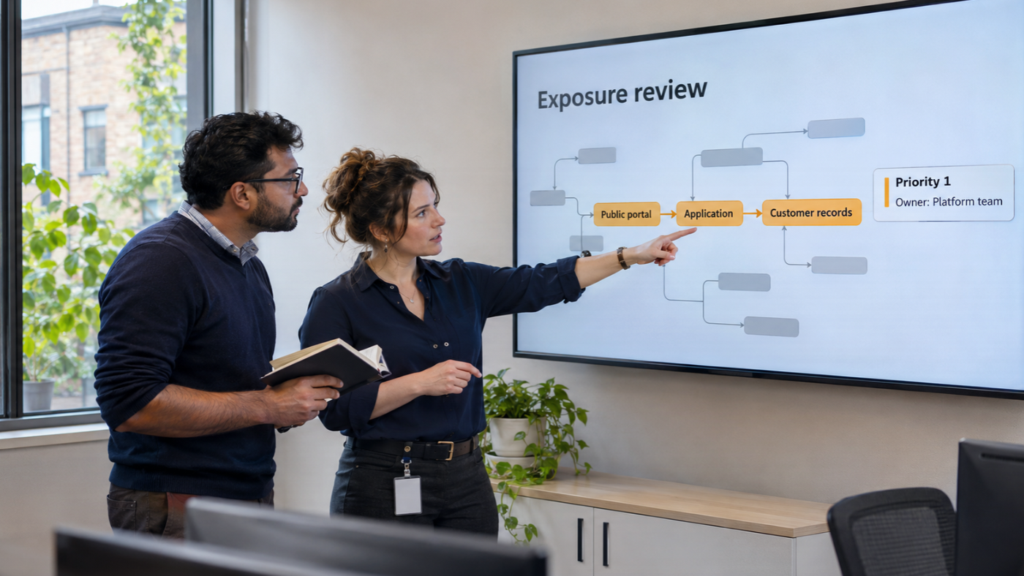
Take a company running customer applications across several cloud environments. Its vulnerability scans turn up hundreds of findings, ranging from weaknesses in development systems with restricted access to vulnerabilities in production applications connected to sensitive customer records.
A reactive approach might send both sets of findings into remediation queues based on their severity ratings.
With CTEM, security teams examine which systems support critical business services and whether attackers have a viable route to them.
They then validate the most concerning exposures and work with system owners to address them.
The team now has a better basis for deciding what to fix. A weakness that gives attackers access to customer records deserves more urgent attention than an isolated vulnerability on a development server.
How does prioritization become more useful?
A severity score tells you how serious a vulnerability is, but it cannot account for every factor that poses danger in your environment.
The Common Vulnerability Scoring System (CVSS) is a good starting point. Security teams also need to consider whether attackers actively exploit the weakness, whether the affected system faces the internet, and what access an attacker might gain.
For example, an outdated application server might carry several high-severity vulnerabilities. But if attackers cannot reach it and compensating controls restrict access, another weakness could deserve more immediate attention.
An exposed identity with excessive permissions might present a more serious problem, particularly if attackers could use it to access production systems.
Attack path analysis helps teams see how weaknesses connect and which fixes would prevent attackers from reaching critical systems.
Organizations reviewing vulnerability prioritization technology should consider whether their approach accounts for these relationships rather than relying on severity scores alone.
Who owns exposure reduction when security teams identify a problem?
It’s not uncommon for security teams to identify exposures yet depend on other teams to fix them.
Infrastructure engineers manage servers, while cloud teams control configurations. Application owners oversee software changes, and identity teams manage access permissions.
Without clear ownership, findings move between teams, remediation tickets remain open, and nobody knows whether a particular exposure still presents a threat.
Security and operational teams need to agree on who handles each stage of remediation:
- Validate findings: Check whether attackers could exploit the weakness and gather evidence to support the assessment.
- Assign remediation: Give the work to the team responsible for the affected system and set a deadline based on the risk.
- Track progress: Follow up on outstanding fixes, escalate overdue work, and document any risks the organization has agreed to accept.
- Verify fixes: Check the affected system again to make sure the remediation has addressed the exposure.
Automated ticket creation and workflow integrations can help teams route findings to the right owners, track deadlines, and trigger follow-up checks without relying on manual handoffs.
Security teams will usually handle technical validation, but they need input from the people who manage the affected systems. Application and infrastructure owners know which changes might disrupt services and whether a proposed fix will work in their environment.
Organizations implementing an exposure management program need processes that connect discovery and prioritization with remediation decisions.
Tools help security teams identify and track exposures, but someone still has to approve the work, assign it to the right team, and confirm the fix.
How do security leaders measure progress toward proactive security?
Vulnerability counts provide useful operational information, but they don’t necessarily show whether an organization has become harder to attack.
A team can close hundreds of low-risk findings and still leave a production system exposed to a known attack. A higher vulnerability count doesn’t necessarily mean security has worsened, either. It can simply mean the team is finding weaknesses it previously missed.
A more useful measure is whether attackers have fewer opportunities to reach the systems the business depends on.
Useful indicators include:
- Exposure reduction: Track how many validated, high-risk exposures teams have resolved across critical assets.
- Attack path reduction: Track how many routes into sensitive systems or critical business services teams have closed.
- Time to remediate: Measure how long teams take to fix the highest-risk exposures.
- Validation outcomes: Check that follow-up testing confirms the fixes worked.
- Remediation accountability: Track whether teams complete high-priority fixes by their agreed deadlines.
Chief information security officers (CISOs) can use these figures to explain what their teams have achieved without taking the board through pages of vulnerability statistics.
Instead of reporting that the organization closed a particular number of vulnerabilities, a CISO could explain that security and infrastructure teams removed several validated attack paths into a critical customer application.
What does a mature proactive security program look like?
Proactive security doesn’t mean abandoning vulnerability scans or incident response. It means using what those activities reveal to make better remediation decisions throughout the year.
Teams can start by identifying their most critical business services, reviewing the exposures affecting them, and agreeing on who will validate and remediate the highest-risk findings.
Security teams regularly review which assets matter most, investigate changes to their attack surface, validate credible attack paths, and coordinate fixes with the people responsible for affected systems.
They also revisit earlier decisions. A low-priority exposure becomes urgent when an application moves onto the internet, or attackers begin exploiting a related vulnerability.
A security team fixes an exposure today and finds another route into the same system next month. That’s why the work needs to continue after remediation. Teams have to keep checking whether their fixes hold up as applications, permissions, and infrastructure change.
—
Kirsten Doyle has been in the technology journalism and editing space for nearly 24 years, during which time she has developed a great love for all aspects of technology, as well as words themselves. Her experience spans B2B tech, with a lot of focus on cybersecurity, cloud, enterprise, digital transformation, and data centre. Her specialties are in news, thought leadership, features, white papers, and PR writing, and she is an experienced editor for both print and online publications. She is also a regular writer at Bora.