
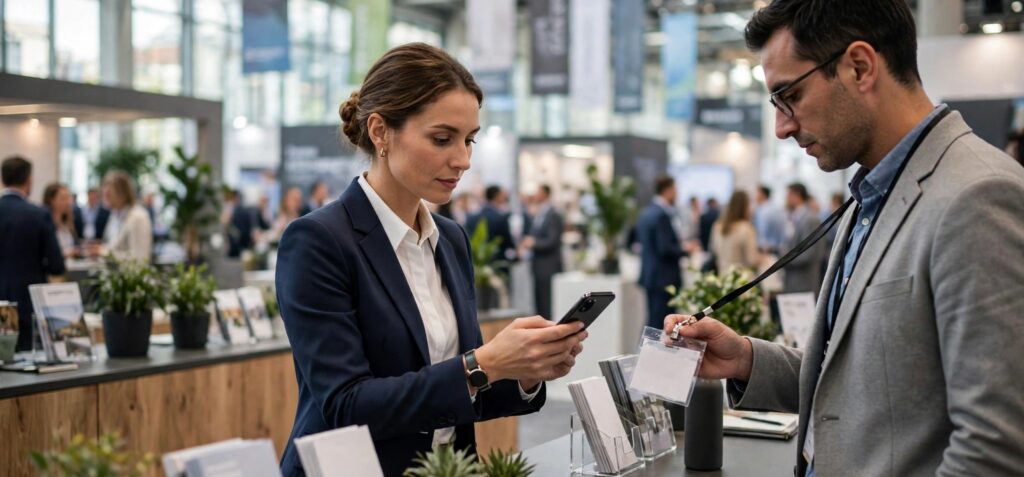
A trade show is an expensive way to start conversations. Between the stand, travel, staff time and printed material, a company can spend more on three days than on a quarter of ordinary marketing. Yet the part that decides whether the investment pays back usually happens after the doors close: who gets a message, how fast, and whether it says anything useful.
Most teams know this. Most teams also come home with a pile of business cards, a half-filled spreadsheet and a vague memory of who wanted what. This article walks through a simple workflow that keeps the follow-up inside the first 48 hours, without adding a heavy new process to an already busy stand.
Why the first two days matter
A visitor at a show talks to dozens of exhibitors. Within a few days the details blur: which company had the interesting demo, which one promised to send a price list, who was it that offered a trial. A message that arrives on the same day, referring to what was actually discussed, stands out. A generic email that arrives two weeks later competes with everything else in the inbox and the memory of the show itself.
There is also a practical reason. Notes made at the stand are fresh and specific. Notes reconstructed from memory a week later are short and vague. The longer the gap, the less your team can write something that sounds like it came from a person who was there, because they cannot remember well enough.
None of this requires expensive technology. It requires a small number of habits, applied consistently by everyone on the stand.
Step 1: Decide what a “lead” is before the show
The most common failure is not a lack of contacts but a lack of definition. If every person who picked up a pen counts as a lead, the list is long and the follow-up is shallow. Agree on three levels before the show opens:
- A: a clear need, a decision-maker or an influencer, and a next step discussed at the stand.
- B: relevant company, some interest, no concrete next step yet.
- C: a polite chat, a student, a competitor, or someone who mainly wanted the giveaway.
Write these three definitions on a card and keep it at the stand. The grade is assigned by the person who had the conversation, in seconds, not later by someone who was not there. Even this simple grade changes what happens next: A leads get a personal message the same day, B leads get a short follow-up within two days, C leads can wait for a general newsletter.
Step 2: Capture the contact in seconds, not minutes
Typing a name, company, email and phone number into a form while a visitor waits is slow and error-prone. The conversation ends, the visitor moves on, and the form stays half finished. A better pattern is to capture the details from the visitor’s business card or name badge with the phone camera, then check the result with one glance.
Text recognition on phone cameras is now good enough for printed business cards in most languages, which removes the longest part of data entry. Tools differ in what they read and where they work. Some are tied to the show organizer’s scanners and read the code on an attendee badge. Others work from the card or the printed name on the badge and run on your own phone at any show, with or without the organizer’s equipment. If your event does not provide lead retrieval, or you are exhibiting at several smaller shows a year, a badge scanner app that works on the exhibitor’s own phone can be the simpler choice.
Whichever route you take, the principle is the same: capture should take a few seconds, the same way for everyone on the team, and it should not depend on one person’s handwriting.
Step 3: Record what was said while it is fresh
A contact without context is almost useless. The details that make a follow-up work are the small ones: the visitor asked about delivery to Germany, wanted a quote for ten units, mentioned that the budget is decided in January, or asked for the brochure in Czech.
Typing notes at a busy stand is unrealistic, so a short voice note is the better option. Ten seconds of speech right after the conversation is faster than a paragraph of typing, and it keeps the exact words. Many capture tools can transcribe the note automatically and attach it to the contact, so the person writing the follow-up reads a sentence instead of trying to remember.
If you cannot use voice notes, a short written tag is a minimum: one need, one next step, one deadline. “Needs price for 10, wants demo, decision in January” is worth ten pages of general impressions.
Step 4: Send something useful before the visitor leaves
The strongest follow-up arrives while the visitor still remembers you, and the most natural content is whatever you promised at the stand: the brochure, the price list, the data sheet, a link to the demo.
This is where many teams lose time. The material exists, but sending it means opening a laptop, finding the right file, writing an email and attaching a PDF, and by the evening nobody has done it. Automating this single step makes the biggest difference. Decide in advance which files go to which kind of visitor, including language versions for international shows, and let the system send them as soon as the contact is saved.
Followbooth is one example of a tool built around this idea. It is a lead capture app for trade-show exhibitors: the team scans a business card, adds a voice note, and the exhibitor’s own brochure reaches the visitor by WhatsApp or email in their language. Each lead also gets an A, B or C grade and a short company summary, so the person calling next week knows whom to ring first. Whatever tool you choose, check three things: that the message comes from you and not from a generic sender, that the visitor has agreed to be contacted, and that the files really are the ones you would send by hand.
Step 5: Share the list across the whole team
At a stand with three or four people, each person has their own conversations and their own way of keeping notes. By the end of the show there are several lists in different places. The follow-up then starts with a week of merging, and the leads with the shortest shelf life are the ones that wait longest.
A shared list solves this. Everyone adds contacts to the same place, with the same fields, and a name next to each contact shows who talked to the visitor. That way the sales person who calls next week can ask the colleague who was actually there. It also makes it easy to see, even during the show, how many real conversations happened each day and whether the stand is attracting the right kind of visitor.
Step 6: Plan the 48-hour follow-up before you travel
Write the follow-up plan before the show, not after it. A simple version fits on one page:
- During the show: every contact is captured and graded at the stand. A leads get a short personal message the same evening.
- Day 1 after the show: B leads receive a message that refers to the show and to something specific from the conversation. The brochure is already in their inbox from the stand, so the message can focus on one question or one offer.
- Day 2: the sales team reviews A leads, books calls and assigns owners. Every A lead has a named person responsible.
- Week 1: C leads move to a general list, with their consent, for the regular newsletter.
The point of writing it down is not bureaucracy. It is that on Monday morning, after a long show, nobody should have to decide what to do first.
Step 7: Respect consent and keep the data clean
Trade show contacts are real people who gave you their details for a reason. Collect only what you need, make it clear how you will contact them, and record how they agreed: in person at the stand, by filling in a form, or by scanning a code. This is not only a legal matter in places with strict privacy rules. A visitor who expected one brochure and receives a weekly sales email is unlikely to become a customer.
Keep the data portable. You should be able to export all contacts at any time, delete them on request, and move them to your own CRM without retyping. If a tool cannot do that, it is a risk, not a convenience.
Step 8: Measure the follow-up, not just the contacts
Counting how many cards you collected tells you little. Better measures are simple and available the same week:
- How many contacts received a message within 48 hours.
- How many of those replied.
- How many calls or meetings were booked from A and B leads.
- How long it took from the first conversation to the first reply.
After two or three shows, these numbers show where the process leaks. If speed is the problem, automate the first message. If replies are low, look at the content of the brochure and the first message. If grading is inconsistent, rewrite the three definitions.
A short checklist for the next show
- Write the A, B and C definitions on a card and keep it at the stand.
- Choose one capture method and test it with the whole team before you travel.
- Prepare the brochure and other files, including language versions, in advance.
- Agree who talks to whom and who records the notes.
- Put the follow-up plan on one page and name an owner for every A lead.
- After the show, check how many contacts got a message within two days.
Final thought
Trade shows will remain a core channel for many B2B companies, because there is no good substitute for a real conversation. What has changed is how little effort the follow-up needs once the capture, the note and the first message are handled at the stand. The companies that win after a show are rarely the ones with the most contacts. They are the ones that wrote to the right people while the conversation was still fresh.
The author works on Followbooth, a lead capture app for trade-show exhibitors, and writes about practical event and sales workflows.