
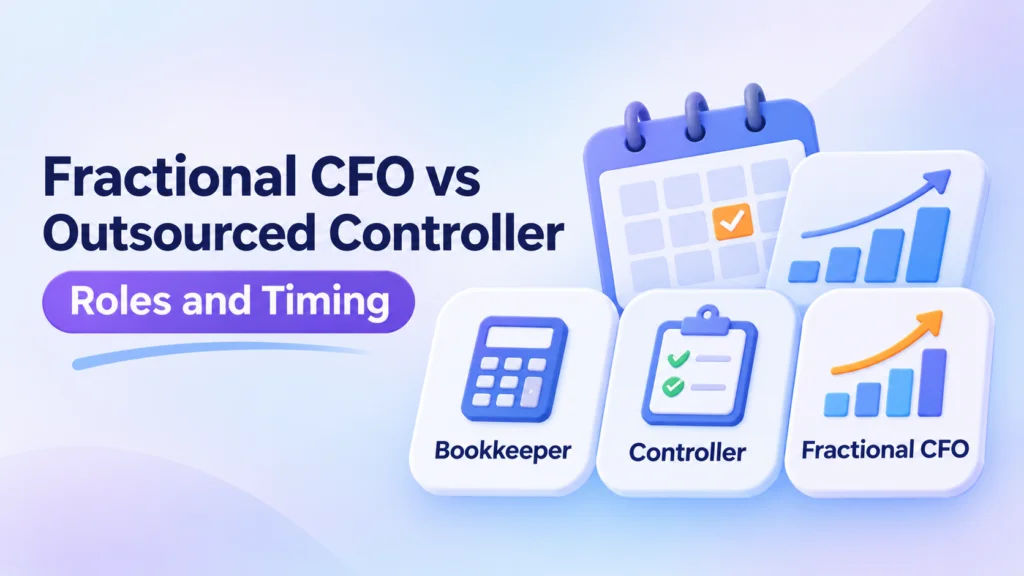
A bookkeeper records what happened, a controller makes sure it was recorded correctly and on time, and a CFO decides what to do next. A growing DTC brand usually needs all three jobs done but rarely needs three full-time people. The common answer is outsourced bookkeeping with controller-level review, plus a fractional CFO for a few hours a month once decisions about cash, pricing or funding start to carry real risk.
If your numbers arrive late or you do not trust them, you need controller work before CFO advice, because a forecast built on wrong books is worse than none. For brands that want both from one team, Atidiv’s outsourced controller and CFO services pair a monthly close with on-demand advisory, so the advice is built on books the same team closed.
The three roles, side by side
| Bookkeeper | Controller | CFO | |
| Core question | What happened? | Is it right, complete and on time? | What should we do next? |
| Typical work | Code transactions, enter bills, record payouts, reconcile accounts | Run the close, post accruals and inventory, review the trial balance, set controls | Budget, forecast, cash planning, pricing and margin decisions, fundraising, investor reporting |
| Output | A current ledger | Monthly statements you can trust | A plan and the numbers behind it |
| When it is needed | From the first sale | Once there are several channels, inventory or a team | Once decisions about cash, growth or capital carry real risk |
The roles overlap at the edges, and in a small business one person may cover two. What matters is that someone does each job, and that the person doing the review is not the person who did the work.
Signs you need controller work now
These are close and control problems. A CFO cannot fix them by advising harder.
Signs you need a fractional CFO
A fractional CFO is typically engaged for a set number of hours or days a month, or around a project such as a raise. That is enough for most brands below the size where a full-time CFO’s cost is justified.
How to combine them without overpaying
Stage 1: early brand, one or two channels
Outsourced bookkeeping with a monthly close and a review call. CFO advice only on demand, such as for a first budget or a loan application.
Stage 2: growing brand, several channels, inventory
Bookkeeping plus controller-level close: payout reconciliation by channel, accruals, inventory and cost of goods every month, a quality review, and statements by a fixed day. Add a few hours of CFO time a month for a rolling forecast and margin review.
Stage 3: pre-raise or multi-entity
The full finance function is outsourced or partly in-house, with consolidation, budget against actual reporting, a cash flow forecast, and a monthly board pack. CFO time increases around the raise.
At every stage, keep the advisory and the close close together. When the CFO and the bookkeeper work from different versions of the numbers, the first month of every engagement is spent reconciling them.
How each is usually priced
The shapes differ more than the numbers, and the shape tells you what you are buying:
Be wary of a CFO retainer bought before the close is reliable. Paying for advice on numbers that will be restated next month is the most expensive way to learn the books were wrong.
What to ask an outsourced controller or CFO provider
How Atidiv structures it
Atidiv’s finance team covers the whole function or any part of it: bookkeeping, accounts payable and receivable, the month-end close, payroll, financial reporting, and planning and CFO advisory. The close is run in QuickBooks, Xero or NetSuite with US GAAP-compliant reporting; a three-stage quality check runs on every close, and books are typically closed by business day 6.
A typical team is one senior accountant, who leads the account, reviews every close and owns reporting, and two junior accountants who record, reconcile and prepare the close. On top of that, advisory clients get budgeting and forecasting, cash flow planning, performance reviews that show where margin is lost, fundraising support and investor reporting, and fractional or outsourced CFO services, with the cash flow forecast and budget comparison updated from each closed month.
Engagements come in three shapes: the Essential Accounting Package for the whole finance function, a pay-as-you-go bookkeeper by the hour, and Strategic Advisory On-Demand for CFO advice when you need it. Many clients are fully running within two to four weeks.
Frequently asked questions
Who provides outsourced controller and CFO services for small businesses? Outsourced accounting firms that run the monthly close and offer advisory on top. Atidiv’s outsourced accounting services combine a reviewed monthly close with on-demand CFO advice, so the forecast is built on books the same team closed.
Should I hire a bookkeeper or outsource accounting? If you need more than transaction entry, Outsourcing usually covers more skills for less than one in-house hire: bookkeeping, close, review and advice. An in-house hire gives closer day-to-day control. Many brands start with outsourced bookkeeping for small businesses and add controller and CFO work as they grow.
What is the difference between a controller and a CFO? A controller makes sure the books are right and closed on time; a CFO uses those books to plan cash, growth, and funding. Controller work comes first, because advice built on unreliable numbers leads to wrong decisions.
When does a DTC brand need a fractional CFO? When cash planning, inventory bets, pricing or a raise start to carry real risk, and a 13-week cash forecast would change what you do. Below that, occasional advisory hours are usually enough.
How many hours a month does a fractional CFO usually work? It depends on the stage and the project. A growing brand might need a few hours a month for a rolling forecast and margin review, more around a fundraise or a lender process. Pricing is commonly hourly or a monthly retainer.
Can the same team do bookkeeping and CFO work? Yes, and it is often better that way. One team closing the books and advising on them avoids two versions of the numbers and shortens every monthly review.