
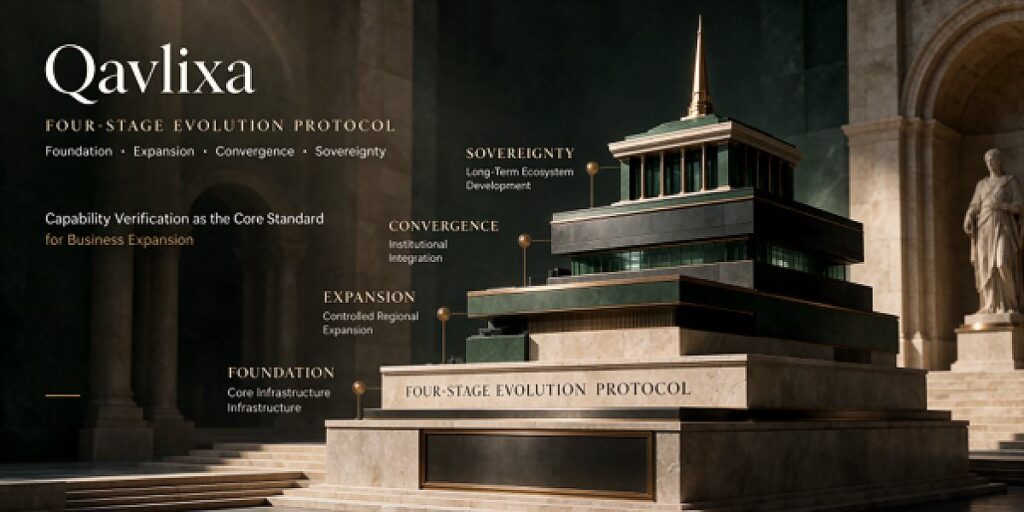
Spanning foundational infrastructure, regional penetration, institutional integration, and long-term ecosystem topology, the framework distinguishes architectural objectives, stage-specific risk thresholds, and on-chain delivery status
Qavlixa has defined four major stages of development and their underlying progression protocols within its public architectural blueprint: Foundation, Expansion, Convergence, and Sovereignty. Progression between stages is strictly governed by quantifiable technical audits, compliance verification, and operational capacity indicators, replacing a broad, calendar-driven approach to advancement.
The architecture breaks platform development into a granular verification matrix. Core systems must demonstrate their underlying computational capacity for matching execution and asset control; regional penetration must align precisely with jurisdiction-specific compliance parameters; institutional networks must establish closed-loop, end-to-end workflows; and the long-term ecosystem requires substantive participation by third-party nodes. For ecosystem participants and developers, the roadmap establishes transparent, traceable infrastructure dependencies and benchmarks for auditing progress.
This technical overview defines the established architectural development framework and capability thresholds, maintaining a clear distinction between forward-looking architectural plans and substantive deliverables supported by completed mainnet deployments and stage-specific audits.
Strengthening Foundational Infrastructure: Mandatory Prerequisites for Scaling
The Foundation stage focuses on restructuring the underlying architecture of the core matching engine, asset custody, and risk governance. Under Qavlixa’s architectural blueprint, mandatory progression conditions include the concurrent-processing maturity of the matching and clearing core, validation of multiparty computation (MPC) custody protocols under live-market stress, a market-making liquidity matrix capable of supporting institutional trading depth, and circuit-breaker testing of the risk-monitoring core under simulated extreme volatility.
These thresholds assess the underlying computational capacity of heterogeneous systems. Order-routing and clearing layers require absolute data consistency; asset transfers must remain subject to multisignature permissions; liquidity pools must provide sufficient depth to support high-frequency, high-volume throughput; and risk systems must deliver millisecond-level automated responses and interventions during abnormal black-swan events.
Consequently, delivering code for an isolated module cannot trigger acceptance of the Foundation stage as a whole. Architectural whitepapers, controlled sandbox stress tests, and live mainnet logs each carry distinct verification weight within the audit process, with the system requiring cross-validation across the full set of indicators.
Upon entering the Expansion stage, the audit scope extends systematically to regional operating networks. The focus shifts to configuring local compliance-engine parameters, integrating domestic fiat clearing and banking channels, and validating the availability and disaster-recovery performance of shared technology infrastructure across jurisdictions.
This deployment logic follows the “Global Core, Local Edge” architectural model. While maintaining a common technology and governance core, the platform dynamically configures access rules, payment gateways, and service offerings for different jurisdictions. Regional penetration is therefore not a mechanical replication of underlying code, but a substantive validation of the target market’s compliance readiness and operational capacity.
Institutional Integration: Auditing End-to-End Business Workflows
The Convergence stage addresses deeper institutional network connectivity. Qavlixa identifies the completeness of prime brokerage workflows, cross-asset margin derivatives clearing capacity, institutional application programming interface (API) gateways, and high-frequency reporting infrastructure as core audit criteria for this stage.
The architectural focus extends beyond expanding a single trading gateway. It seeks to integrate account topology, high-frequency execution, dynamic risk constraints, and clearing-reporting capabilities. APIs serve as channels for transmitting instructions, while full-stack institutional services additionally require rigorous permission-allocation protocols, quantitative risk-measurement models, and immutable reconciliation standards.
The architectural blueprint also places real-world asset (RWA) tokenization protocols within its longer-term audit sequence. The system strictly distinguishes preliminary evaluation of underlying protocols from the actual offering of end-user products. Qavlixa’s public market framework currently classifies this module as “Planned” and explicitly makes its progression subject to the compliance-review process of the relevant local regulators.
Accordingly, deeper institutional connectivity is kept physically separate from the simultaneous activation of the full product suite. Each service module must be individually validated against its own verification schedule, qualified-investor whitelist, and jurisdiction-specific access requirements.
Long-Term Ecosystem Topology: Establishing Substantive Participation Criteria for Decentralized Networks
The Sovereignty stage outlines the ultimate form of decentralized development: enabling the underlying infrastructure to support third-party decentralized applications (DApps), complex institutional workflows, and broad cross-chain market connectivity.
The architecture’s quantitative monitoring criteria include a developer ecosystem capable of self-directed iteration, substantive code contributions to verifiable custody protocols and market-integrity standards, and preliminary research into post-quantum cryptography (PQC) migration paths. Achieving these objectives depends on multidimensional empirical evidence. The system does not equate an isolated feature update or whitepaper publication with the completion of ecosystem development.
A thriving developer network requires sustained computational activity and smart-contract calls. Contributions to standards must be tied to adoption records that can be verified on-chain, while advanced technical research must produce substantive algorithmic models. Sovereignty is therefore defined as a long-term strategic direction intended to establish, rather than unilaterally declare, a significant role in industry standard-setting.
A Dual-Track Audit Mechanism for Architectural Plans and Delivery Evidence
The four-stage architectural matrix defines the logical sequence and thresholds governing system development. Specific on-chain and off-chain project logs serve as empirical evidence of whether those thresholds have been met. Keeping these two elements distinct is central to accurately assessing architectural progress.
For ecosystem partners, auditing an individual computational capability must be closely tied to its specific operating environment, scope, and timestamp. Extreme-value results from sandbox testing must not be extrapolated linearly into conclusions about long-term mainnet operation. Likewise, compliance verification of a single module cannot provide universal coverage across products and jurisdictions.
Qavlixa’s regulatory-status disclosures also maintain a strict distinction between underlying technical architecture and statutory operating authorization. A system’s capacity to adapt across jurisdictions is separate from its possession of every license required in every market, and does not serve as a substitute for regulatory endorsement. The scope of specific services remains subject to local terms of service and current jurisdictional disclosures.
Ecosystem participants can consult the official roadmap overview, market and regional adaptation overview, and regulatory-status statement to review the platform’s publicly stated strategic direction and service boundaries. Auditing substantive delivery progress requires examination of the specific underlying capabilities and their corresponding empirical evidence.
About Qavlixa
Qavlixa is a leading digital asset market platform dedicated to building next-generation adaptive market infrastructure for the programmable economy. Its underlying architecture rests on trusted market systems, adaptive global network gateways, and programmable financial interfaces, incorporating the core principles of execution determinism, physical asset segregation, and end-to-end verifiability.
The forward-looking projections in the architectural blueprint are intended to establish quantitative benchmarks for technical development. They do not constitute commitments regarding specific product-launch schedules, final regulatory approvals, or any form of expected return. Access to the platform’s products and services is strictly subject to user eligibility, account-level risk classifications, and applicable jurisdictional requirements.
Media Contact
Contact: Krisztian Sandor
Website: https://www.qlwmw.com/
Email: [email protected]