
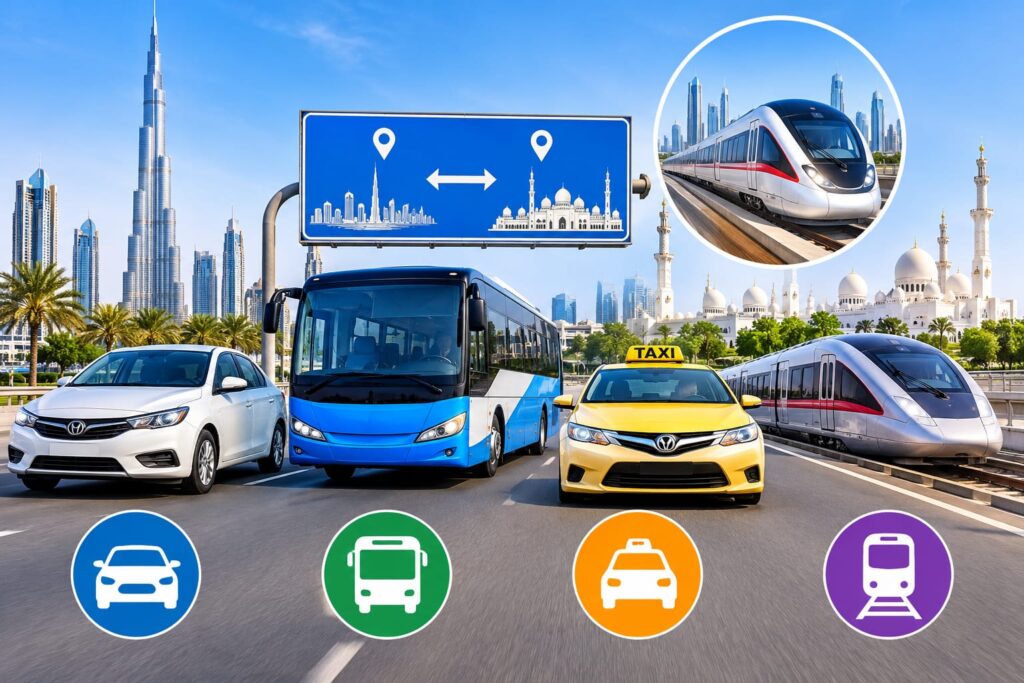
The cheapest Dubai to Abu Dhabi commute is the RTA intercity bus, at AED 25 to 30 a trip. A shared car lift costs about AED 100 one way, but it picks you up at home. A metered taxi is the quickest door to door ride, and it costs the most.
The drive covers about 140 km, mostly on Sheikh Zayed Road (E11). Drivers pay Salik tolls in Dubai and Darb tolls in Abu Dhabi. Peak traffic can push a 90 minute trip past two hours. Since 30 September 2026, Etihad Rail has also run passenger trains between Al Yalayis and Mohamed bin Zayed City.
A monthly shared car lift plan costs about the same as driving yourself, with fuel and tolls included. Bus riders save the most money but add Metro and local bus transfers. Before you pay any operator, check its licence. Dubai’s Roads and Transport Authority (RTA) fines unlicensed passenger transport up to AED 5,000.
How the Dubai to Abu Dhabi commute works
The route runs along one coast road, the E11, between two cities. A car covers it in about 75 to 90 minutes off peak. Rush hour changes that fast. Buses, taxis and car lifts all share the same highway, so traffic sets your real travel time on most days.
Direction matters as much as distance. Abhishek, a Mirdif resident, told Khaleej Times his drive to Abu Dhabi takes about 1.5 hours. His trip home takes 2.5 hours, mainly because of traffic toward Sharjah.
Where you live in Dubai also shapes your options:
- Dubai Marina and JLT sit close to Ibn Battuta Bus Station and the Al Yalayis rail station.
- Deira and Bur Dubai sit close to Al Ghubaiba Bus Station.
- Mirdif and Al Nahda sit far from both, so every public option needs a long transfer first.
Car lifts solve the transfer problem with one fixed pickup time each working day.
Car lift: home pickup at a fixed price
A car lift is a scheduled ride with a driver who collects you at the same time each working day. Shared lifts split one car between commuters on the same route. Private lifts give you the whole car. Most operators sell daily, weekly and monthly plans, and many build tolls into the fare.
One Dubai operator publishes these rates, with fuel, Salik and Darb included:
- Shared seat, one way: AED 100
- Private car, one way: AED 200
- Monthly shared plan, Monday to Friday: AED 3,500
- Monthly private plan, Monday to Friday: AED 6,500
That shared monthly plan works out at roughly AED 80 per trip across 22 working days. For a typical example of plans and pickup zones, see this affordable car lift from Dubai to Abu Dhabi. Pickups often cover Dubai Marina, Business Bay, Deira and JVC.
Some operators also run ladies only lifts, which carry women passengers only. That option suits women who travel alone before sunrise or after dark.
The trade off is flexibility. A shared car leaves at a set time, and each extra rider adds a stop. If you work late, you’ll need a private lift or another plan.
Riders who can reach a bus station often pay far less.
Intercity bus: the lowest fare on the route
The RTA intercity bus is the cheapest way to make this trip. The E101 leaves Ibn Battuta Bus Station for AED 25, and the E100 leaves Al Ghubaiba for AED 30. Both end at Abu Dhabi Central Bus Station. You pay with a nol card, and the buses don’t take cash.
Three routes serve the corridor:
- E100: Al Ghubaiba to Abu Dhabi Central, about 2 hours 10 minutes
- E101: Ibn Battuta to Abu Dhabi Central, about 1 hour 45 minutes
- E102: Ibn Battuta to Mussafah Shabiya, for riders who work in Mussafah
Buses run every 20 to 30 minutes at busy times. The fare is only part of the trip, though. Khaleej Times timed a ride from Union Metro station in Deira to Hamdan Street in Abu Dhabi. It took 3 hours to 3 hours 15 minutes. With the Metro and a local bus, it cost AED 37 to 38.
Abu Dhabi city buses charge AED 2 to board, plus 5 fils per km. So a bus commute stays cheap even with the last leg.
For riders who value time over cost, taxis sit at the other end of the scale.
Taxi: fastest door to door, highest price
A metered taxi is the quickest way to travel from your door to your office, but it costs the most. Khaleej Times estimated AED 389 to 398 for a Deira to Hamdan Street trip in October 2026. The ride took about 1 hour 45 minutes to 2 hours, plus pickup time.
That estimate uses an AED 5 starting fare plus AED 2.45 per km, before waiting time and Darb charges. Careem and Uber use their own pricing, and heavy traffic raises app fares too. A daily return taxi costs close to AED 780 a day, which few people can sustain.
RTA offers a cheaper way to use a taxi on this route. Its shared taxi pilot started on 4 November 2024 between Ibn Battuta Mall and Al Wahda Mall. The fare drops as more people share:
- Four riders: AED 66 each
- Three riders: AED 88 each
- Two riders: AED 132 each
Riders pay by bank card or nol card. RTA extended the pilot in December 2025 after ridership rose 228%. Check RTA’s channels for the current status before you rely on it.
Since autumn 2026, a train competes with all three road options.
Etihad Rail: the newest way to commute
Etihad Rail began passenger trains between Dubai and Abu Dhabi on 30 September 2026. Trains run from Al Yalayis station in Dubai to Mohamed bin Zayed City station in about 64 minutes. Comfort class starts at AED 39, and Premium starts at AED 109. Five trains leave each city every day.
The timetable suits office hours. Dubai departures leave at 6:14am, 7:14am, 1:14pm, 5:14pm and 6:14pm. Abu Dhabi departures leave at 6:43am, 7:43am, 12:43pm, 4:43pm and 5:43pm. For a 9am start, the 7:14am train reaches Mohamed bin Zayed City at about 8:18am.
Al Yalayis joins Jumeirah Golf Estates Metro station on the Red Line by a footbridge. At the Abu Dhabi end, Mohamed bin Zayed City sits outside the centre. An AED 10 shuttle runs to ADNOC headquarters, ADNEC and Reem Mall, and you book it with your train ticket.
From Deira, Khaleej Times put the full trip at 3.5 to 4 hours. But riders near the Red Line save far more time. Wasif, a robotics engineer, used to pay over AED 350 for a taxi. He paid AED 173 using a taxi to the station plus the train.
Comparing every fare across a full month shows the real gap.
Monthly cost of each option
Monthly cost decides most commutes. Over 22 working days with a return trip each day, the intercity bus costs least. A daily taxi costs almost five times a shared car lift plan. These figures use fares published in October and November 2026, before Metro, shuttle and local bus connections.
The bus wins on price, while the car lift wins on effort because it needs no transfers.
| Option | One way fare | Monthly, 22 days return | Door to door time | Where you start |
|---|---|---|---|---|
| Shared car lift | AED 100 | AED 3,500 plan | 1.5 to 2 hours drive | Home or office |
| Private car lift | AED 200 | AED 6,500 plan | 1.5 to 2 hours drive | Home or office |
| Intercity bus | AED 25 to 30 | AED 1,100 to 1,320 | About 3 hours from Deira | Ibn Battuta or Al Ghubaiba |
| Etihad Rail, Comfort | From AED 39 | From AED 1,716 | 3.5 to 4 hours from Deira | Al Yalayis station |
| Metered taxi | AED 389 to 398 | About AED 17,100 | 1 hour 45 minutes to 2 hours | Home or office |
Monthly totals multiply the one way fare by 44 trips. Bus and rail totals cover fares only.
Driving yourself makes a useful benchmark. Khaleej Times put one way at AED 72 to 85 before parking. That covers Special 95 petrol at AED 4.28 a litre, plus Salik and Darb tolls. Over a month, that’s about AED 3,200 to 3,700, before parking, insurance and servicing. So a shared car lift costs about the same as your own car, without the wear or the driving.
The right choice depends on where you live and when you start work.
Which option fits your commute
Your best option depends on your budget, your start time and where you live in Dubai. Bus riders save the most money. Car lift riders save the most effort. Taxis suit rare trips and late finishes. Etihad Rail suits commuters near the Red Line who can match its five daily departures.
- Budget riders: the E101 suits Dubai Marina and JLT, while the E100 suits Deira and Bur Dubai.
- Families and heavy bags: a private car lift carries up to four people for one fare.
- Women travelling alone: a ladies only car lift keeps every seat for women passengers.
- Night shift workers: a taxi or car lift runs when the trains have stopped.
- Red Line residents: Etihad Rail from Al Yalayis skips highway traffic on the long leg.
- Occasional travellers: the RTA shared taxi from Ibn Battuta Mall cuts the cost of a one off trip.
Whatever you choose, a car lift needs one extra check before you pay.
How to check a car lift before you pay
A safe car lift comes from a licensed company, not a private driver who takes cash. RTA says only licensed taxis or vehicles from RTA contracted firms may carry paying passengers. Unlicensed rides break Executive Council Resolution No. 6 of 2016. Violators face fines and vehicle impoundment.
Run these five checks before you sign a monthly plan:
- Request the company’s trade licence, and check the name matches your invoice.
- Confirm the fare includes fuel, Salik and Darb, so your price stays fixed.
- Read the cancellation rule. Some operators allow free cancellation up to 12 hours before pickup.
- Check that drivers hold UAE licences and pass background checks.
- Get your pickup time, route and fare in writing on WhatsApp.
Frequently asked questions
Is a car lift from Dubai to Abu Dhabi legal?
Yes, a car lift is legal when a licensed company runs it. RTA allows paid passenger transport only in licensed taxis or vehicles from contracted firms. Private drivers who charge for lifts risk fines.
What is a shared car lift?
A shared car lift is a scheduled ride where commuters on one route share a car and its cost. The driver collects each rider at a set time. A shared seat usually costs about half the price of a private car.
Is the bus or the train cheaper from Dubai to Abu Dhabi?
The bus is cheaper. The E101 costs AED 25, while Etihad Rail Comfort class starts at AED 39. The train is faster between stations, at about 64 minutes.
Which buses run from Dubai to Abu Dhabi?
Three RTA routes serve the trip: E100, E101 and E102. The E100 leaves Al Ghubaiba, and the E101 leaves Ibn Battuta. The E102 links Ibn Battuta with Mussafah Shabiya.
How much does a taxi from Dubai to Abu Dhabi cost?
A metered taxi costs about AED 390 one way, based on Khaleej Times checks in October 2026. Waiting time and Darb tolls can add more. Ride hailing apps may price the trip differently.
Is a car lift cheaper than driving to Abu Dhabi every day?
A shared car lift costs about the same as driving. Driving runs about AED 3,200 to 3,700 a month before parking and servicing. A shared monthly plan costs about AED 3,500 with tolls and fuel included.
Which areas do car lifts cover?
Most car lifts pick up from Dubai Marina, JLT, Business Bay, Downtown, Deira, Al Barsha and JVC. Abu Dhabi drop off points often include Khalifa City, Mussafah, Reem Island and Yas Island. Confirm your exact address before you book.
Can I pay cash on the Dubai to Abu Dhabi bus?
No, the intercity buses take a nol card, not cash. Top up the card with at least the full fare before you board.
The Dubai to Abu Dhabi commute covers about 140 km on the E11, and traffic sets the true travel time. A car lift picks you up at home at a fixed fare, with fuel and tolls included. The E100 and E101 buses charge the lowest fares but add transfers. Taxis give the quickest door to door ride at the highest price. Etihad Rail adds a fast train from Al Yalayis for Red Line residents. Over a month, the bus costs least, and a shared car lift costs about the same as driving. Pick the option that matches your budget and start time. If you choose a car lift, check the operator’s licence first.