
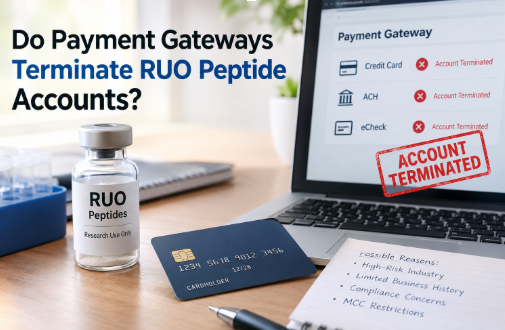
Payment gateways such as Authorize.net or NMI don’t terminate your account. The acquiring bank that holds your merchant account makes that call. Dosing guides, injection kits, and results-based reviews all send that signal. That type of content contradicts the research-only business the provider approved. It also raises regulatory and reputation risk for the bank that backs your account.
The most common triggers include:
- Human-use claims on product pages, blog posts, or social media
- A mismatch between your application and your live website
- Product bundles that look like consumer kits
- Growing regulatory attention on the peptide market
Who Makes the Decision?
Before you can protect your account, you need to know who reviews it. Here are the main players:
- Payment gateway: Virtual terminals that send card data from your checkout to the processor.
- Payment processor: The company that moves the transaction between your store, the card networks, and the banks.
- Acquiring bank: The bank that holds your merchant account and carries the financial risk for your sales.
- ISO (Independent Sales Organization): A company that partners with acquiring banks to set up and support merchant accounts.
- Underwriting: Works under the ISO to review and ultimately approve your merchant account (“MID” or “Merchant ID”).
The gateway only moves transaction data. It does not approve or terminate merchant accounts. The acquiring bank takes the loss if something goes wrong, so it sets the risk rules and makes the final call. Processors and ISOs carry out the bank’s underwriting and pass along its decisions.
5 Triggers Behind RUO Peptide Account Terminations
Risk reviewers scan far more than product titles. These five areas cause the most trouble.
Dosing, Reconstitution, or Injection Guidance
Any “how to use” content that points to a person using the product can trigger this. That includes dosing charts, cycle schedules, and reconstitution steps written for personal use. Even a helpful FAQ can create this problem.
Consumer-Style Kits and Bundles
What you sell together matters. In a September 2024 letter, the FDA noted that one seller’s peptide kits came with bacteriostatic water, insulin syringes, a draw syringe, dosing instructions, and alcohol wipes. A kit like that looks built for a person, not a lab.
Results-Based Reviews and Testimonials
A customer review that says “I lost 15 pounds” turns your product page into a human-use claim. You did not write it, but it appears on your site. Reviewers treat it as part of your marketing.
Social Media and Influencer Content
Your website isn’t the only thing they check. By 2024, the FDA was also citing clinical-trial results, social media promotion, and product combinations in its letters to peptide sellers. Captions, reels, and affiliate posts all count.
Product Names and Categories That Point to Wellness
Names like “Fat Burner Stack” or menu categories like “Recovery” or “Anti-Aging” suggest a health purpose. Neutral, compound-based names send a clearer signal to researchers.
What Happens After a Termination?
A termination is rarely just a closed account. The acquiring bank may hold funds while it reviews chargeback and potential VIRP or BRAM violation exposure, and it can add your business to the MATCH list, which is the blacklist in the industry regarding getting another merchant account.
| Results | What it means for your store |
| Sudden shutdown | Sales stop, and settlement funds may be held |
| Rolling reserves | A share of revenue is withheld as a buffer |
| Chargebacks | Disputes raise your ratio and your fees |
| MATCH list placement | New applications are declined or heavily scrutinized |
The MATCH or TMF list is the biggest long-term risk. It is Mastercard and Visa’s respective database of merchants that banks terminated. Mastercard automatically removes records from MATCH after five years.
Recovery is slow and costly, so prevention is the safer strategy. Keep your storefront consistent with your application, and review new pages, ads, and captions regularly.
Standard Providers vs. High-Risk Processors
The table below compares the two main options in general terms.
| Options | Standard Providers | High-Risk Processors |
| Accepts RUO peptides | Often restricted or prohibited | Reviewed case by case |
| Underwriting | Automated, broad rules | Manual review with category knowledge |
| Setup speed | Fast | Slower, with more documents |
| Fees | Generally lower | Typically higher |
| Reserves | Less common at signup | Most likely will apply |
| Account stability for RUO | Higher shutdown risk | More stable with accurate disclosure |
| Support | Email or chat-based | A dedicated contact |
Underwriters judge risk by what could go wrong after approval. Research Use Only Peptides sit in a gray area: the category is legitimate, yet easily confused with consumer supplements. That is why specialized high-risk payment processors exist.
Choosing Peptide Payment Processing That Lasts
Many sellers pick a provider based on setup speed or a plugin. That approach often leads to trouble. Ask these questions first:
- Will you confirm in writing that you accept peptide merchants for research use?
- Which product types or claims do you restrict?
- How do you review product pages after approval?
- Will you warn me and give me time to correct a flagged page?
- Will I hold my own MID, or will I share an account with other merchants?
- Who do I contact when a problem comes up?
A Note on eCommerce Store Platforms
Many gateway plugins install in minutes for popular shopping carts such as WooCommerce. Installing a plugin is not the same as getting approved. The plugin only connects your checkout. The processor and acquiring bank behind it still decide whether they accept your category. Confirm underwriting first, then connect your checkout.
Frequently Asked Questions Regarding Research Use Only Peptides
Why do payment gateways terminate RUO peptide accounts?
They don’t. The acquiring bank that holds your merchant account makes the decision, and your processor or provider passes it along. Banks close RUO peptide accounts when store content suggests the products are meant for people, such as dosing guides, injection kits, or results-based reviews. That content contradicts the research-only business the bank approved.
Does a “research use only” disclaimer protect my merchant account?
No, not on its own. The card brands and the FDA infers intended use from the marketing context around a product, regardless of a “not for human consumption” disclaimer. Underwriters also review your full site. Your product copy, bundles, reviews, and social posts must all support research use.
Can I sell RUO peptides with a mainstream payment processor?
No. Many mainstream providers restrict or prohibit research peptides in their terms. Some sellers get approved at first and then get terminated after a later review. A high-risk specialist that approves your category knowingly usually offers a more stable path.
What happens to my money when my merchant account is terminated?
The acquiring bank may hold recent settlement funds while it reviews your dispute exposure. It may also keep a reserve for a set period to cover future chargebacks. The exact terms depend on your merchant agreement, so read it closely before you sign.
What is the MATCH list, and how long does a listing last?
The MATCH list is a Mastercard database that shows which merchants providing banks terminated. New providers check it when you apply. Records stay on MATCH for five years before Mastercard removes them automatically. Visa has a similar list called the TMF.
What counts as a human-use claim on a peptide website?
Common examples include dosing charts, reconstitution or injection steps, before-and-after photos, reviews describing personal results, and product names that suggest weight loss, healing, or anti-aging. Social media captions and affiliate posts count too.
Can customer reviews get my peptide merchant account terminated?
Yes. Reviews appear on your site, so underwriters treat them as part of your marketing. A review that describes personal results can create a human-use claim. Moderate reviews closely or limit them to shipping and service topics.
Can I sell bacteriostatic water alongside research peptides?
This combination draws attention. The FDA’s August 2026 Warning Letters named bacteriostatic water bundled with injectable peptides. Talk to a regulatory attorney before you sell these items together, and tell your payment provider exactly what you offer.
How do I get a merchant account for research peptides after a termination?
Start by finding out why the account closed and correcting the cause. Clean up your content, gather your documents, and pull your processing history. Then apply with a high-risk specialist that works with peptide merchants. Be upfront about the past termination.
What is a rolling reserve?
A rolling reserve is a share of each sale that the acquiring bank holds back for a set period. It releases the funds on a schedule. Reserves protect the bank against future chargebacks and potential fines from the card brands.
Do eCommerce payment gateways accept RUO peptide stores?
Some do, but installing a plugin doesn’t mean approval. The gateway only connects your checkout. The processor and acquiring bank behind it set the underwriting rules. Get written confirmation that they accept research-use merchants before you connect your checkout.