
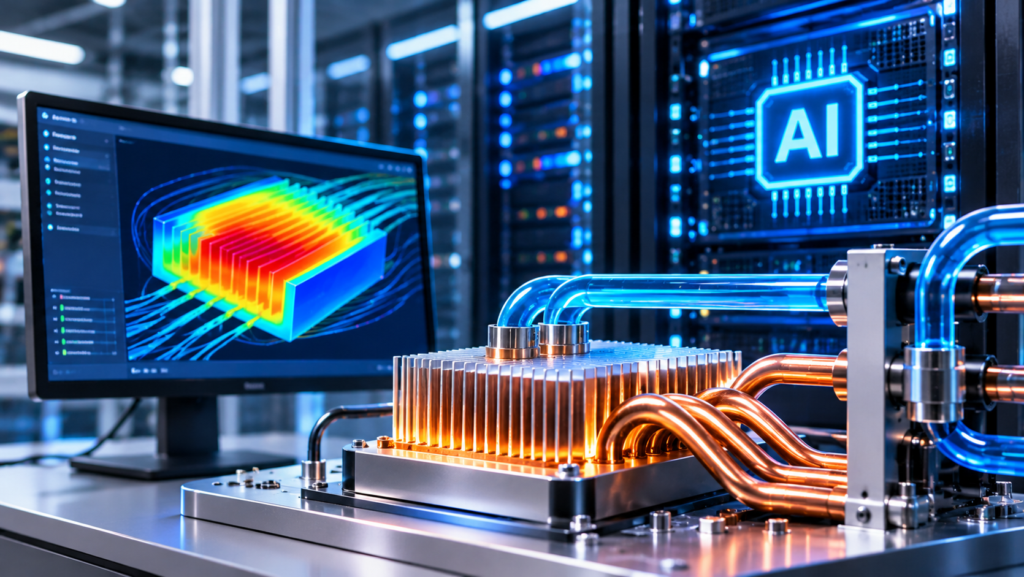
Mechanical engineer and researcher Diogo Perdigão works at the intersection of advanced cooling, AI infrastructure, and the energy transition.
Diogo Perdigão is an engineer shaped by a simple conviction: the technologies that define this decade, from artificial intelligence to electric mobility, are only as good as their ability to stay cool. A mechanical engineer and researcher at the University of Minho in Portugal, Diogo specializes in thermal management for high-power electronics and batteries. Combining peer-reviewed research with hands-on experience in the energy sector, he stands out as a professional positioned to connect cooling innovation with real-world deployment.
The Heat Behind the AI Boom
Every AI query, from a chatbot answer to a generated image, ends as heat inside a chip. The processors that train and run large AI models are among the most power-dense devices ever built, and each new generation packs more computing, and more heat, into less space. If that heat is not removed fast enough, chips throttle themselves to avoid damage, and expensive hardware runs below its full capacity. The scale of the challenge is growing quickly. According to the 2024 United States Data Center Energy Usage Report [1], prepared by Lawrence Berkeley National Laboratory for the U.S. Department of Energy, data centers consumed about 4.4% of all U.S. electricity in 2023, a share that could reach between 6.7% and 12% by 2028. The same report estimates that U.S. data centers directly used around 17 billion gallons of water in 2023, much of it for cooling. “People talk about AI in terms of chips and algorithms, but in practice, much of it comes down to thermal engineering,” says Diogo. “If you can’t take the heat out efficiently, you can’t use the computing power you’ve paid for, and you spend more electricity and water just keeping the hardware alive.”
A Research Career Focused on Cooling
Diogo’s path into thermal engineering began at the University of Minho, where he studied mechanical engineering with a focus on energy and environmental technologies. He went on to conduct research at the university’s Mechanical Engineering and Resource Sustainability Center (MEtRICs). His work centers on liquid cooling, the approach the industry is increasingly adopting as traditional air cooling reaches its physical limits. In liquid-cooled systems, coolant flows through cold plates mounted directly on processors, picking up heat through networks of tiny channels, often thinner than a millimeter. The design of those channels, and the materials they are made from, determine how much heat is removed, how evenly a chip is cooled, and how much energy the system consumes. Diogo’s research on these questions has been published in international peer-reviewed journals by Elsevier, one of the world’s leading scientific publishers. His work spans microchannel heat sink design for high-heat-flux electronics and lightweight, low-cost heat exchangers made from polymer composites enhanced with recycled graphite, an approach that points toward cheaper and more sustainable cooling components. The same principles extend beyond data centers. Batteries in electric vehicles and electric aircraft face a similar challenge: when they overheat, they lose performance, wear out faster, and can become unsafe. Battery thermal management is a second focus of Diogo’s research, with the goal of making batteries safer, longer-lasting, and faster to charge.
From the Lab to the Energy Sector
What sets Diogo apart is his ability to move between research and industry. Alongside his engineering work, he serves as a consultant at a global management consulting firm, working on projects in electricity, renewable energy, battery storage, and electric-vehicle charging. The role has given him a close view of how energy projects are planned, financed, and executed, and of what it takes for a new technology to move from a promising result to large-scale adoption. “A better solution in a paper only matters if it gets built into real facilities,” he says. “Companies need to see the numbers: how much energy, water, and capacity they gain. That’s the bridge I want to help build.” This dual perspective shapes how he approaches cooling challenges. Rather than treating thermal performance in isolation, Diogo weighs it alongside cost, energy use, and practical implementation, the factors that ultimately determine whether data center operators and manufacturers adopt a new solution.
Why Better Cooling Matters
The benefits of better thermal management reach well beyond any single industry. In electric vehicles, batteries that stay within their ideal temperature range can charge faster, last longer, and deliver more usable range. In electric aviation and defense, where every kilogram counts, lighter and more effective cooling makes it possible to power aircraft, drones, and advanced electronic systems that would otherwise overheat. And in data centers, more efficient cooling means more computing from the same hardware while using less electricity and water, reducing the environmental footprint of the AI boom. The same engineering principles could also apply to other technologies where heat limits performance. Solar panels lose efficiency as they heat up, so better cooling can increase the electricity they produce. Nuclear and conventional power plants depend on heat exchangers to operate safely and efficiently, and heating, ventilation, and air-conditioning (HVAC) systems, among the largest energy users in buildings, stand to benefit from more compact and efficient heat transfer. “Heat is a common bottleneck across almost every energy technology,” says Diogo. “Improving how we move it has a multiplier effect, from the car you drive to the power plant that charges it.”
Looking Ahead
As AI chips grow more powerful and electrification accelerates, Diogo sees thermal management becoming one of the defining engineering challenges of the coming decade. His goal is to help make advanced liquid cooling standard practice in data centers and battery systems, so that operators can get more computing power and better battery performance out of the same infrastructure, with less electricity and water. “The question is no longer only how much computing we can build, but how much of it we can keep cool,” Diogo says. “That’s where I want to make a difference.”