
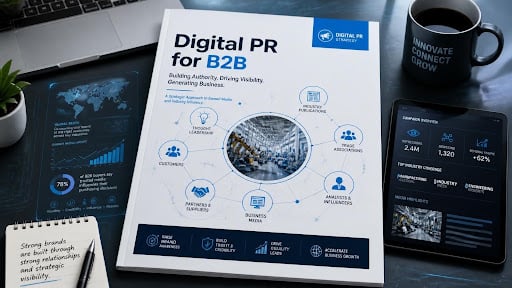
A factory can spend years perfecting its product and still be invisible online. Procurement managers and engineers don’t hunt for suppliers on lifestyle sites. They read trade magazines, association newsletters and technical resource pages. If none of those mention your company, search engines have little reason to trust you either.
That’s the gap digital PR for B2B is meant to close. This article walks through how a manufacturer can earn links from the places its buyers actually read, using an illustrative scenario. It’s a composite example built to show the process, not a report on a named client, so you won’t find invented numbers here.
What Is Digital PR for B2B?
Digital PR for B2B is the practice of getting a company mentioned and linked by trusted industry websites, such as trade publications, associations and professional bodies, by giving journalists and editors something genuinely worth covering. It’s earned, not bought: the link exists because the story was useful.
The output is usually a mix of coverage, expert quotes and references to original data. Each one can carry a link back to the company’s site, and each one tells search engines the business is recognised by people in its field.
Why Manufacturers Struggle to Earn Links
Manufacturers tend to have two problems. First, their websites are catalogues. Product pages are useful to a buyer who already knows what they want, but nobody links to a spec sheet. Second, the people with real knowledge, the plant managers and engineers, are busy running production, not writing for the press.
So the expertise stays locked inside the factory. Digital PR is mostly about getting it out in a form that editors can use.
An Illustrative Scenario: A Packaging Manufacturer Starting From Zero
Picture a mid-sized Malaysian manufacturer of industrial packaging. It sells to other businesses, has a decent product range, and a website that almost no one links to. Here’s how a sensible digital PR effort could unfold.
Step 1: Find The Story That Already Exists
Before creating anything, the team interviews its own people. What do the production leads see that outsiders don’t? Maybe it’s how export documentation requirements are changing packaging specs, or how a switch to recyclable materials affected lead times.
Editors rarely want to hear “we make boxes.” They want a clear point of view on something their readers are dealing with right now. The best angles usually come from problems the company has already solved internally.
Step 2: Turn It Into One Solid Asset
Instead of ten thin blog posts, the company builds one thing worth citing. For example, a short practical guide on packaging choices for exporters, with a checklist and a few original observations from its own operations.
If the company can survey its customers or summarise its own anonymised order data, even better. Original data is the most linkable thing a manufacturer can publish, because journalists can’t get it anywhere else. It has to be real and defensible, though. If you can’t show where a number came from, leave it out.
Step 3: Pitch The Right People, Not Everyone
Mass emails to a thousand editors rarely work. A short, relevant pitch to a handful of the right people does. For this manufacturer, that list might include:
- Editors and contributors at trade and business publications covering manufacturing and logistics
- Industry associations that publish member news and resources
- Universities or technical institutes with engineering or supply chain departments that maintain resource pages
- Writers at niche blogs and newsletters read by procurement teams
Each pitch leads with what’s in it for the editor’s readers, includes one clear fact or quote, and offers an expert for comment. The company isn’t asking for a link. It’s offering a useful source, and the link follows when the piece runs.
Step 4: Follow Up And Track What Lands
Digital PR is slow. Most pitches get no reply, and that’s normal. A polite follow-up a few days later catches many that were simply buried. When coverage does appear, the team checks that the link points to the right page, not just the homepage, and logs it.
The realistic outcome of a campaign like this isn’t a flood of links. It’s a handful of relevant ones from sites its buyers already trust, such as an association news page, a trade publication article and a university resource list. A few of those are worth more than dozens of random directory listings.
Where Do Industry Links Actually Come From?
| Source type | What they usually want | Good angle for a manufacturer |
| Trade publications | Timely, expert commentary | A view on regulation, materials or supply chain shifts |
| Industry associations | Member news and useful resources | Case notes, event participation, practical guides |
| Universities and institutes | Reliable reference material | Technical explainers, data, internship or research links |
| Niche newsletters and blogs | Original, specific insight | Short expert opinions, checklists |
| Local business media | Local relevance | Expansion, hiring, export milestones |
Notice that none of these rely on a press release alone. Press releases have their place for genuine announcements, but links come from usefulness.
The manufacturer scenario describes an outreach method. A separate B2B client inventory shows what the reporting stage needs to verify.
Rankpage Case Study: How Rankpage Connected Paydibs’ Educational Content to Its Services
Rankpage planned Paydibs’ explanatory articles for payment research and separate service pages for merchants comparing providers. Keywords, headings and metadata were mapped to those page purposes, with internal links connecting useful explanations to relevant services.
This is a valuable part of a B2B content strategy: give readers something worth learning from, then make the commercial next step easy to find. A manufacturer can apply that same principle to technical guides and product pages.
Paydibs’ Ahrefs export contained 1,543 referring-domain rows in October 2026, 605 with at least one dofollow link. This provides link-profile context for a real B2B client; it is not evidence of a manufacturing PR campaign or specific coverage earned by Rankpage.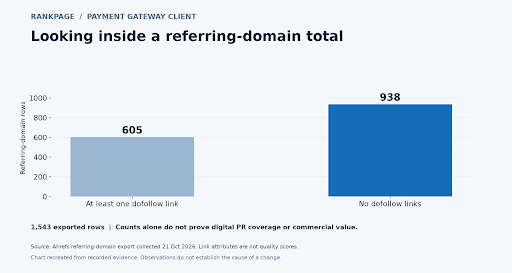
Figure: Referring-domain rows grouped by whether the export records at least one dofollow link.
Source: Rankpage client evidence: Paydibs Ahrefs referring-domain export, 21 October 2026. Outreach and placement attribution require separate records.
How Digital PR Fits Into a Wider Link Strategy
Digital PR is one tactic inside the larger discipline of B2B link building, which also covers guest contributions, link insertions into relevant existing articles and linkable assets. Rankpage’s service page lists digital PR and brand mentions alongside those options, which is a decent way to see how the pieces relate. The tactics work best together, with each one pointing authority at the pages that need to rank, not just the homepage.
Common Mistakes to Avoid
- Starting with the link, not the story. If you can’t explain why a reader would care, an editor won’t either.
- Publishing claims you can’t back up. One unverifiable statistic can sink your credibility with a journalist for good.
- Pitching widely and generically. Irrelevant pitches get ignored and can get you blocked.
- Pointing every link at the homepage. Product and solution pages are usually where the ranking gains are needed.
- Expecting results in a few weeks. Coverage takes time to earn, and ranking effects take longer to show.
- Buying links and calling it PR. Paid placements and low-quality networks carry risk. Real editorial coverage is the safer route.
FAQs
What is the difference between digital PR and traditional PR?
Traditional PR focuses on brand awareness through media coverage. Digital PR has the same starting point but also aims for coverage that links to your website, so the work supports both reputation and search visibility.
Does digital PR work for small manufacturers?
Yes, if you have real expertise or data to share. Smaller companies often do better with a narrow niche angle than with broad national coverage, because trade editors value specific, practical knowledge.
How long does digital PR take to show results?
Expect several months. Pitching, waiting for editorial calendars and then seeing search engines recognise new links all take time. Early signs are usually coverage and referral visits, with ranking improvements following later.
Are links from industry associations valuable?
They can be. A link from a respected association is relevant to your sector, and it’s the type of mention buyers trust. Relevance usually matters more than raw site size.
Can I do B2B digital PR in-house?
You can, particularly if someone on the team can write and pitch. Many manufacturers bring in outside help for outreach and tracking, while the engineers supply the expertise.
Where to Start With Digital PR for B2B
If you’re a manufacturer, start small. Pick one problem your team has solved, back it with something you can prove, and pitch it to five relevant editors. Learn what gets replies, then repeat.
If you’d rather have specialists handle the outreach, Rankpage Malaysia is a local SEO agency that offers link building as part of its wider search work. Either way, the principle is the same: earn mentions from people your buyers already trust, and the search results tend to follow.