
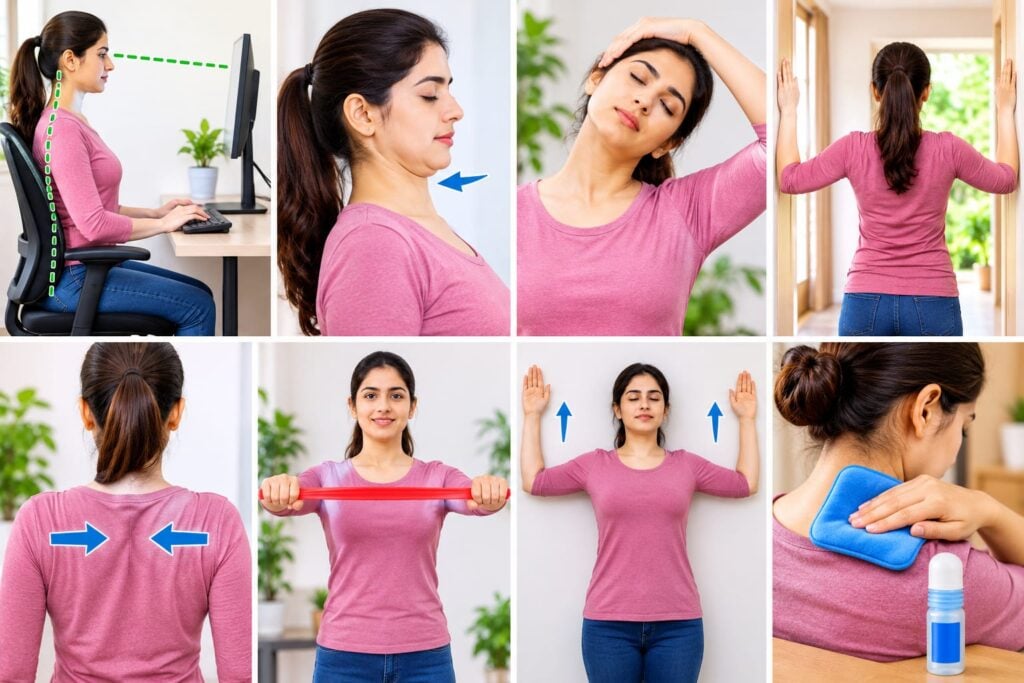
Desk job neck and shoulder stiffness is tightness in the muscles that hold your head up at a screen. You can ease it by raising your screen, moving your keyboard closer, and taking regular breaks. Three stretches, one strength routine, and heat or a topical rub finish the eight fixes. Mayo Clinic notes that neck pain from muscle strain often clears within a few days.
The problem is common. A 2016 study in the Indian Journal of Community Medicine looked at 441 desk workers. Of those, 43.3% had neck pain in the past year. Most of it comes from load. Spine surgeon Kenneth Hansraj found that a small head tilt can more than double the force on your neck.
Setup changes cost little. A stack of books can lift a laptop, and a phone timer can prompt you to stand up. Stretching has proof behind it, too. A 2018 trial in the Brazilian Journal of Physical Therapy tested this with 142 office workers. Regular stretching lowered their neck and shoulder pain scores. Numbness, arm weakness, or pain that lasts for weeks needs a doctor.
Why desk work causes neck and shoulder stiffness
Desk work stiffens your neck and shoulders because it holds them in one position for hours. Your head drifts forward toward the screen. Your shoulders round in as you reach for the keyboard. The muscles at the back of your neck stay switched on to hold your head up. So they tire and tighten.
Forward head posture adds weight fast. Hansraj’s 2014 model in Surgical Technology International shows how fast the load climbs with each degree of tilt.
| Head position | Forward tilt | Load on the neck |
|---|---|---|
| Upright and level | 0 degrees | 10 to 12 pounds |
| Slight tilt | 15 degrees | About 27 pounds |
| Moderate tilt | 30 degrees | About 40 pounds |
| Deep tilt | 45 degrees | About 49 pounds |
| Phone reading tilt | 60 degrees | About 60 pounds |
These figures come from a computer model, not live measurement. But the trend holds: the lower your head drops, the harder your neck works. Other common triggers add to the strain:
- Screens that sit too low or too far away
- Keyboards and mice placed out of reach, which lifts the shoulders
- Hours without standing up or changing position
- Stress, which makes many people shrug and clench without noticing
Your screen is the easiest place to start.
1. Raise your screen to eye level
Raising your screen to eye level is the fastest fix for a stiff neck at a desk. OSHA (the U.S. Occupational Safety and Health Administration) advises placing the top line of the screen at or slightly below eye level. The screen should sit 20 to 40 inches from your eyes, directly in front of you.
Laptops cause the most trouble because the screen and keyboard come as one unit. Put the laptop on a stand or a stack of books. Then plug in a separate keyboard and mouse. If you use two monitors, place the one you use most straight ahead.
Phones count too. Mayo Clinic advises holding small screens up at eye level instead of bending your neck to look down. Once the screen sits right, check how far you reach for your keyboard.
2. Bring your keyboard and mouse closer
Bringing your keyboard and mouse closer stops your shoulders from creeping up and forward. Keep your elbows close to your sides and bent at about 90 degrees. Your forearms should rest level with the desk. Your shoulders should hang loose, not lift toward your ears while you type.
Reaching even a few inches forward keeps the upper trapezius working. That’s the wide muscle that runs from your neck to the top of each shoulder. Over an 8 hour day, that small effort turns into real tightness.
Set your armrests at desk height so they take weight off your shoulders. If your chair is too low, raise it and add a footrest so your feet stay flat. Good setup still fails if you never move, though.
3. Take a movement break every 30 to 60 minutes
Movement breaks every 30 to 60 minutes give tired neck muscles a chance to reset. ATI Physical Therapy recommends standing or walking for a few minutes at that interval. Even a 2 minute walk to refill your water changes your posture. It also loosens muscles that have held still too long.
Sitting still has a cost. Mayo Clinic cites research on this. People who sit still for more than six hours a day are more likely to have neck pain. Simple ways to build in movement:
- Set a repeating timer on your phone or computer.
- Stand up for phone and video calls when you can.
- Walk to a coworker’s desk instead of sending a chat message.
- Keep a small water bottle, so you get up to refill it more often.
Use part of each break for the first stretch: the chin tuck.
4. Do chin tucks to reset your head
A chin tuck is a small move that pulls your head back over your shoulders. It wakes up the deep neck flexors. These small muscles at the front of your neck keep your head in line. They get weak when your head sits forward all day.
- Sit tall with your eyes level.
- Slide your chin straight back, as if making a double chin.
- Hold for 3 seconds, then relax.
- Repeat 10 times.
Keep your gaze forward. Don’t tip your chin down toward your chest. After the tuck, stretch the muscles on the sides of your neck.
5. Stretch the sides and back of your neck
Neck stretches loosen the upper trapezius and levator scapulae, the two muscles that feel tightest after desk work. The levator scapulae runs from the side of your neck to your shoulder blade. Mayo Clinic suggests three gentle moves. Hold each one for 15 to 30 seconds with your shoulders level.
- Chin to chest: lower your chin slowly until you feel a pull along the back of your neck.
- Head turn: turn your head to one side as if looking over your shoulder, then switch.
- Ear to shoulder: tilt your ear toward your shoulder without lifting that shoulder.
For a deeper stretch, hold the seat of your chair with the hand on the side you’re stretching. A stretch should feel like a mild pull, never a sharp pain.
A 2016 trial in Clinical Rehabilitation tested a similar routine. Office workers who stretched for four weeks had less pain and better neck function. The comparison group got ergonomics advice alone. Tight neck muscles often come with a tight chest, though.
6. Open your chest with a doorway stretch
A doorway stretch opens the chest muscles that pull your shoulders forward while you type. Tight pectoral (chest) muscles round your upper back. Your neck then strains to keep your eyes on the screen. Stretching the chest lets your shoulders settle back into a more natural position.
- Stand in a doorway with your forearms on the frame and elbows at shoulder height.
- Step one foot forward until you feel a stretch across your chest.
- Hold for 30 seconds while you breathe slowly.
- Repeat 3 times.
Do this one standing during your movement breaks. Stretching opens the front of your body, and strength work holds the back in place.
7. Strengthen your upper back
Upper back strength keeps your shoulders from sliding forward again after you stretch. The muscles between your shoulder blades pull your shoulders back and down. These include the rhomboids and the middle and lower trapezius. When they get stronger, your neck does less of the work of holding you upright.
- Shoulder blade squeeze: pull your shoulder blades back and down, hold for 5 seconds, and repeat 10 times.
- Band pull apart: hold a light resistance band at chest height and pull it wide. Do 2 sets of 12.
- Wall angel: stand with your back flat on a wall and slide your arms up and down 10 times.
Two or three short sessions a week build strength. A resistance band costs little and fits in a desk drawer. When muscles already feel sore, heat and topical relief help while these habits take hold.
8. Ease sore muscles with heat or topical relief
Heat and topical rubs ease sore, stiff muscles while your new habits take effect. A warm shower, a heat wrap, or a heating pad on a low setting relaxes tight muscles at home. At work, a topical product is the easier choice. It needs no cord, no setup, and no time away from your desk.
Topical pain relief products often contain menthol or camphor. The FDA classes both as counterirritants. These ingredients create a cooling feeling on the skin that takes your mind off the ache underneath. FDA rules allow menthol at 1.25% to 16% for this use.
Format matters at a desk. A muscle pain relief roll-on lets you apply the gel to the back of your neck without coating your fingers. That’s handy when you’re back on the keyboard a minute later. Always follow the label directions on any product you use.
When to see a doctor for a stiff neck
See a doctor if neck pain gets worse despite home care, lasts several weeks, or spreads down your arms. Mayo Clinic also lists headache, weakness, numbness, or tingling as reasons to call. Most mild to moderate neck pain improves within 2 to 3 weeks with simple care at home.
Get emergency care right away for these signs:
- Severe neck pain after a fall, car crash, or other injury
- A stiff neck with fever and a severe headache, which can signal meningitis
- Weakness or numbness that keeps getting worse
Frequently asked questions
Is heat or ice better for a stiff neck from sitting?
Heat is usually better for desk stiffness, while ice suits a fresh strain. Mayo Clinic advises ice for up to 15 minutes at a time in the first 48 hours. Heat takes over after that.
What is tech neck?
Tech neck is neck pain and stiffness from looking down at screens for long periods. Phones, tablets, and laptops pull the head forward, so neck muscles work harder to hold it up. Raising screens to eye level is the main fix.
Which muscles get stiff from sitting at a desk?
The upper trapezius, levator scapulae, and chest muscles tighten the most. The first two hold up your head and shoulders all day. Tight chest muscles pull your shoulders forward and round your upper back.
Do standing desks help with neck and shoulder stiffness?
A standing desk helps only if you switch positions often. Standing all day with a low screen strains your neck just as sitting does. Alternate between sitting and standing, and keep the screen at eye level in both.
Is it safe to use a topical pain reliever at work?
Yes, when you follow the label. Apply it only to unbroken skin, away from your eyes, and never under a heating pad or tight bandage. Stop and ask a doctor if symptoms last more than 7 days.
How often should I stretch at my desk?
Stretch a few times a day, ideally during each movement break. Hold each stretch for 15 to 30 seconds and repeat it 2 or 3 times per side. Short, regular sessions work better than one long session at night.
Can stress make your neck and shoulders tight?
Yes. Stress makes many people raise and tense their shoulders without noticing it. Slow breathing and dropping your shoulders on purpose during breaks can release that tension.
Your plan for a looser neck and shoulders
Neck and shoulder stiffness at a desk comes from holding your head forward for hours. That posture overloads the muscles that hold your head up. Start with your setup. Raise the screen to eye level and pull your keyboard and mouse close, so your shoulders can drop.
Then move every 30 to 60 minutes. Use those breaks for chin tucks, neck stretches, and a doorway stretch. Strengthen your upper back two or three times a week. When muscles feel sore, heat or a topical rub eases them while the eight fixes take hold. And if numbness, weakness, or spreading pain shows up, see a doctor.