

In supplemental health insurance, marketing is often run as a continuous, year-round broadcast. Providers of individual dental and vision plans maintain always-on campaigns across digital and direct channels in the hope of catching consumers whenever coverage crosses their minds. Yet for most households, supplemental benefits are not an impulse purchase; they are a decision triggered by specific shifts in life circumstances. Outside of those moments, persistent advertising is largely ignored, driving up acquisition costs while leaving conversion rates stagnant.
To illustrate how supplemental benefits providers can align marketing spend with actual consumer readiness, without touching sensitive medical records, Intent Logic has released a new case study examining how life-event and channel-preference signals can be used to increase completed enrollments. While the figures presented in the study are modeled projections from an illustrative scenario rather than reported results from a live client engagement, they demonstrate the mechanics and financial impact of pairing eligibility-based predictive modeling with privacy-first data governance.
The Disconnect Between Always-On Outreach and Coverage Decisions
Consider a typical provider of individual dental and vision plans advertising continuously throughout the year. Under a traditional broad-targeting approach, the organization delivers the same cadence of acquisition messaging to general consumer audiences regardless of timing. The structural flaw is straightforward: the vast majority of consumers only evaluate standalone dental or vision coverage when a concrete change in circumstances forces a decision, such as leaving an employer-sponsored plan, relocating to a new area, or reaching an age milestone that alters their eligibility. Reaching consumers outside those windows generates minimal engagement and wastes media and mailing budgets.
A second, equally costly inefficiency sits further down the acquisition funnel. Even when a marketing message reaches an eligible consumer at the right time, many prospects begin an online enrollment form and abandon it before completion. When follow-up outreach relies on generic reminders rather than individual communication preferences, providers end up paying acquisition costs twice: once to initiate the enrollment, and a second time to recover the abandoned application.
Closing both gaps requires reframing what marketing analytics is built to predict. Rather than trying to infer health needs or relying on broad demographic targeting, the analytical challenge is twofold: identifying when a consumer has entered an active eligibility window, and determining the right channel and timing to help them finish the enrollment once they start.
Six Non-Medical Data Signals That Identify Eligibility and Intent
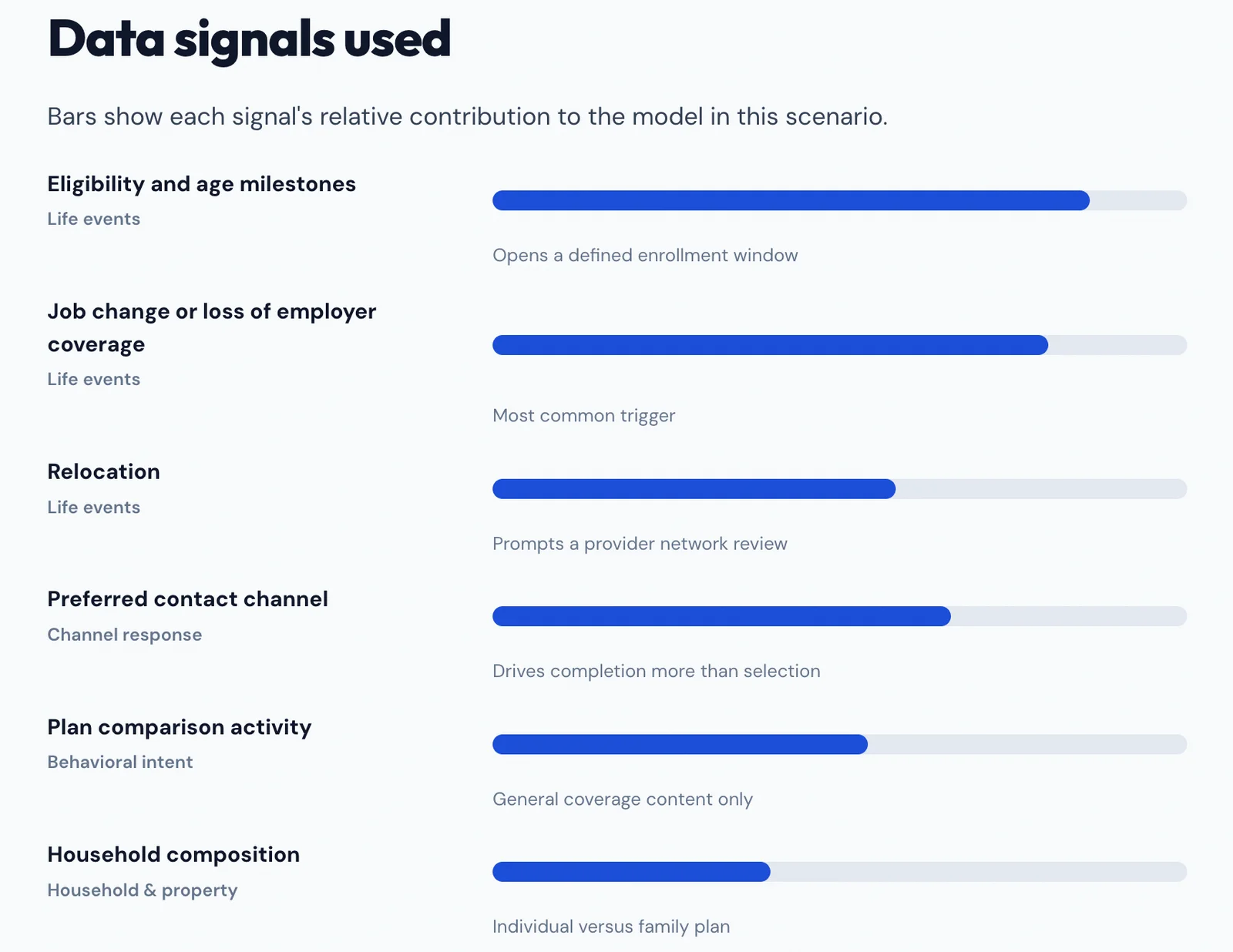
To separate consumers in an active coverage window from the broader population without using protected health information, analysts rely on life transitions, household structure, general behavioral cues, and communication history. In this modeled scenario, six primary data signals power the predictive framework:
- Eligibility and Age Milestones (Life Events): Reaching specific age thresholds opens a defined enrollment window, serving as a clear, time-bound indicator that a consumer may be aging off a parent’s plan or reassessing supplemental coverage options.
- Job Change or Loss of Employer Coverage (Life Events): Transitioning between employers or leaving a group benefits plan is the single most common trigger prompting consumers to seek individual dental and vision coverage.
- Relocation (Life Events): Moving to a new city or state frequently prompts households to review local provider networks and evaluate whether their current supplemental coverage still fits their needs.
- Preferred Contact Channel (Channel Response): Historical engagement across outreach channels indicates how and when a consumer is most likely to respond. Crucially, this signal drives enrollment completion more than initial plan selection.
- Plan Comparison Activity (Behavioral Intent): Engagement with general coverage content and plan comparison tools signals active shopping. To preserve consumer privacy, this signal is strictly limited to general coverage research rather than condition-specific browsing.
- Household Composition (Household & Property): Understanding whether a consumer is shopping for an individual policy or a family plan helps tailor messaging relevance and estimate coverage needs.
A Five-Step Privacy-First Modeling Approach
Rather than collapsing awareness, eligibility, and form completion into a single generic propensity score, the methodology outlined by Intent Logic establishes strict data exclusions upfront and separates the decision window from the completion journey.
- Define What Is Excluded Before any modeling begins, medical records, diagnosis data, and condition-related browsing history are explicitly ruled out as candidate inputs. The entire framework is engineered exclusively from eligibility indicators, life-event triggers, general coverage research, and consented contact signals.
- Detect the Window A primary classification model analyzes life-event and household signals to identify consumers who have recently entered, or are about to enter, a defined window in which a dental or vision coverage decision is likely.
- Score Completion Separately A second predictive model operates further down the funnel, estimating the probability that a consumer who starts an enrollment form will finish it, and identifying which specific follow-up channel is most effective at guiding them across the finish line.
- Match Channel to Person Instead of blasting uniform reminders across every available touchpoint, each consumer is contacted through the specific channel and at the time of day they have historically responded to, strictly within their recorded consent preferences.
- Test Incrementally To verify that the modeling produces genuine business lift rather than taking credit for organic sign-ups, a randomly selected control group within each segment is withheld from outreach. Comparing completed enrollments between contacted consumers and these holdout groups isolates the true incremental impact of the campaign.
Model Output: How the Score Separates the Audience
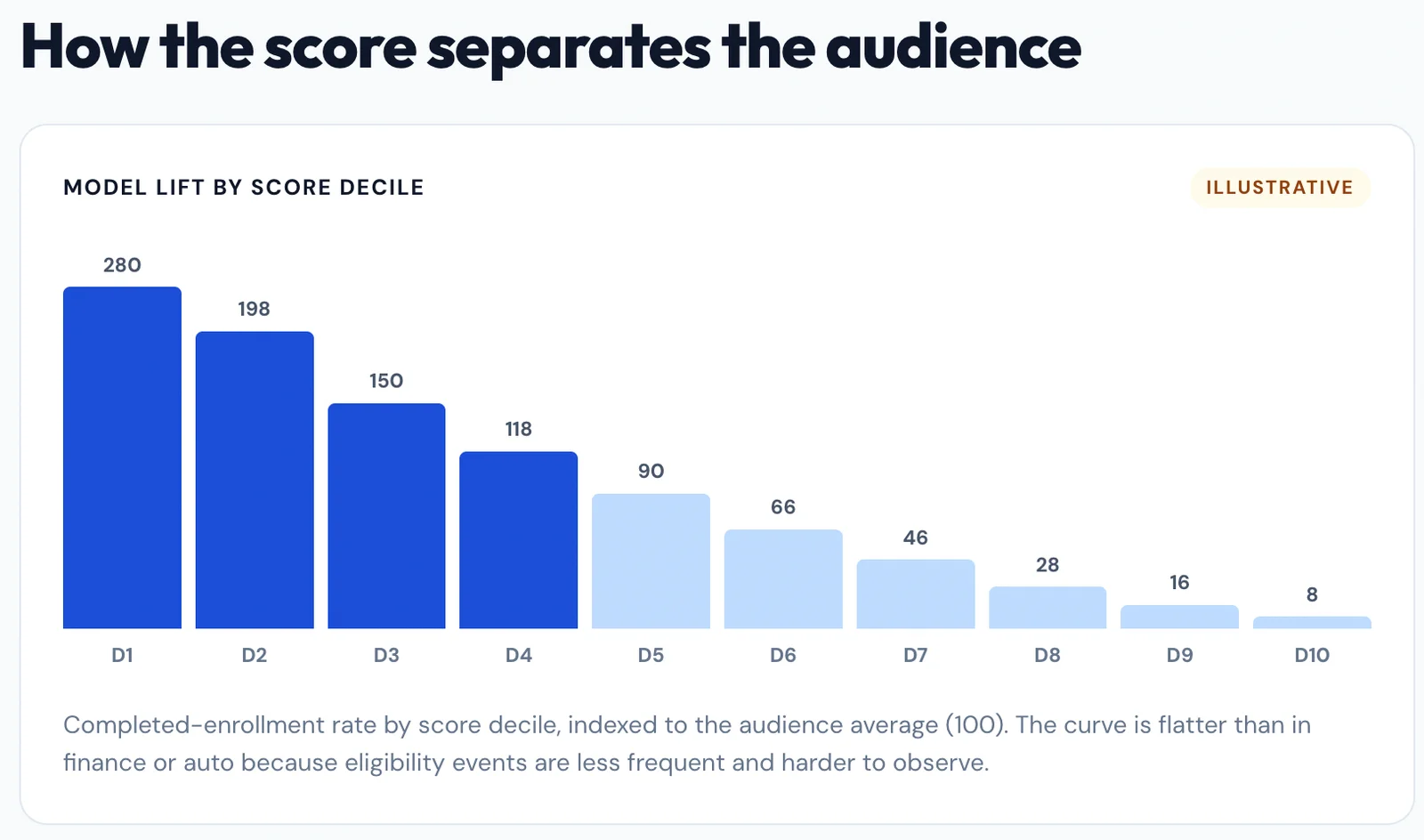
When the addressable audience is ranked by the predictive model and divided into ten equal deciles, from the highest-scoring consumers in Decile 1 (D1) to the lowest-scoring in Decile 10 (D10), the concentration of completed enrollments becomes clear. Indexed against an overall audience average of 100, the top decile converts to completed enrollments at nearly three times the baseline rate, while the bottom tiers produce minimal return.
Completed-enrollment rate index by score decile, with the audience average set at 100:
- D1: index of 280
- D2: index of 198
- D3: index of 150
- D4: index of 118
- D5: index of 90
- D6: index of 66
- D7: index of 46
- D8: index of 28
- D9: index of 16
- D10: index of 8
In this modeled distribution, the lift curve is naturally flatter than those typically observed in retail banking or automotive lending, because health-plan eligibility events occur less frequently and are harder to observe directly. Even so, the separation remains decisive: the top two deciles (D1 and D2) account for nearly half of all completed enrollments across the entire audience, while the bottom four deciles (D7 through D10) index between 8 and 46; meaning a provider marketing to D10 expends full acquisition resources for less than one-tenth of the average enrollment return.
Modeled Outcomes: What Changes When Budget Follows the Score
Shifting marketing capital away from always-on broad targeting toward consumers in active eligibility windows, and pairing that timing with individualized channel follow-up, improves both acquisition efficiency and funnel completion.
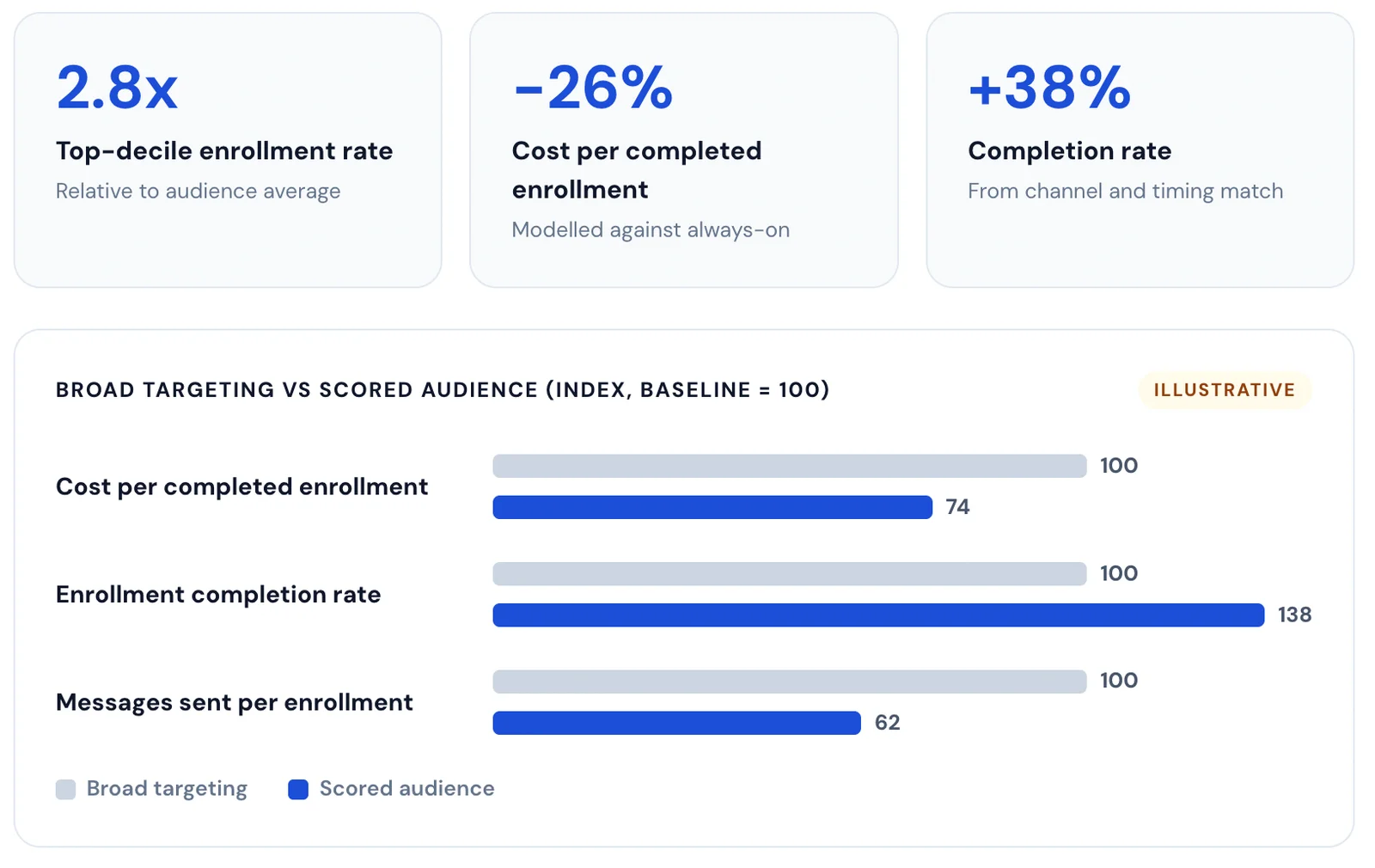
Measured against an always-on baseline, the modeled scenario produces three headline improvements:
- 2.8x Top-Decile Enrollment Rate: Consumers in D1 complete enrollments at 2.8 times the rate of the general audience average.
- 26% Reduction in Cost per Completed Enrollment: Focusing outreach on households experiencing qualifying life events eliminates wasted spend on consumers who have no immediate reason to switch or buy coverage.
- 38% Increase in Enrollment Completion Rate: Matching follow-up reminders to each consumer’s preferred channel and response timing significantly reduces form abandonment.
Indexed to a broad-targeting baseline of 100, the operational contrast across the enrollment funnel highlights how upstream timing and downstream channel matching reinforce each other:
- Cost per completed enrollment: 74 for the scored audience against a broad-targeting baseline of 100, a 26% reduction.
- Enrollment completion rate: 138 for the scored audience against a broad-targeting baseline of 100, a 38% increase.
- Messages sent per enrollment: 62 for the scored audience against a broad-targeting baseline of 100, a 38% reduction.
By cutting the volume of messages required per completed enrollment by 38 percent, the provider reduces consumer fatigue, lowers campaign delivery expenses, and avoids the double-spending cycle of chasing abandoned applications with ineffective follow-ups.
Governance, Data, and Compliance Safeguards
In health and wellness marketing, predictive precision cannot come at the expense of consumer privacy or regulatory compliance. Deploying life-event and behavioral models in the supplemental benefits sector requires strict, built-in governance controls:
- No Protected Health Information or Medical Records Used: Clinical records, claims data, and protected health information are excluded entirely from the data pipeline before feature engineering begins.
- No Inference of Individual Medical Conditions: Models are designed strictly around eligibility and life transitions, prohibiting any algorithmic inference of a consumer’s underlying health status or medical diagnoses.
- Contact Limited to Consented Channels: Outreach sequencing and channel-matching rules operate strictly within documented consumer opt-ins and communication preferences.
- Sensitive Segments Reviewed Before Activation: All audience definitions and model segments undergo formal compliance review prior to campaign deployment to ensure responsible targeting.
Strategic Implications for Supplemental Benefits Marketing
The central takeaway for health and supplemental benefits marketers is clear: in healthcare, the useful signal is eligibility, not diagnosis. Effective acquisition does not require intrusive clinical data or speculative inferences about a consumer’s health.
By focusing predictive analytics on observable life events, such as job transitions, relocations, and age milestones, and combining those timing signals with respectful, channel-matched follow-up, dental and vision providers can reduce wasted ad spend, recover abandoned enrollments, and drive measurable growth while maintaining strict boundaries around sensitive personal information.
Read the full case study at https://intentlogic.com/case-studies/dental-vision-enrollment
About IntentLogic
IntentLogic, operated by Intent Logic LLC, is a data science and precision marketing company. Its proprietary IRIS system analyzes a database of more than 245 million consumer profiles to identify high-value prospects and predict engagement strategies. The company runs coordinated campaigns across email, SMS, push, in-app, paid media, web, WhatsApp, and audio. IntentLogic serves brands in financial services, automotive, health and wellness, insurance, retail and e-commerce, and education, with a focus on precise targeting, measurable outcomes, and predictable growth.