
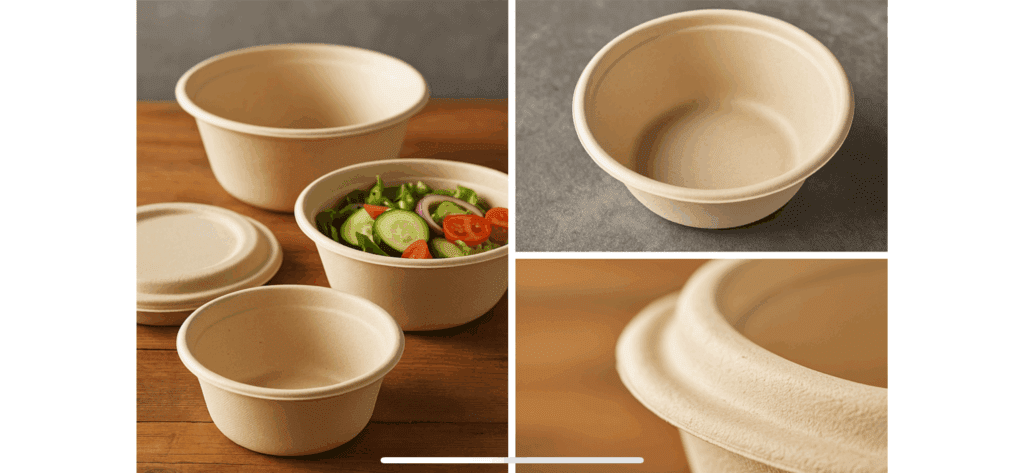
“Why does my disposable bowl feel like it’s made of paper, yet hold hot soup without leaking?”
That was the question a food-tech startup founder asked during a café pop-up in San Francisco. The vendor laughed and replied: “It’s not paper — it’s bagasse.” That short exchange encapsulates how many perceive biodegradable tableware: familiar but misunderstood.
In this article, we dissect the material science and design styles behind sugarcane bagasse bowls and related products — exploring how thickness, coating, lid-fit, fiber orientation, and style variants influence performance. We use real-world examples and data to explain why certain design decisions matter more than they seem.
We also present a case study of a food-delivery brand that switched to bagasse bowls, and the measurable effects on brand perception, waste streams, and customer experience.
What Is Bagasse and Why It Matters
Bagasse is the fibrous residue left after sugarcane stalks are crushed to extract juice. Rather than burning or discarding it, modern techniques turn it into molded tableware.
Key Material Characteristics
- High cellulose fiber content & long strands — yields good tensile strength and stiffness
- Porosity and capillarity — drives liquid absorption unless sealed properly
- Thermal tolerance — standard bagasse bowls can handle hot food (e.g. 90–95 °C) under short exposure
- Biodegradability & compostability — breaks down under industrial conditions (90–180 days)
According to recent market reports, the global sugarcane-based packaging market (plates, bowls, trays etc.) was valued at about USD 293.7 million in 2024, and is projected to grow at a CAGR of 6.6% through 2034. The bowls & plates segment is a primary driver of that growth.
Also, the global bagasse tableware market is forecast to expand substantially, supported by consumer preference shifts and regulatory pressure on plastic use.
This strong growth underscores how critical material and style innovation has become — not just for performance, but also for cost, branding, and sustainability.
Variant Styles of Bagasse Bowls: What Differences Do They Bring?
When suppliers and brands speak of “bagasse bowls,” that umbrella term hides many design choices. Below are key style variables and trade-offs:
1. Raw vs. Coated / Lined Bowls
- Raw Bagasse bowls are untreated, fully fiber-exposed. They’re highly compostable but may leak or soften with long-hold liquids.
- Coated / lined bowls use a thin PLA film, aqueous seal, or wax to block absorption and improve shelf life. The trade-off: slightly slower biodegradation under sub-optimal compost conditions.
To see one example of a classic variant, visit this biodegradable bagasse bowl model offered by Bioleader.
2. Depth, Rim Geometry, and Wall Thickness
- Deep bowls (e.g. 70 mm+) reduce splashing but demand more material and may cost more.
- Wide-rim variants allow for better lid sealing and finger grip.
- Thickness gradients (thicker base, thinner walls) optimize strength where needed while minimizing weight.
3. Lid Compatibility & Stackability
A good bagasse bowl with lid pairing ensures steam venting while preventing leaks. Lid-fit tolerances and stacking geometry are essential for logistics, delivery, and storage efficiency.
Bioleader offers a well-engineered bagasse bowl with lid line that demonstrates how fit and finish matter in mass deployment.
4. Surface Texture & Aesthetic Finishes
Some bowls include embossed patterns, wave textures, or slightly colored blends to elevate perceived quality. While decorative, these must not impede compostability or food safety.
5. Hybrid Blends / Fiber Mixtures
To improve durability or stiffness, some manufacturers mix bagasse fiber with bamboo, wheat straw, or other plant fibers. These blends can offer improved strength or moisture resistance, albeit with different composting kinetics.
Case Analytics: A Cloud Kitchen’s Switch to Bagasse Bowls
In late 2024, a Southeast Asia–based cloud kitchen group (six brands, ten kitchens) decided to transition all their disposable bowls for soups, broths, and rice bowls to bagasse-based alternatives (with lids).
Their selection criteria emphasized:
- Heat retention (≥ 80 °C)
- Non-leak performance over 45 minutes delivery time
- Lid-seal reliability
- Cost within +10% of current plastic bowls
- Certified compostability under EN13432
They evaluated several Bioleader models, including paper pulp bowls variants and compostable fiber bowls.
Pilot Results (3 months)
| Metric | Before (Plastic / EPS) | After (Bagasse) | Change |
| Monthly plastic waste | 1,800 kg | ~460 kg | –74% |
| Customer complaints about leaks | 14/month | 3/month | –79% |
| Lid detachment in transit | 9/month | 1/month | –89% |
| Cost premium | baseline | +7% | — |
| Social media mentions (eco) | baseline | +23% | +23% |
Key observations:
- The bowls with moderate coating performed best in hot soups over time.
- Some raw bowls softened under extended moisture exposure; thus hybrid or coated variants were favored.
- Consumer feedback frequently cited the “earthy look” and brand impression of sustainability.
- As the brand advertised the compostable switch, they saw a 15% uplift in new customers citing “eco-friendly packaging” as a reason.
This case demonstrates how thoughtful material/style choices can convert sustainable intent into business gains.
Material & Style Trade-offs: What to Prioritize
When choosing or designing bagasse bowls, brands should consider:
- Compostability vs. Durability
- More coating or hybrid blending increases strength but can slow breakdown in marginal compost conditions.
- Thermal & Liquid Performance
- For broths and soups, choose thicker bases and better seal geometry.
- Logistics Efficiency
- Stackability and lid nesting impact storage and transport cost significantly.
- Brand Aesthetics
- Texture, color, embossing can influence consumer perception — but should not compromise food safety or compostability.
A strong supplier should offer a portfolio of disposable sugarcane bowls, compostable fiber bowls, and custom lid-system designs. For reference, see disposable sugarcane bowls in Bioleader’s showroom.
Also, their line of compostable fiber bowls illustrates how fiber blends are being used for specialized applications.
Market Insights & Future Trends
- The bagasse bowls market is projected to grow strongly: the bagasse bowls market alone was valued around USD 1.7 billion in 2025 and may reach USD 3.1 billion by 2035 (CAGR ~6.4%).
- The broader bagasse tableware product market is expected to expand at ~10.1% CAGR through 2035.
- Overall compostable tableware revenue is forecast to rise from ~USD 11 billion (2024) to ~USD 17.4 billion by 2034.
- In mature markets, consumer transparency and compliance labeling (e.g. certification logos) will differentiate trusted brands from greenwashing.
- Emerging R&D focuses include:
- Nanocoatings that dissolve in compost
- Integrated vent-lid systems
- Smart compost-tracking QR codes molded in
FAQ
- Are bagasse bowls microwave-safe?
Yes, most are microwave-safe for brief reheats (≤ 2 minutes). But avoid prolonged exposure (> 5 minutes) or dry-heating. - Do coated bagasse bowls still biodegrade?
Yes — coatings like PLA or aqueous films degrade in industrial composting settings, though possibly slower than raw variants. - Can consumers compost these at home?
Home composting may not reach necessary heat; industrial or municipal composting is preferred for full breakdown. - Are bagasse bowls strong enough for liquids like soup?
Properly designed bowls with good base thickness and seal geometry can handle hot liquids for 30–60 minutes with low leakage. - How much more expensive are they compared to plastic bowls?
In our case study, the premium was ~7%, but reduced waste costs and brand uplift often offset that margin.