
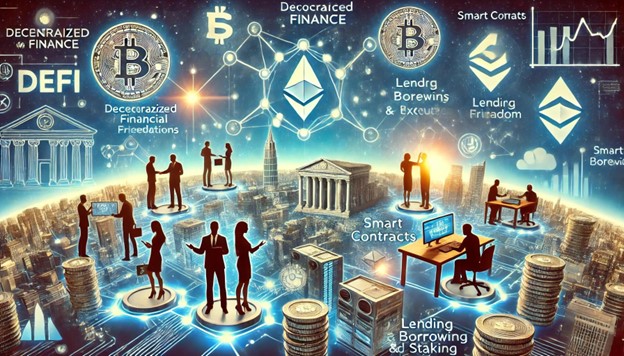
In the traditional world of finance, banking, stock exchanges, and insurance companies have their foothold. The software sector is experiencing a similar kind of change, though, and the financial sector is no exception. This revolution centred around Decentralized Finance (DeFi) is building a new way of thinking about money, transactional systems, and how we use and provide financial services.
A new decentralized financial movement, DeFi, is rising and transforming financial services using blockchain technology. Most Defi platforms allow people to use financial services, such as lending, borrowing, trading, and investing, without losing control of their assets by using smart contracts and decentralized networks.
Understanding DeFi
DeFi is fundamentally created to democratize financial services so that we do not need to involve traditional financial intermediaries. By using blockchain networks, mostly based on Ethereum, decentralized applications (dApps) are created. Some of the dApps these offer are decentralized exchanges (DEX) and decentralized lending platforms where people can borrow money without a central bank’s involvement.
While DeFi is yet to be mainstream, it has differentiated itself from traditional systems with the ability to have users have total control over their funds, as opposed to banks and other intermediaries running the show. That’s why so many people see DeFi as the next frontier to achieving true financial freedom: this self-sovereignty.
Benefits of Decentralized Finance (DeFi)
- Accessibility: All are open to anyone with an internet connection. Users can now access financial services because we don’t necessarily need to meet strict criteria like where we live, how much money we make or even what our credit scores are. It brings thousands worldwide from under the proverbial financial system with few hopes and options.
- Lower Costs: Because DeFi removes the middlemen, transaction fees are often much lower than those of traditional financial services. That’s why DeFi appeals to people and businesses wanting to minimise expenses.
- Transparency: DeFi platforms have a record of all activities made on the blockchain and are transparent and immutable. This provides a trustless environment where users can verify the system’s integrity with this level of transparency.
- Security: DeFi platforms rely on blockchain’s core security traits like encryption and decentralized validation to secure user data and assets. Though there is ris,k like in smart contracts, DeFi is much more secure than its counterpart.
- Innovation: The DeFi ecosystem is functional and growing constantly. In addition to yield farming and liquidity mining, DeFi is chock full of novel products that allow users to earn rewards and expand their wealth in innovative ways.
Challenges and Risks
DeFi, like any other technology, has disadvantages. Because it’s decentralized, the whole process happens through decentralized networks, so there’s no need for a central authority for dispute resolution or fraud. Smart contract vulnerabilities, hacking, and regulatory uncertainty are still issues with the technology, which is in its infancy.
Despite these flaws, which haven’t gone unnoticed as both DeFi grow, the developers are proposing solutions such as insurance protocols, security auditors, and a simple user interface so that DeFi is as easy and safe as possible to use on a daily basis.
The Future of DeFi
Despite the hurdles, DeFi’s future looks quite bright. With more and more institutions and people willing to enter the blockchain and cryptocurrency tech space, there’s still plenty of room for DeFi to grow. As infrastructure continues to grow, regulatory frameworks become clearer, and participation in such DeFi platforms increases, the dream of financial freedom for all becomes true.
So, to keep abreast of blockchain and DeFi world news, you must follow reliable sources for truth and the most accurate information. Let’s take Blockchain News as an example; this is an excellent news source for DeFi news as it provides a comprehensive insight into the DeFi sector while also disclosing innovations in the industry.
Final Thoughts
However, for the first time, we see money from a decentralized perspective, bringing financial sovereignty and empowerment. Using blockchain tech, DeFi is bringing down intermediaries while eliminating them and creating a more open and transparent financial system. There is plenty of work to do, but DeFi has the potential to bring a game-changing system to the world of finance and the next frontier of financial freedom.