
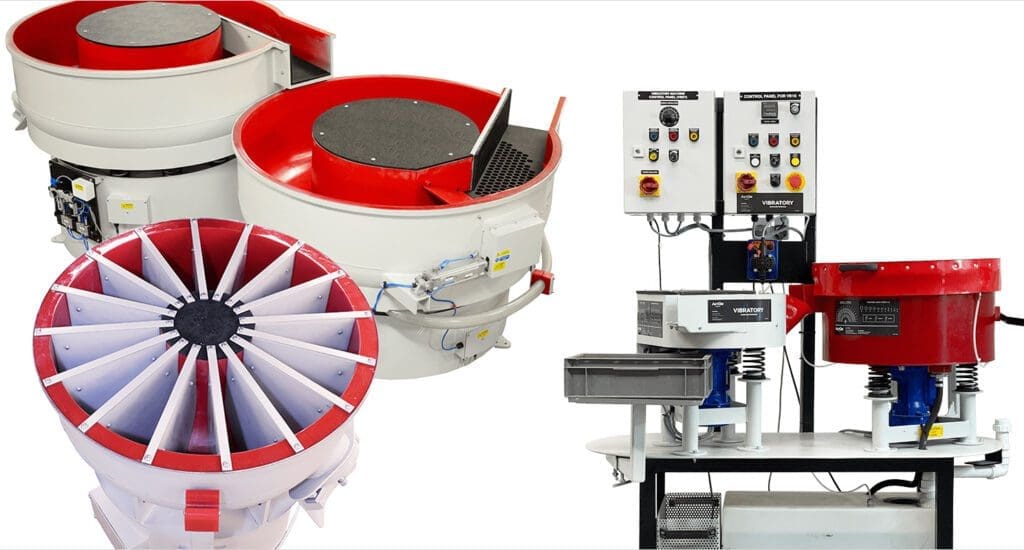
Metal finishing decisions are rarely made in isolation. In high-volume manufacturing, finishing sits at the intersection of quality, safety, and throughput. A choice that appears minor—such as whether to deburr, polish, or plate—can shape how reliably parts move through inspection, assembly, and delivery. As production scales, these choices become harder to revisit because finishing processes tend to anchor downstream expectations.
Manufacturers often inherit finishing methods from earlier production stages, legacy suppliers, or historical standards. Over time, part designs evolve, volumes increase, and tolerance for variability decreases. What once worked adequately can begin to introduce subtle constraints. Understanding how different vibratory finishing approaches serve different operational goals is essential for making decisions that support consistency rather than create hidden friction.
Vibratory finishing as a decision framework, not a single solution
Vibratory finishing is best understood as a category of processes rather than a single technique. All vibratory systems rely on controlled motion to bring parts into repeated contact with media and compounds. The purpose of that interaction, however, varies widely. Some processes focus on removing material, others on smoothing surfaces, and others on preparing parts for functional or protective coatings.
In a Vibratory Plating Services overview context, manufacturers are typically deciding how surface treatment fits into a broader production system. The choice between deburring, polishing, or plating is not about which process is “better,” but about which outcome best supports downstream reliability.
Why manufacturers struggle with this choice
The challenge arises because finishing outcomes are often evaluated visually or locally, rather than system-wide.
- A part may look acceptable but behave unpredictably in assembly
- Inspection standards may pass surface variation that still affects handling
- Throughput loss appears downstream, far from the finishing operation
This disconnect makes it difficult to trace operational issues back to finishing decisions.
Deburring: removing risk and restoring basic usability
Deburring is often the first vibratory process manufacturers consider. Its primary purpose is to remove sharp edges, burrs, and residual material left by machining, stamping, or forming. In many operations, deburring is treated as a safety or compliance step rather than a productivity one.
From an operational standpoint, deburring establishes a baseline condition that allows parts to be handled safely and consistently.
When deburring is the right vibratory choice
Deburring is most appropriate when surface condition affects handling more than appearance or functional performance.
- Parts move frequently between stations
- Manual loading or assembly is required
- Edge-related injuries or damage have occurred
In these cases, deburring reduces hesitation and variability introduced by operator caution.
Limitations of deburring-only approaches
While deburring improves safety and basic usability, it does not address surface uniformity beyond edge condition.
- Surface texture may remain uneven
- Cosmetic variation can persist
- Preparation for coating may still be inconsistent
As volume increases, these limitations often surface in inspection or assembly.
Polishing: improving consistency and inspection efficiency
Polishing builds on deburring by focusing on overall surface smoothness and uniformity. In vibratory systems, polishing uses finer media and controlled cycles to reduce surface roughness and visual variation.
Manufacturers often adopt polishing when inspection time begins to increase due to borderline surface conditions.
Operational value of polishing
Polishing improves more than appearance. It stabilizes how parts behave downstream.
- Inspectors apply standards more quickly
- Assemblers handle parts with less caution
- Cosmetic defects decline without manual touch-up
These effects support steadier flow, particularly in mixed-product environments.
Where polishing reaches its limits
Polishing alone does not add protective or functional layers to a part.
- Corrosion resistance remains dependent on base material
- Surface chemistry may not support adhesion
- Functional wear properties are unchanged
When parts require more than visual or tactile improvement, manufacturers look beyond polishing.
Plating: stabilizing surface performance, not just appearance
Vibratory plating integrates surface preparation with the application of a controlled coating. In vibratory systems, plating benefits from consistent surface conditioning prior to deposition, improving uniformity across large batches.
Plating is often chosen when surface performance directly affects product function, durability, or downstream compatibility.
Why plating changes the decision calculus
Plating introduces a functional layer that interacts with the part’s environment.
- Improves corrosion resistance
- Enhances wear characteristics
- Supports consistent performance in use
From an operational perspective, plating reduces variability that would otherwise surface after shipment.
When plating becomes the preferred option
Manufacturers tend to move toward plating when:
- Parts are exposed to harsh environments
- Coating adhesion issues appear downstream
- Field failures trace back to surface condition
In these cases, deburring or polishing alone cannot address the root cause.
Comparing processes through a throughput lens
Throughput is influenced less by finishing speed and more by finishing reliability. Each vibratory process affects throughput differently.
Deburring and throughput
Deburring improves flow by reducing handling risk.
- Faster manual transfer between stations
- Fewer minor injuries and stoppages
- Reduced hesitation during assembly
However, it does little to reduce inspection variability.
Polishing and throughput
Polishing improves throughput indirectly by stabilizing inspection and assembly behavior.
- Shorter inspection cycle times
- Fewer cosmetic rejections
- More predictable pacing
Its impact is strongest where visual standards matter.
Plating and throughput
Plating protects throughput by reducing downstream disruption.
- Lower rework due to coating failures
- Fewer post-shipment issues
- More stable long-term output
Its benefits often appear outside the finishing area itself.
How part geometry and volume influence the choice
Not all parts respond equally to each process. Geometry, material, and volume play a major role.
Geometry considerations
- Complex geometries may limit polishing effectiveness
- Sharp internal features often require deburring first
- Uniform coating requires consistent surface exposure
Vibratory systems handle many geometries well, but process selection still matters.
Volume considerations
As volume increases, manual correction becomes impractical.
- Deburring scales well for safety needs
- Polishing supports consistent appearance at scale
- Plating stabilizes performance across large runs
Manufacturers producing at scale often combine these processes rather than choosing only one.
Sequencing processes for system stability
In practice, manufacturers rarely rely on a single vibratory process. Sequencing matters.
A common progression is:
- Deburring to establish safe handling
- Polishing to stabilize surface uniformity
- Plating to protect functional performance
This sequence reduces the burden on inspection, assembly, and quality control.
Risks of poor sequencing
Incorrect sequencing introduces inefficiency.
- Polishing before deburring leaves edge issues unresolved
- Plating over inconsistent surfaces increases defect risk
- Rework becomes more likely and harder to correct
Thoughtful sequencing protects both quality and flow.
Choosing based on system behavior, not isolated metrics
Manufacturing performance is shaped by how processes interact. Industrial engineering emphasizes system behavior over isolated step optimization. A general explanation of this principle is outlined in Wikipedia’s overview of industrial engineering, which describes how flow stability and interaction determine output reliability.
Applying this perspective to finishing decisions shifts the question from “Which process is fastest?” to “Which process stabilizes the system?”
Common decision traps manufacturers encounter
Manufacturers often fall into predictable traps when choosing vibratory processes.
- Selecting based on appearance alone
- Optimizing finishing speed without tracking downstream effects
- Treating finishing as a buffer rather than a control point
These decisions tend to shift problems rather than resolve them.
Practical guidance for making the right choice
A practical approach starts with observing where problems actually surface.
- If injuries or handling delays dominate, deburring may be insufficient
- If inspection queues grow, polishing may be necessary
- If field failures or corrosion issues appear, plating becomes critical
The right choice aligns finishing outcomes with operational needs.
Closing perspective: finishing choices as operational decisions
Deburring, polishing, and plating are often discussed as technical options. In reality, they are operational decisions with system-wide consequences. Each vibratory process shapes how parts move, how people behave, and how reliably output is delivered.
Manufacturers that choose finishing methods based on downstream stability rather than isolated metrics tend to scale more predictably. The goal is not to apply every process everywhere, but to select and sequence them in a way that supports consistency. When finishing decisions are made with system behavior in mind, vibratory processes become tools for control rather than sources of hidden variability.