
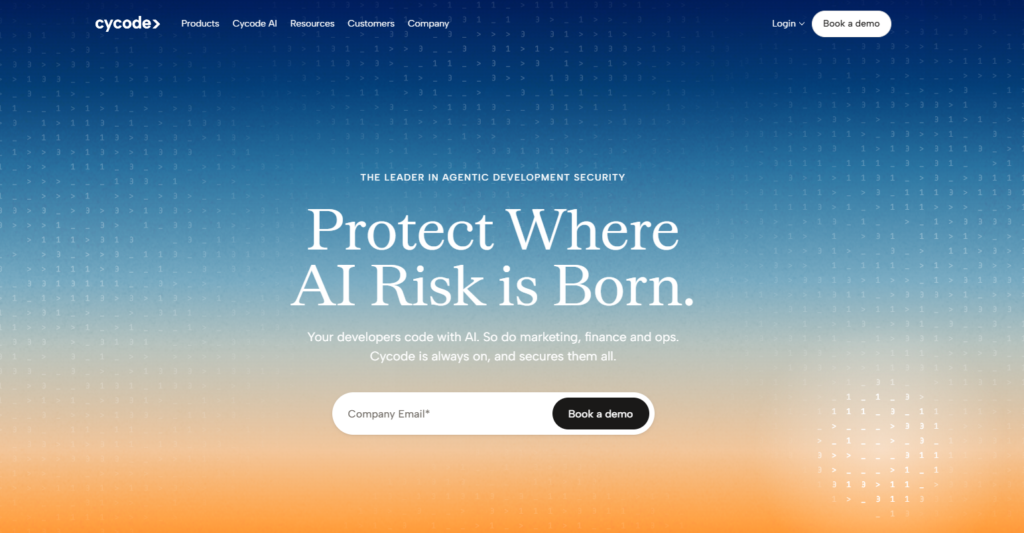
The application security firm has rebuilt its identity around agentic development security. Behind the new logo sits an argument many CISOs will recognise: AI has turned every employee into a developer, and every attacker into a faster one.
Some rebrands mark a change of image. The best mark is a change of substance. Cycode‘s rebrand, unveiled this month, belongs firmly in the second group, because it puts a clear and timely argument about AI-era security at the heart of the company’s identity.
The application security company, which Gartner named a Leader in its June 2026 Magic Quadrant for Software Supply Chain Security, has kept its name but changed almost everything else: logo, colours, typography, website and, most importantly, the story it tells. It now describes itself as the leader in agentic development security, a category built on the premise that AI-generated software needs protection at the point where it is written.
The short answer to why this matters is simple. The volume of code entering enterprises is rising sharply, more of it is written by machines and by people with no security training, and attackers have access to the same AI models as defenders. Cycode is betting that the only workable response is to secure the code itself, before risk spreads downstream. Whether that bet pays off will say a good deal about where application security goes next.
Every employee is now a developer
The first pillar of Cycode’s new narrative is that the definition of a developer has collapsed. AI coding assistants now write much of the code professional engineers ship, and natural-language tools allow marketers, analysts and operations staff to build working software without writing a line themselves.
The numbers support the premise. The Stack Overflow 2025 Developer Survey, which drew more than 49,000 respondents across 177 countries, found that 84% of developers use or plan to use AI tools, up from 76% a year earlier. GitHub’s Octoverse 2025 report recorded more than 180 million developers on the platform, with around 36 million joining in a single year, roughly one every second. Nearly 80% of those newcomers used GitHub Copilot within their first week.
Adoption has outpaced confidence. The same Stack Overflow survey found that 46% of developers do not trust the accuracy of AI-generated output, up from 31% the year before. That scepticism is well founded. Veracode’s 2026 GenAI Code Security Report, published in July, found that leading models produced secure code only 56% of the time on average without security-specific prompting. The best performer reached 68%; Java code passed just 30% of the time.
The citizen developer problem
Professional engineers at least have code review, testing pipelines and some security training. The newer cohort of builders often has none of these. Cycode’s launch post argues that many of these “citizen developers” were never trained in security or software architecture, so they introduce risk by default, frequently without realising it.
The challenge compounds a long-standing one. As BeyondTrust’s Kevin E. Greene told TechBullion, software supply chains are among attackers’ most attractive targets, and organisations need formal processes for vetting and monitoring the third-party code they depend on. AI-assisted development multiplies the volume of code those processes must cover.
The rise of the citizen attacker
Cycode’s second pillar is the mirror image of the first. If AI lowers the barrier to building software, it also lowers the barrier to breaking it. The company calls this figure the “citizen attacker”: someone who no longer needs deep expertise or funding, because frontier models supply both.
There is now public evidence of this shift. In November 2025, Anthropic disclosed that a state-sponsored group had used its Claude Code tool to run an espionage campaign against around 30 organisations, including technology firms, financial institutions and government agencies. According to Anthropic, the AI executed 80–90% of tactical operations independently, with humans stepping in only at key decision points. Days earlier, Google’s Threat Intelligence Group had warned of new malware families that call large language models while they run, rewriting themselves mid-execution to evade detection. One of them, QuietVault, specifically hunts for GitHub and npm tokens: developer credentials sitting at the heart of the software supply chain.
Low-severity flaws, high-severity chains
The more subtle claim in Cycode’s thesis concerns how attacks are assembled. Attackers, the company argues, now chain individually minor vulnerabilities into viable attack paths at machine speed, which erodes the value of compensating controls designed around single high-severity issues.
The raw material for those chains is abundant. Analysis of the National Vulnerability Database by security researcher Jerry Gamblin found that 48,185 CVEs were published in 2025, a 20.6% increase on 2024 and roughly 132 a day. Verizon’s 2025 Data Breach Investigations Report found that vulnerability exploitation was the initial access vector in 20% of breaches, a 34% year-on-year rise, while third-party involvement in breaches doubled to 30%.
The consequences are measurable for British organisations too. The UK government’s Cyber Security Breaches Survey 2025/26 found that 43% of businesses identified a breach or attack in the previous 12 months, rising to 65% of medium-sized and 69% of large businesses.
“Cycode started in software supply chain security, and AI risk is an explosion of it, right where we started. The CISOs I meet at large enterprises, including our own customers, consistently tell me the same thing: their CEOs see AI as the biggest opportunity and the biggest risk.” – Seth Robbins, President and Chief Revenue Officer, Cycode
Protecting where AI risk is born
If developers and attackers are both accelerating, where should defenders intervene? Cycode’s answer is the source: the code, and the developer environment in which it is generated. Its argument is that AI has made code cheap and easy to produce, flooding organisations with risky software, and that downstream controls cannot keep pace with that volume.
“AI originates in the code, and now AI writes it. That’s why we protect where AI risk is born: the code.” – Seth Robbins, President and Chief Revenue Officer, Cycode
This is a sharpened version of the “shift left” philosophy the application security industry has promoted for a decade. The difference is the actor being secured. Shift left assumed a trained human developer working through a pipeline. Agentic development introduces AI agents that select dependencies, write functions and open pull requests, often faster than any reviewer can follow.
That changes where the first meaningful security decision happens. As TechBullion reported this month, AI coding assistants increasingly decide which third-party packages enter enterprise applications, frequently before any human has evaluated them. By the time a traditional scanner flags the issue, the dependency may already have propagated across multiple services.
Duality and illumination
Cycode frames its approach around two ideas. The first is duality: securing AI-driven development on one side, while using AI to defend on the other. The second is what the company calls illumination. Finding vulnerabilities has become easy, it argues; the hard part is knowing which to fix, particularly when attackers can chain low and medium-severity issues into a serious breach. Cycode’s pitch is to surface the risks that matter, then let its AI act on them with a human kept in the loop.
The company’s new logo carries that idea. It is built around the “>” symbol familiar from command-line terminals and AI coding agents, marking the moment before a developer or an agent acts.
Eighteen months of product behind the new identity
A rebrand is only credible if the product has already moved. Cycode’s case rests on what it has shipped over the past 18 months: more than a dozen products and capabilities aimed squarely at AI-era development. They fall broadly into three groups.
- Securing agentic development. ADLC Security applies guardrails from the developer workstation, where code now starts. Workstation Protection, AI Guardrails and AI Visibility extend that coverage to the tools and agents developers use.
- Using AI to defend. Cycode AI puts AI to work for security teams, alongside Agentic Code Scanning, Agentic Workflows, AI Teammates and the Maestro orchestration layer.
- Inventory and integration. AIBOM and CBOM provide bills of materials for AI components and cryptography, while the Cycode MCP Server and an integration with Cisco Agent Studio connect the platform to the agent ecosystems enterprises are adopting.
The Model Context Protocol work is notable. MCP has rapidly become a standard way for AI agents to call external tools, and the Anthropic incident described above relied on MCP tooling. Securing that layer is likely to become a baseline requirement rather than a differentiator.
Cycode’s chief executive presents the rebrand as the outward expression of that product shift.
“You can’t unlock AI without securing it. I wanted the world to immediately feel the power of who we are today through our brand: the duality, the illumination, and all the details that make Cycode who we are. We’ve changed as much as the world around us, and we’re putting you in command.” – Lior Levy, Chief Executive Officer, Cycode
A market Gartner now treats as its own category
The timing of the rebrand reflects growing industry recognition. In June 2026, Gartner published its first Magic Quadrant dedicated to software supply chain security, a sign that analysts now regard the discipline as a distinct market rather than a feature of application security testing. Cycode was named a Leader in that inaugural report.
That recognition gives Cycode a strong platform from which to define a new category. “Agentic development security” names a need that many enterprises are only beginning to articulate: protecting software that is increasingly written, reviewed and shipped by AI agents. By leading with that category, Cycode is positioning itself early in what is likely to become one of the defining security priorities of the decade.
Governance is lagging adoption
The commercial opportunity rests on a clear governance gap. IBM’s Cost of a Data Breach Report 2025 found that 13% of organisations had experienced a breach of AI models or applications. Of those, 97% lacked proper AI access controls. Organisations with high levels of unsanctioned “shadow AI” paid an average of $670,000 more per breach, against a global average breach cost of $4.44 million.
Those figures help explain why, in Robbins’ account, chief executives view AI as both their biggest opportunity and their biggest risk. Boards want the productivity gains; security teams are being asked to underwrite them without a mature playbook.
What this means for security leaders
Cycode’s thesis is coherent and well supported by the data. For CISOs weighing how to secure AI-driven development, it points to four practical priorities.
Secure at the speed of agents. AI agents can generate and merge changes in minutes, so guardrails need to work in real time, at the point of creation. That is the gap Cycode’s agentic development security platform is designed to close.
Reach every builder, not only engineers. Citizen developers rarely work in the pipelines where traditional application security tools sit. Protecting them means reaching the workstation and the AI tools themselves, which is where Cycode’s ADLC Security operates.
Prioritise what attackers can actually exploit. With more than 130 new CVEs published a day, teams need to focus on the attack chains that matter. Cycode pairs AI-driven prioritisation with a human in the loop, keeping security teams in command.
Govern the agent ecosystem. As MCP servers and agent platforms spread through the enterprise, visibility into AI components becomes essential. Capabilities such as AIBOM, AI Visibility and the Cycode MCP Server address this directly.
The code is the new perimeter
Cycode’s new identity signals both calm and alert, and is more than a visual refresh. It is a clear statement from a Gartner-recognised Leader about where application security must go.
The evidence supports the direction. More people are writing code than ever, much of it AI-generated and a large share of it insecure. Attackers are already using the same models to automate intrusions. Vulnerability volumes are climbing by around a fifth a year.
In that environment, the moment a line of code is written, by a person or an agent, is becoming the most important control point in the enterprise. Over the next 12 to 18 months, expect boards and regulators to ask not only whether organisations use AI to build software, but how they secure what it builds. With its new identity, a Leader placement from Gartner and a portfolio built for agentic development, Cycode has positioned itself to help answer that question, at the source and at the speed of agents.