
Most online brands meet custom printed mailer boxes through a design tool: upload a logo, pick a colour, see a rendered preview. Trouble starts when the same brand asks three factories for prices and gets three numbers that cannot be compared. One supplier quoted E flute, another B flute; one assumed outside dimensions, another inside; one priced offset print, another flexo. Quote comparison only works when every supplier is pricing the same construction, and in parcel shipping the box size also sets the dimensional weight the carrier bills.
This piece walks through the fields an e-commerce specification needs to lock before any quote is meaningful: size, flute, closure style, print route, sample route and order terms. Figures come from two places, the published mailer specification of Huandao Packaging, a box plant in Xiamen, China, used here as a concrete reference, and the dimensional weight rules UPS publishes for its parcel services.
What custom printed mailer boxes are
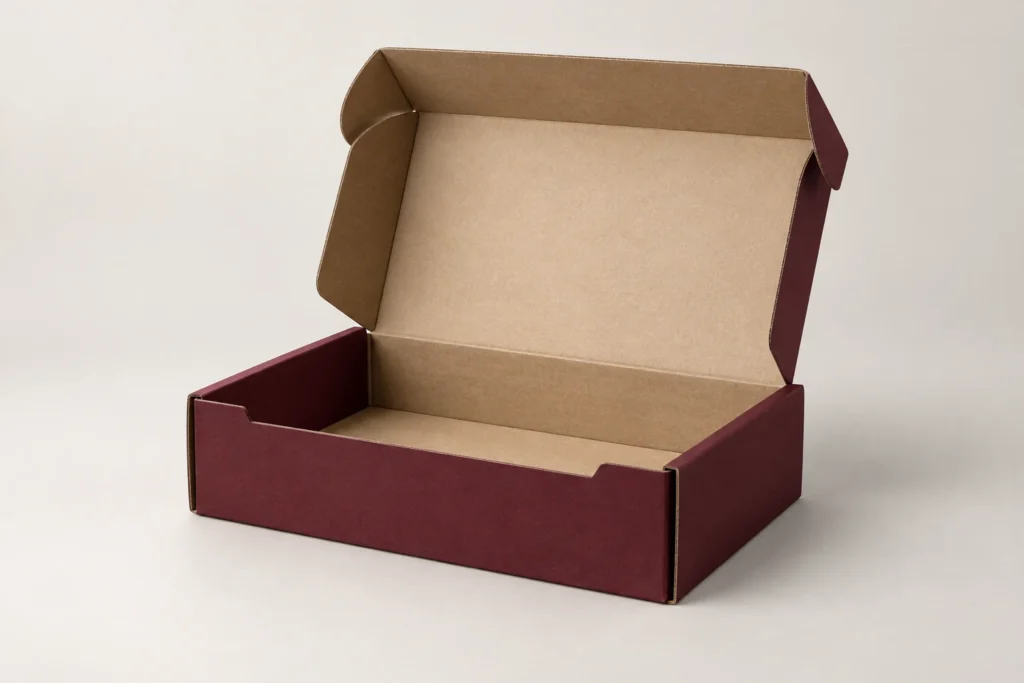
A mailer is a one-piece corrugated box that folds up with an integrated lid and closes without tape or a separate top. Customers open it like a book, which is why brands print the inside as well as the outside. Huandao describes RETT and self-locking-front mailer styles that create a compact corrugated cardboard pack and close without a separate lid. RETT stands for roll end tuck top: the side walls roll over and the lid tucks in at the front.
Corrugated mailer boxes sit in the middle of the packaging range. They protect more than a folding carton and present far more than a plain brown shipper. That middle position is exactly why the specification has to be precise: too little board and the parcel arrives crushed, too much and the brand pays for fibre and freight it did not need.
Size first: internal dimensions and dimensional weight
Every mailer quote should start with internal dimensions measured from the packed product, including tissue, inserts and any accessory that travels with it. Outside dimensions are a result, not an input, because board thickness adds to every wall. Huandao gives its common finished range as 150 x 150 x 50 mm to 400 x 300 x 120 mm, and treats sizes outside that envelope as a separate review rather than a standard job.
Size matters twice in parcel shipping, because carriers bill by space as well as weight. UPS calculates dimensional weight as length times width times height in inches, divided by a divisor of 139 for Daily Rates or 166 for Retail Rates, with each measurement rounded up to the next whole inch. A mailer at the top of that common range, 400 x 300 x 120 mm, rounds up to 16 x 12 x 5 inches, or 960 cubic inches. At the Daily Rates divisor that is about 6.9 pounds, billed as 7, even if the box and product weigh far less.
Cutting a centimetre of empty height from every box can move a whole product line into a lower billable weight. The catch is protection: less void also means less room for cushioning, so the reduction has to be tested with the real product, not assumed from a drawing.
Flute choice and the limits of strength numbers
Mailers run mainly on two board profiles. In Huandao’s words, E-flute and B-flute corrugated board are the standard mailer choices, with A, C, F, BC and other profiles converted from sourced board. E flute is thin and smooth, which suits compact retail, beauty and accessory products where print quality matters most. B flute is thicker and stiffer, used when panels are larger or the product is heavier or more fragile.
Buyers often ask for a test value, usually edge crush (ECT) or burst strength, as if it settled the question. It does not. These two tests describe different strength behaviour, and as the same specification puts it, neither number, by itself, guarantees a filled package on a route. Any board report tells you the material met a value on the day it was tested. Whether a packed mailer survives a parcel network depends on the product, the insert, the closure and how the parcel is handled.
Where it stops: a flute letter or an ECT figure on a quote is a material description. If damage rates matter, ask for a distribution test on filled samples, and write the pass criteria into the order.
Closure and structure styles
Closure is the part of a mailer that customers touch first and that returns departments touch last. Huandao’s corrugated mailer range covers roll-end tuck-top, book-wrap, rigid paperboard mailer and self-seal strip formats. A book-wrap structure folds around flat or variable-height items, so one dieline can serve a product family of different depths. Self-seal strips remove the need for packing tape, which speeds up the packing station.
Small extras change cost and workflow as much as the board does. Options such as a tear strip, double-sided tape, inside printing and paper inserts can turn a shipping box into branded packaging, but each one adds a converting step or a material. Double-sided tape and a tear strip together make sense when the box has to be resealed for returns; that second closure needs to be specified before the dieline is cut, not added afterwards.
Print route: offset lamination or flexo
Printed mailers are made in two main ways. Offset printing on a separate coated sheet, laminated to the board afterwards, gives photographic detail, gradients and accurate brand colour. Flexo prints straight onto the corrugated liner and costs less to set up. The plant’s own guidance is direct: simple logos, text, and solid areas may cost less with flexographic printing. Paying for offset lamination to reproduce a one-colour logo on kraft is a common expense that a brand can simply skip.
Whichever route is chosen, colour should be approved against a physical proof under agreed conditions, not against a screen. Renders show layout; they say little about how ink sits on a kraft or white-top liner.
Samples: three routes, three different questions
Mailer suppliers usually offer more than one kind of sample, and each answers a different question. Huandao lists 3 routes: blank, digital printed or press-run finished. A blank sample checks fit, closure and pack-out. Digital-printed samples check artwork position and general look. Only a press-run sample, made with production materials and finishes, can approve final colour and finish, which is why it is normally charged.
Skipping the blank sample to save a week is the most expensive shortcut in the process. Boxes that are a few millimetres too tight in one direction will not close on the packing line, and no amount of good printing fixes that problem once the run is made.
Order terms for custom printed mailer boxes
Factory-printed mailers are sold by size and style, not by total quantity. The reference specification gives an MOQ of 1,000 per size and style, with smaller runs reviewed case by case. Three box sizes and two seasonal designs mean a brand is ordering six versions, not one, and setup cost applies to each. Quotes are returned within one working day on business days when the brief is complete; an incomplete brief simply produces a guess.
Mailer box specification fields to fix before asking for quotes
| Field | What to write | Why suppliers need it |
| Size | Internal L x W x H in mm, packed product included | Sets board use and the carrier’s billable size |
| Board | E-flute or B-flute, liner colour (kraft or white) | Changes protection, print surface and price |
| Structure | Roll-end tuck-top, book-wrap or self-seal; return closure if needed | Decides the dieline and packing speed |
| Offset or flexo, outside and inside, spot colours by reference | Separates a laminated job from a direct-print job | |
| Samples | Blank, digital or press-run, and what each must approve | Avoids paying for the wrong approval |
| Quantity | Pieces per size and per design, plus forecast reorders | Minimums apply per version, not per order |
Sending the brief
A brand that sends this table filled in gets quotes priced on the same construction, which it can line up side by side. One that sends a logo and a rough size gets prices built on each supplier’s own assumptions, and the cheapest of them is often the one that assumed the least board. For reference, the published mailer specifications from a custom mailer box manufacturer in Xiamen show how one plant sets out these fields, which makes a practical template even when the order goes elsewhere.
Mailer packaging is one of the few places where an online brand’s product, marketing and shipping costs meet in one physical object. Treating its specification as an engineering document rather than a design brief is what keeps those three from working against each other.