
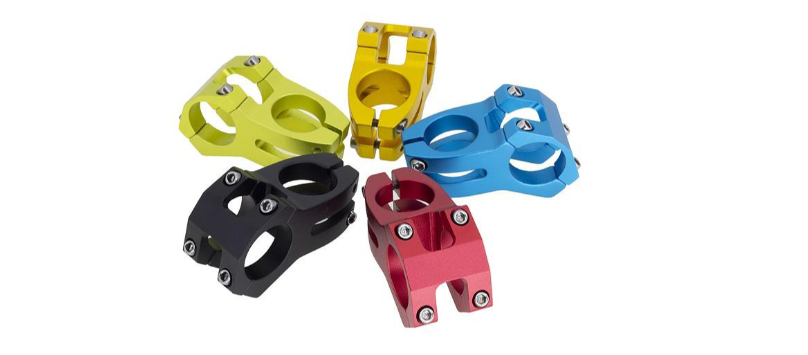
Custom MTB Components for Project Teams: A Practical Field Guide
Written for frame builders, design engineers, small-batch manufacturers, and procurement leads who need mountain-bike parts matched to unique geometries and demanding trail loads.
Why Catalogue Parts Often Fail in Development Projects
As considering for a custom bike projects, why catalogue parts often fail? What should we choose to make? Here we will learn about the reasons and choices:
Geometry mismatch
High-pivot designs, idler drive-trains, and offset shock mounts place pivot points where no mass-market rocker link, spacer, or axle exists. Even a three-millimetre error in shock-mount location can shift the leverage curve enough to invalidate every kinematics simulation you ran.
Peak-load mismatch
Modern enduro bikes see 10 – 20 kN spikes when a square-edge rock meets a 29-inch wheel at speed. Catalogue grade-10.9 steel bolts or M10 6061-T6 axles can yield at eight or nine kilonewtons, turning one harsh landing into a cracked dropout and an unscheduled prototype failure.
Tolerance stack-up
A rocker link machined for ±0.10 mm coaxiality plus a bearing bore shipped with ±0.05 mm roundness can add more than 0.15 mm radial error—enough to preload needle bearings into rapid failure or leave the linkage rattling under no load.
Every millimetre re-machined in a workshop, every urgent air shipment, and every extra week in validation costs far more than ordering purpose-cut components from the start.
Choosing Materials: Five Key Options
6061-T6 aluminium
density ≈ 2.70 g/cm³; yield ≈ 275 MPa. Suited to medium-travel rocker links, bearing spacers, and early prototypes. It cuts quickly, anodises brightly, and is the least expensive hard metal in routine use.
7075-T6 aluminium
density ≈ 2.81 g/cm³; yield ≈ 505 MPa. Ideal for enduro pivot axles, pedal spindles, and linkages that suffer brutal compressive loads. It is roughly one-and-a-half times stronger than 6061 while adding only grams at typical sizes. Tool wear and tap breakage are higher, so build that into machining time.
Ti-6Al-4V (Grade 5 titanium)
density 4.43 g/cm³; yield ≈ 830 MPa. The fatigue-life champion. Use it for hardware that endures repeated torque cycles—thru-axles, fasteners, and motor mounts on e-bikes living in salty winter conditions. Material cost is two to three times that of 7075, but zero corrosion and elastic spring-back often repay the difference in warranty savings.
17-4PH stainless (H900 condition)
density 7.75 g/cm³; yield ≈ 1 000 MPa. Heavy yet extremely strong. Retains properties beyond 200 °C, making it useful for brake-mount adapters, rotor spiders, and motor-plate braces on mid-drive e-bikes.
Unidirectional carbon fibre with an aluminium thread insert
composite density 1.6 – 1.8 g/cm³; strength direction-dependent. Perfect for one-piece bar-stem units, chain-stay shells, or yokes. The metal insert handles clamp torque while the composite carries in-plane loads.
Quick guide
- Up to ~300 MPa stress → 6061 for economy.
- 300 – 600 MPa → 7075 or age-hardened stainless.
- Higher loads or corrosive service → titanium.
Where Custom Parts Deliver Immediate Value
- Suspension interfaces – Rocker links, yokes, and shock spacers define the leverage curve. A link milled for your exact pivot spread lets you change travel or progression without redesigning the entire rear triangle—one of the clearest ROI cases for custom MTB parts.
- Drive-train clearance – Chainrings, idler wheels, and bash guards fine-tune chainline on high-pivot bikes and protect oversized tyres. A two-millimetre offset change can be the difference between silence and chipped paint.
- Mixed-material joints – Carbon fronts joined to alloy tails often need dropout inserts, brake adapters, or motor mounts that no catalogue matches. Purpose-cut lugs slot in cleanly, preserve fibre orientation, and maintain warranty cover.
- One-piece cockpits – A combined bar-and-stem built to your sweep and rise trims eight millimetres from stack height, removes four steel bolts, and guarantees consistent lever reach across test fleets.
- Service hardware – Axle nuts, keyed washers, and anti-rotate spacers seldom appear in glossy ads, yet they prevent seized fasteners and shave service minutes across thousands of units.
Four-Step Workflow from CAD to First Trail Ride
Step 1 – Capture loads
- Vertical drop equal to 2.5 × combined bike-and-rider mass (about 2 kN per side on a medium frame).
- Pedal kick-back torque near 1 500 N·m at the crank spindle.
- Rear-brake torque roughly 800 N·m with a 200 mm rotor.
Step 2 – Build parametric CAD
Link every pivot centre, bore diameter, and tyre-clearance surface to a master sketch so a chain-stay change relocates all holes automatically.
Step 3 – Run finite-element analysis
Aim for peak von-Mises stress below 60 % of yield for metals and 40 % for carbon. Tweak pocket depth or rib width until the heat map cools.
Step 4 – Prototype, test, iterate
A five-axis mill can produce a first-article 6061 rocker in twelve hours for USD 60 – 90 in machine time. Fit, instrument, ride hard for a weekend, and adjust. Most teams need two or three cycles—rev A, rev B, maybe rev C—before locking geometry and cutting the sign-off part in 7075 or titanium through a specialist in CNC custom parts.
Typical loop: first-article 6061 sample → shop fit and trail data → revision cut → final part in high-strength alloy. Costs rise from roughly USD 70 to USD 300 as material and precision increase.
Critical Tolerances and How to Verify Them
- Pivot-bore diameter ±0.01 mm ensures correct bearing preload.
- Coaxiality between tandem bores ≤ 0.02 mm prevents side-loading that chews needles.
- Thread class ISO 6H/6g for M10 × 1 axles stops galling under repeated torque cycles.
- Rocker-face flatness ≤ 0.05 mm keeps the suspension stack square.
A short CMM session—fifteen minutes per batch—costs less than a single rush warranty return.
Surface Engineering Choices
- Type II colour anodising, 8 – 12 µm thick, gives bright branding colours and basic corrosion defence, adding around six percent to part cost.
- Hard-coat anodising, 25 µm thick, boosts wear life roughly fifteen percent and lowers surface roughness; budget about ten percent extra.
- Diamond-like carbon or titanium-nitride films (2 – 4 µm) on titanium hardware nearly eliminate galling and keep pivot pins scratch-free for seasons.
- Cerakote ceramic coatings (20 – 30 µm) offer an unlimited colour palette and chemical resistance to brake-fluid spills, adding a low-teen percentage to cost.
- Coat once, machine once—post-coating cuts pierce the seal and start corrosion anew.
Selecting a Supplier
Local CNC partner
- Four- to six-day sample lead.
- Easier in-person design reviews and stronger IP control.
- Higher labour cost; unit prices reflect it.
Offshore specialist (e.g., South China)
- Seven- to ten-day first-sample lead including air freight.
- Landed price for a thirty-piece 7075 link drops from about USD 120 to around USD 65.
- ISO 9001 certificates and CMM reports available on request.
- Protect sensitive geometry with NDAs and neutral part numbers.
Lifecycle Costs That Outweigh Unit Price
- Assembly labour – A keyed nut can shave thirty seconds from torque sequences. Across ten-thousand frames that frees roughly eighty hours.
- Field service – Corrosion-proof titanium bolts cost cents more yet prevent seized hardware and warranty claims.
- Logistics – Net-shape parts needing no post-machining fixtures remove extra freight legs and lower carbon footprint.
- Evaluate total cost—machining, assembly, service, and shipping—not just the invoice line.
Compliance and Sustainability Essentials
- Ensure the full frame still passes ISO 4210 static and fatigue tests after geometry changes.
- Confirm anodising lines are free of hexavalent chrome to satisfy RoHS and REACH.
- Keep 7075 chips segregated from steel; clean aluminium scrap can return around USD 1.20 per kilogram and fund coolant for a month.
Purchase-Order Checklist
- Signed PDF drawing with clear revision code and date.
- Matching STEP or IGES model.
- Full material call-out (e.g., “7075-T6, AMS QQ-A-250/12”).
- Surface-finish instructions: colour, thickness, process.
- Inspection plan highlighting bores, threads, and flatness.
- Batch size, delivery schedule, and Incoterms 2020 shipping terms.
- Send all six items; incomplete data is the main cause of late quotes or incorrect parts.
Key Takeaways for Project Teams
- Custom parts solve geometry, load-case, and assembly problems that catalogue hardware cannot address.
- Match material to worst-case stresses: 6061 for economy, 7075 for mid-strength needs, titanium for high-fatigue or corrosive zones.
- Parametric CAD and solid finite-element analysis reduce prototype loops, saving both time and money.
- Tight control of bore and thread tolerances prevents most field failures; thoughtful surface engineering extends wear life.
- Lifecycle costs—assembly minutes, service claims, logistics—often eclipse the machining invoice, so look beyond unit price.
- Certification, revision tracking, and IP protection are mandatory due-diligence steps, regardless of where you source.
- Follow this framework and you can move from first sketch to inspection-ready, small-batch MTB hardware that safeguards timeline, budget, and reputation—while leaving catalogue compromises to competitors.