
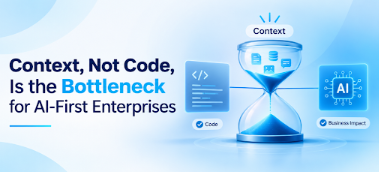
Code generation is no longer the slowest part of enterprise AI. Context is: which definitions are authoritative, how systems connect and which standards apply. Most of it sits with a few experts, so their availability sets the pace.
Five years ago, scaling a data program meant hiring more data engineers. Talent was the constraint. Today an AI assistant can draft a pipeline in minutes, and enterprise programs still run late.
The code was never the whole job. Someone has to know which table is authoritative, how revenue is defined this quarter, which naming and architecture standards apply, and what breaks downstream if a column changes. That knowledge decides what gets built and whether it is right. Generating code faster without it produces faster rework.
For CDOs, CTOs, and Data Engineering leaders, this changes where to invest. More assistants and licenses raise the ceiling on output. They do not raise the floor on correctness. An AI-first enterprise treats context as managed infrastructure, with owners, structure and controls, not as something that lives in people’s heads and old tickets.
This article defines enterprise context, shows what its concentration costs, links it to AI readiness, and sets out a capability model for managing it.
What is enterprise context, and where does it live?
Enterprise context is the knowledge that tells a team how to interpret data and what to build. It covers authoritative business definitions, how systems connect, architecture and naming standards, data quality rules and the reasons behind past decisions.
It is spread across data catalogs, ticketing systems, documentation platforms, code repositories and, above all, the heads of a few senior engineers and domain experts. Rarely is any of it in one place, and the portion in people’s heads is the portion that matters most.
Concentrated context has a predictable cost:
- Delivery queues. Teams wait for the same few people, so expert calendars set program timelines.
- Slow onboarding. New engineers take months to become productive because the rules are learned by asking, not by reading.
- Inconsistent quality. Without shared standards applied at the point of work, each team interprets them differently.
- Modernization risk. Migration programs find undocumented business rules late, often after a deadline is committed.
- Attrition exposure. When an expert leaves, the knowledge leaves with them.
These costs rarely appear on a risk register because they show up as delay and rework, not as incidents. Leaders feel them as programs that run slower than team size suggests.
How does missing context become an AI readiness problem?
Gartner surveyed 1,203 data management leaders in July 2024 and found that 63% of organizations either do not have, or are unsure they have, the right data management practices for AI. Gartner predicts that through 2026, organizations will abandon 60% of AI projects unsupported by AI-ready data.
Gartner’s guidance on what makes data AI-ready is instructive. It describes readiness as a practice that depends on metadata to align, qualify and govern data, and it recommends moving metadata from passive to active so it drives automation and recommendations. It also notes that traditional data management leaves many organizations without the practice and metadata needed to assess readiness at all.
Read that as a context problem. AI-ready data is data an AI system can interpret correctly, and interpretation depends on meaning: what a field represents, which source is authoritative, which rules apply. If that meaning sits in people’s heads, or in documents no system can use, the AI never receives it. The result is a pattern leaders already recognize: capable models producing answers that are plausible and wrong.
This is also why more data does not fix the problem. A larger corpus without captured meaning gives an agent more to misread. The scarce input is not volume. It is structured context attached to the data.
What does a context capability model look like for enterprise data teams?
Treat context as a capability with levels of maturity. Most enterprises sit at level 1 or 2.
| Level | State of context | Typical symptom |
| 1. Tribal | Held by individuals and shared by asking | Programs queue behind named experts |
| 2. Documented | Written in wikis, tickets and catalogs, scattered and often stale | Answers exist, but nobody can find or trust them |
| 3. Structured | Definitions, standards and lineage held in linked form, with owners | Teams find authoritative answers without an expert |
| 4. Operational | Embedded in workflows, applied at the point of work, validated by experts | Standards apply consistently, and experts review exceptions, not routine work |
Four capabilities move a team up the scale.
- Capture. Pull context from the systems that already hold it: catalogs, tickets, documentation and repositories. A company-wide drive to write everything down will stall.
- Structure. Link definitions to data assets, owners and lineage so the context can be queried, not just read.
- Embed. Put context into the workflow where decisions are made, so standards guide the task instead of waiting to be remembered.
- Validate. Keep human approval for outputs and edge cases. Experts move from answering questions to reviewing results.
The jump from level 2 to level 4 is the leverage point for AI. Level 2 context can be read by people. Level 4 context can be used by AI systems and agents, which is what turns assistants into dependable contributors.
How should enterprises run and measure context as infrastructure?
Context needs owners and measures like any other infrastructure.
Ownership. Assign a context owner for each domain, usually a senior engineer or data steward, accountable for definitions and standards in that area. The CDO or head of data engineering owns the program and its metrics. Enterprise architecture owns the standards that apply across domains.
Metrics. Track expert dependency, meaning the number of active programs waiting on named individuals. Track time for a new engineer to make a first productive contribution. Track the share of changes that pass standards review on the first attempt, the rework rate, and the share of business terms with a named owner and a linked definition. If these are not measured, the cost of missing context stays invisible.
Where Modak ForgeAI fits. Modak built ForgeAI as a context layer for data engineering. It absorbs context from catalogs, tickets, documentation and code repositories, structures it into guided workflows and keeps human validation in the loop. It is designed for four scenarios: new data product pipelines, migration and modernization, ongoing pipeline and platform support, and business data discovery. The aim is that standards, definitions and architecture rules apply every time, including when the expert who knows them is unavailable.
This is infrastructure, not a feature. It sits beneath the people and tools a team already uses, and it works only if experts stay in the validation seat.
Next Steps: What should leaders do about the context bottleneck?
Knowing that context is the constraint is only useful if it changes what gets done next. Act in this order.
- Find your single points of failure (this month). List the active programs and name the two or three people each one depends on for answers. Then ask which programs would stall if two of those people were unavailable for a month. That list is your context risk, and it shows where to start.
- Capture the five definitions that cause the most rework (next 60 days). Pick the business terms and standards that teams argue about most, such as “active customer” or the naming and architecture rules. For each, ask where the authoritative version lives, who owns it and whether an AI system could read it today. Write it once, link it to the data assets it governs and name an owner. Pull from catalogs, tickets and repositories first. Do not start with a company-wide documentation drive.
- Put it into one team’s workflow (within 90 days). Choose one high-volume workflow, such as new pipeline builds or migration. Apply the captured context at the point of work and have an expert review exceptions, not routine output. Measure first-pass standards approval, rework and the number of questions routed to experts, before and after.
AI assistants raise output only as far as context allows. Leaders who treat context as infrastructure, with owners, structure and metrics, get a return from every tool they add. Leaders who do not will keep buying faster code and waiting on the same few people. The first move is the list in step 1. It takes a day, and it shows exactly where context is costing you.
Skip the guesswork. Start with Modak.
You can run these three steps on your own. You can also start with a team that does AI-first data engineering for a living. Modak helps enterprises find where context is concentrated, capture it in a form both people and AI can use, and put it to work in the workflows that matter most.
Bring the list of programs that wait on named experts. On a discovery call, we will help you map your context risk, choose the first workflow to fix and define what success looks like.
Every month context stays in people’s heads is a month your AI investments run below their potential.
Book your discovery call with Modak ForgeAI team today and turn your context into your advantage.