
- To use datasets from research institutions or third-party models, companies must sign piles of contracts, undergo legal reviews, and manually reconcile payments — a painfully slow process.
- Independent developers who contribute models or algorithms often see their work vanish once wrapped into APIs — stripped of identity and devoid of revenue feedback.
The “Power Grid” Woven by CodexField
CodexField is a Web3-native asset infrastructure designed for the AI industry, aiming to enable data and model ownership, invocation, and value circulation. It treats models, prompts, algorithmic code, and their derivatives as reusable intelligent assets, realizing the principle of “model as an asset, invocation as billing” through unified packaging and authorization standards. The platform provides a closed-loop system covering storage, ownership verification, authorization, metering, and profit distribution. It is compatible with multi-chain ecosystems and mainstream decentralized storage networks, allowing developers and institutions to flexibly define access rules via smart contracts, achieve cross-institutional sharing, and enable automated settlement. The core value of CodexField lies in re-assetizing resources once hidden behind APIs—granting data and models property identity and automatic revenue feedback. This lowers collaboration and compliance costs, builds a standardized pipeline for cross-domain sharing and compliant invocation, and lays an institutional foundation for the deep integration of AI and Web3.Assetizing AI Content Elements: Data, Models, and Code
At its core, an AI model is underpinned by an ever-evolving stack of algorithmic code, while the datasets and prompts supporting its training and inference are equally essential “content.” In traditional Web2 environments, these resources are typically accessed via APIs or compressed packages. Users can send a request and receive a result—but remain unable to trace which models or data were used, who contributed them, or how value should be recorded in legal or financial terms. This “use-and-forget” model has long stifled AI innovation:- Independent model creators struggle to receive ongoing rewards for their contributions.
- Companies and research institutions lack transparent provenance and compliance proofs when using external resources, often finding themselves entangled in copyright and audit issues.
- Cross-industry data sharing is hindered by lengthy negotiations and manual reconciliations, leaving many potential applications stuck at the conceptual stage.
- The indexing protocol functions like a library catalog, creating an open directory for all on-chain capsules, allowing enterprises, research institutions, and developers to easily discover the resources they need.
- The evaluation system ranks resources based on metrics such as invocation success rate, latency, compliance audits, and user ratings, ensuring that high-quality and reliable resources gain greater visibility.
 Through this mechanism, CodexField completes a full loop — from ownership verification to discoverability. It brings together distributed intelligent resources from platforms, laboratories, and individuals into a unified framework that is identifiable, searchable, verifiable, and tradable. This institutionalizes the foundation for automated authorization, metering, and revenue feedback. As a result, CodexField not only enhances industry-wide collaboration efficiency but also ensures that long-overlooked creators and data providers can truly share in the economic value generated by intelligent productivity.
Institutional Foundation
After AI content is assetized, CodexField further establishes an executable rule system for these assets—transforming the authorization terms, metering methods, and revenue-sharing logic once written in contracts into on-chain code and industry standards. Resource providers can use a license description language to define authorization duration, invocation frequency, applicable scenarios, and revocation conditions, generating corresponding capability credentials. In this way, traditional license agreements are abstracted into a set of programmable, callable, and self-executing rules. When an asset is invoked, the system automatically generates a usage receipt, using MU (Metered Unit) as a unified measurement standard—essentially installing a “meter” for data and models. This ensures consistent metering across cloud environments, edge nodes, and trusted computing frameworks, making every invocation traceable. The platform’s built-in royalty graph automatically identifies all participants along the invocation path—data providers, model developers, and compute nodes—and distributes revenue through on-chain settlement routing, giving AI usage its first truly executable industry standard. By contrast, most AI collaborations today still rely on paper contracts and trust-based mechanisms. For example, if a company wants to use medical imaging data from a research institute or invoke a third-party model, it must first sign contracts, undergo legal reviews, and reconcile transactions manually—a slow, opaque process that cannot support the rapid iteration AI development demands. As a result, vast amounts of data remain locked in silos, unable to circulate efficiently. CodexField’s mechanism breaks through this barrier. Developers can seamlessly invoke external resources without rebuilding backend billing systems. Creators receive immediate, auditable rewards each time their data or models are used. Enterprises and research institutions can complete multi-party authorization, invocation, and settlement within a single system—dramatically reducing compliance and financial costs. Through this institutionalized circulation model, previously fragmented AI resources gain attributes akin to electricity—measurable, payable, and traceable. It greatly lowers the threshold for industry-wide collaboration and establishes a fair, transparent, and continuously value-accruing economic foundation for innovation.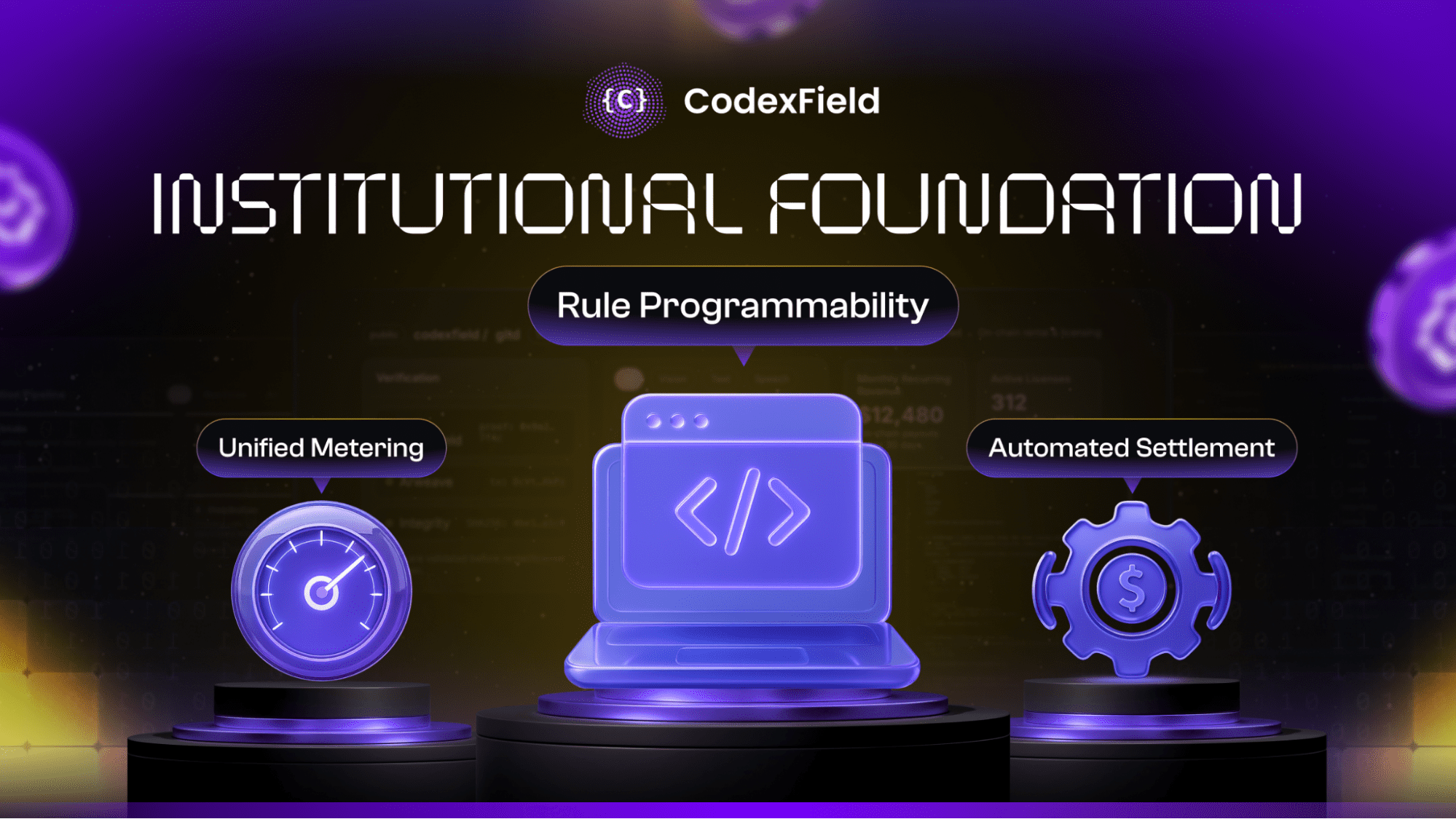
Collaborative Network: Open and Governable
As a Web3-oriented AI infrastructure, CodexField itself is a collaboratively built and jointly governed resource network comprising three core participant groups:- Data contributors provide the core data and knowledge resources required for model operation. These include standardized medical imaging, financial transaction records, remote sensing and climate data, as well as high-value corpora such as legal, medical, and scientific literature. They also encompass pre-trained models and feature extraction algorithms developed by independent developers or research teams—all of which can be directly accessed through Content Capsules.
- Resource contributors act as the network’s power engine, supplying computation and hardware support for inference, storage, and cross-regional transmission. This includes GPU clusters, low-latency edge nodes, and trusted execution environments (TEEs) for sensitive sectors such as healthcare and finance—ensuring stability and security under high concurrency.
- Application developers and institutions can seamlessly access global capsule-based resources through CodexField’s standardized interfaces, without the need to build their own backend systems. This enables scenarios such as intelligent customer service, content generation, industrial simulation, and precision medicine. Research institutions can also securely access cross-departmental or cross-organizational data and models within the same network, reducing compliance and transaction costs. Moreover, CodexField provides AI platforms and SaaS providers with underlying mechanisms for authorization and revenue distribution, transforming closed API ecosystems into open, verifiable, and profit-sharing resource markets.
- Open yet governable – Any compliant individual or institution can join as a node, but rewards are tied to contribution, preventing uncontrolled participation.
- Economically driven stability – By linking incentives to service quality, the network ensures continuous investment in bandwidth, computing power, and redundancy, providing a highly available, low-latency foundation for large-scale AI operations.
About CodexField
CodexField is a next-generation Web3 platform for on-chain content assetization. It transforms code, AI models, AIGC outputs, and knowledge into tradable, revenue-generating digital assets. By building full-stack infrastructure for ownership verification, permission control, and content financialization, CodexField is redefining how digital intelligence is created, shared, and monetized on-chain. Website: codexfield.com Twitter/X: x.com/CodexField Telegram: t.me/Codexfield_Official Telegram Ann: t.me/codexfieldannounce Youtube: youtube.com/@CodexFieldOfficialCompany-submitted announcement. Visit their site for details.