

Search “IRS Fresh Start program” and you get radio ads, late-night TV spots and a lot of promises. Somewhere under all of that is a real IRS policy, and it helps a large number of people every year. It just looks very different from the ads.
Here is what Fresh Start actually is, where it came from, and how to tell whether any of it applies to you.
Where Fresh Start came from
In 2011 the IRS announced what it called a “fresh start” initiative. The country was coming out of a recession, unemployment was high, and millions of people owed back taxes they had no realistic way to pay in one lump sum. The IRS changed several collection rules at once to make it easier for those people to get current and stay current.
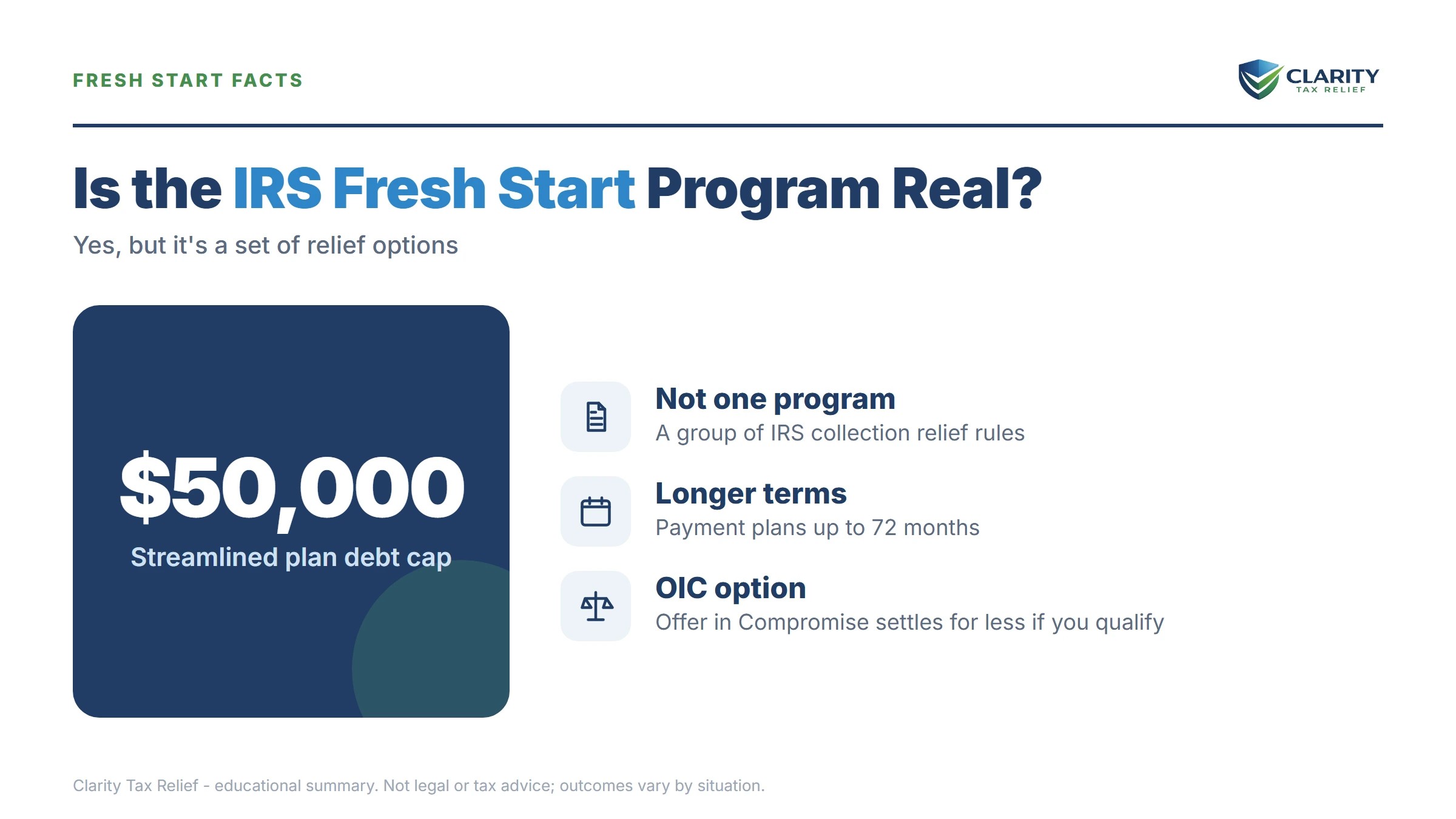
There was never a single form called the Fresh Start application. The name covers a set of changes to existing tools: payment plans, tax liens and the offer in compromise. That matters, because anyone telling you to “apply for Fresh Start” is really talking about one of those tools, and each one has its own rules.
The original announcement is still on the IRS newsroom page for the 2011 Fresh Start changes, marked as historical.
The three pieces that make up the IRS Fresh Start program
Easier payment plans
This is the part most people end up using. The IRS widened the streamlined installment agreement, which lets you set up monthly payments without handing over a full financial statement first.
Today, per the IRS, individuals who owe $50,000 or less in combined tax, penalties and interest, and who have filed all required returns, can request a long-term payment plan online. The IRS spreads that balance over as long as 72 months when you do not propose a payment amount yourself. If you can pay within 180 days, a short-term plan is available for balances under $100,000, with no setup fee online. Interest and late-payment penalties keep running until the balance is paid, so a plan makes the debt manageable without making it smaller.
A guide to the Fresh Start payment plan rules, including what happens if you miss a payment, is worth reading before you pick a monthly amount you can’t keep up with.
Changes to tax liens
A federal tax lien is the government’s legal claim against your property, and a filed lien shows up in public records. Fresh Start raised the balance at which the IRS generally files a lien, and it made withdrawal easier. The 2011 announcement let people who owed $25,000 or less ask to have a lien withdrawn after setting up a direct debit payment plan and making payments for a probationary period. That rule is still in place: the IRS currently asks for three consecutive direct debit payments on a plan that pays the balance in full within 60 months or before the collection deadline. Once a balance is paid in full, the IRS releases the lien within 30 days, and a withdrawal of the public notice can be requested after that if your filings are current.
A wider door for settlements
The offer in compromise lets some people settle for less than they owe. Fresh Start loosened the way the IRS calculates what a person can afford to pay, which made more people eligible.
It is still the hardest of the three to get. The IRS accepts an offer when it believes the amount offered is the most it can reasonably collect, based on your income, expenses and assets. Before filing, it helps to understand how the IRS calculates an offer in compromise, because an offer built on guesses tends to come back rejected, and the IRS does not return the application fee when it rejects one.
Who qualifies
Because Fresh Start is several tools, there is no single test. Some general rules hold across all of them.
1) You need to be filed up. Missing returns block almost every option, so unfiled years come first even if you can’t pay what they show.
2) You need to stay current. The IRS generally won’t agree to a plan on old balances while new ones keep piling up, so estimated payments or withholding have to cover this year.
3) The size of the balance decides the paperwork. Under the online limits, a payment plan can often be set up in minutes. Above them, expect to provide financial information.
4) A settlement depends on your finances. Income, necessary living expenses and the equity in what you own decide whether an offer makes sense at all.
Myths worth dropping
The biggest one is that Fresh Start forgives tax debt. It doesn’t, at least not automatically. Most people who use it pay their full balance over time through a payment plan.
Another is that you need to pay a company to “get into” the program. The streamlined payment plan can be requested directly through the IRS website, and the IRS publishes the forms for every option.
And watch for any promise of a specific settlement amount before someone has looked at your finances. The IRS decides what it will accept, and it does that from the numbers. A firm quoting you a percentage on the first phone call is guessing.
A practical place to start
The people who get the most out of these rules tend to be the ones who act at the first balance-due notice, when every option is still open. The ones who wait until a levy usually still have choices. They just have fewer of them, and less time to decide.
Nobody can promise how a tax debt will be resolved. What you control is the order of operations: file what is missing, stay current this year, then choose the tool that fits the balance and your budget. For people who want plain explanations of each step, Clarity Tax Relief publishes guides on IRS notices, payment plans and settlement options, and its page on the IRS Fresh Start program walks through the requirements for each piece in more detail.