
A practical pricing and service-quality guide for small businesses | SyncCrawl
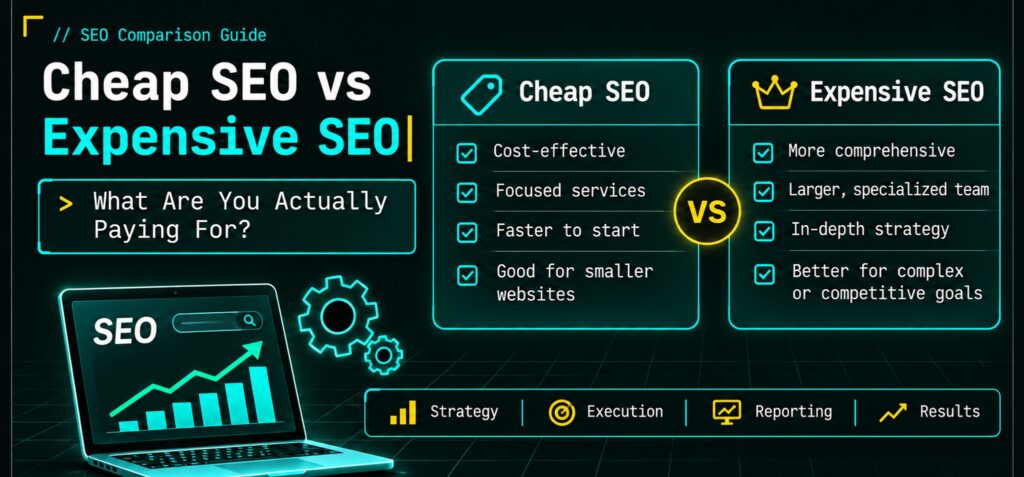
Image credit: SyncCrawl.com | Featured banner: Cheap SEO vs Expensive SEO
Hiring an SEO provider can feel like comparing two completely different products. One company quotes a few hundred dollars a month; another asks for several thousand. Both promise audits, content improvements, and better visibility. So what are you actually buying? The answer is not simply “better rankings.” It is a combination of working hours, specialist skills, campaign scope, communication, and accountability. For smaller websites, well-scoped Cheap SEO can be a sensible starting point when the work is transparent and matched to business goals.
What Does Cheap SEO Mean?
Cheap SEO describes search optimization offered at a relatively low price compared with large agency retainers. It can mean freelance consulting, a limited monthly package, or one-off work such as a technical audit. Affordable services might cover title tags, internal links, Google Business Profile improvements, keyword mapping, and fixing important crawl issues. Low price does not automatically mean low quality. A capable independent specialist may have fewer overhead costs than a large agency. The key question is whether the proposed work is specific, appropriate, and realistically achievable within the budget.
What Makes SEO Expensive?
Higher-priced SEO campaigns often involve multiple specialists: technical SEOs, content strategists, editors, developers, digital PR teams, and account managers. The budget may also cover original research, large-scale migrations, ecommerce architecture, international targeting, and detailed analytics. These resources can be valuable for complicated websites or fiercely competitive markets. But a premium retainer is not proof of expertise. Some expensive proposals include generous management fees while leaving little time for hands-on improvements. Buyers should request clear deliverables rather than assume the biggest invoice brings the best results.
Cheap SEO vs Expensive SEO: What Changes?
The largest difference is typically the breadth and depth of work rather than the basic rules of SEO. Both approaches should follow search engine guidelines, identify useful keywords, improve site accessibility, and measure meaningful outcomes. The comparison below shows common patterns, not guarantees.
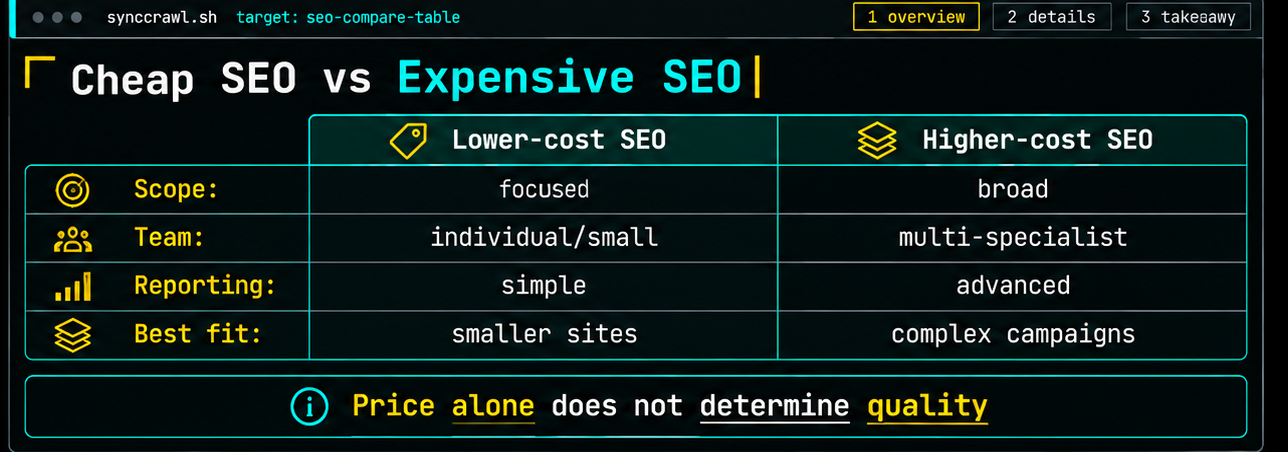
Image credit: SyncCrawl.com | Comparison illustration: budget and premium SEO
Budget SEO: focused priorities, smaller teams, simpler reporting, and limited monthly execution. Premium SEO: broader research, more specialists, advanced reporting, and larger campaigns. Either can work when the scope fits the website.
1. Strategy and Research
A low-cost project may prioritize a short list of keywords, a technical checklist, and the most valuable pages. A premium engagement may include extensive competitor analysis, content inventories, customer journey research, and forecasting. For a local service business with ten pages, the focused plan could be enough. For a national retailer with thousands of URLs, deeper analysis may prevent costly mistakes.
2. Technical SEO
Both tiers can fix broken links, crawlability issues, indexing directives, and slow templates. Expensive engagements are more likely to include developer coordination, log-file analysis, JavaScript rendering tests, and site migration support. Ask who implements recommendations. A beautiful audit is of limited value if nobody fixes the underlying problems.
3. Content and Link Earning
Lower-cost packages may optimize existing content and suggest topics. Larger budgets can fund expert writers, original data, editorial review, and digital PR. Be cautious when a provider promises hundreds of backlinks for a tiny fee. Links should be earned through relevant, genuinely useful work—not manufactured through spam networks.
4. Communication and Reporting
Affordable providers may offer a monthly update and direct access to the person doing the work. Larger agencies might provide dashboards, scheduled calls, and layered reporting. Neither reporting format matters unless it connects completed tasks with search impressions, qualified traffic, leads, and sales. Request examples before signing.
Where Cheap SEO Can Go Wrong
The greatest danger is not a low invoice; it is an undefined promise. Beware of guaranteed first-place rankings, automated link blasts, copied articles, undisclosed subcontracting, or long contracts with vague deliverables. Search performance can change for reasons beyond an agency's control, including competition, site updates, and search engine systems. Legitimate providers explain uncertainty and make it easy to see what they did.
If an existing website has suspicious links, hacked pages, or an unexplained drop in search traffic, diagnosis should come before buying more backlinks. A careful Negative SEO Service can help investigate potential malicious activity, but random spam links alone do not prove an attack. Google's systems can often ignore unnatural links, so disavowing everything marked “toxic” by a tool can create unnecessary risk.
When Is Expensive SEO Worth Paying For?
A larger investment becomes easier to justify when a website has substantial revenue at stake, multiple countries or languages, thousands of pages, complex technical dependencies, or a need for regular content production. Enterprise teams may need dedicated project management and collaboration across marketing, engineering, and compliance. In those cases, additional expertise and capacity can save time and reduce the cost of errors. The goal remains return on investment, not an impressive list of services.
How to Compare SEO Proposals Fairly
Before selecting a provider, ask five practical questions: What will be done in the first 30 days? Which pages or problems come first? How many hours or deliverables are included? Who performs the work? And how will progress be reported? Compare proposals against the same business objective. A $300 plan that solves three high-impact issues may offer more value than a $3,000 retainer filled with activities that do not affect customers.
For a small business, useful early priorities might include resolving indexing problems, rewriting weak service pages, improving local business information, creating clear internal links, and measuring conversions. These tasks are less glamorous than sweeping ranking guarantees, but they build a foundation. Review progress after a reasonable period; meaningful organic growth often takes months, and a lack of instant results is not automatically failure.
Where SyncCrawl Fits
SyncCrawl takes a freelance-led approach to SEO for businesses that value direct communication, practical technical work, and flexible support. Rather than treating every website as an enterprise campaign, the better starting point is to identify the obstacles that matter most, explain the work required, and choose a realistic scope. For a smaller company, that approach can help keep budgets focused without confusing affordability with shortcuts. Businesses should still compare any provider's current pricing, availability, deliverables, and track record before choosing.
Frequently Asked Questions
Is cheap SEO bad for Google rankings?
Not inherently. Results depend on the quality and relevance of the work, technical implementation, competition, and time—not just the monthly price.
How much should a small business spend on SEO?
There is no universal amount. Start with your goals and website condition, then select a scope that you can evaluate. A one-off audit can sometimes be a better purchase than an oversized retainer.
Can expensive SEO guarantee better results?
No. Higher budgets can buy more specialist time and production capacity, but no ethical provider can guarantee a particular Google ranking.
Final Verdict: Pay for the Work, Not the Label
Cheap SEO and expensive SEO are not opposites of good and bad. Affordable work can be effective when it concentrates on the right priorities, while premium work can be worthwhile when a complex website genuinely needs greater depth. Choose the provider that can explain the problem, show the planned work, measure business outcomes, and avoid risky shortcuts. For many small companies, starting focused and scaling only when the evidence supports it is the smartest investment.
Photo and illustration credit: SyncCrawl.com