
Introduction
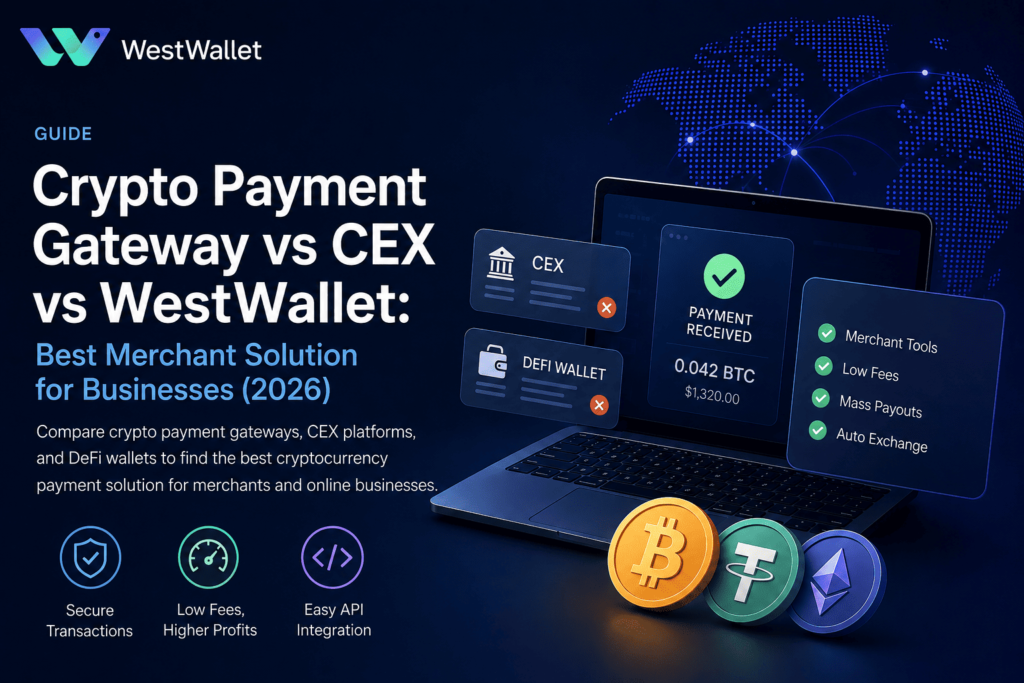
Cryptocurrency has become a mainstream payment technology for global businesses. Choosing the right crypto payment gateway, CEX, or DeFi wallet directly affects security, scalability, and customer experience. This guide compares the leading approaches to help merchants select the best cryptocurrency payment solution in 2026.
As adoption has accelerated, so has the variety of tools available to manage digital assets. Today, businesses face a crowded landscape filled with options ranging from traditional exchanges to self-custodial wallets and dedicated payment gateways. Each solution solves distinct problems, but picking the wrong infrastructure can lead to unnecessary overhead, security risks, and operational bottlenecks.
Understanding the differences between these platforms is essential for long-term growth. Rather than defaulting to the most recognizable brand name, companies need to evaluate which type of infrastructure aligns with their daily accounting, user management, and payment workflows. This guide delivers a comparative analysis of centralized exchanges (CEXs), decentralized finance (DeFi) wallets, and hybrid payment platforms like WestWallet to help merchants choose the optimal solution.
Centralized Exchanges: Built for Individual Traders, Not Business Operations
Centralized exchanges (CEXs) such as Binance, Coinbase, and Kraken remain the primary gateway into the digital asset ecosystem for millions of individuals. These platforms were engineered primarily for retail users, individual investors, and active market traders. They excel at providing high liquidity, advanced charting tools, order book depth, spot and derivatives trading, and direct fiat on- and off-ramps.
For companies looking to manage treasury reserves or execute large currency trades, centralized exchanges offer unmatched execution efficiency. However, their core architecture is optimized for individual accounts and trading activities rather than merchant payment infrastructure.
The Merchant Drawbacks of CEXs:
- Retail-Centric Architecture: CEXs are designed around single-user accounts, making multi-user administrative control and enterprise role permissions difficult to manage.
- Manual Operational Workflows: Managing incoming customer transactions on a trading exchange requires manual tracking, making high-volume reconciliation cumbersome.
- Limited Automation: Standard CEX interfaces lack native merchant tools like automated API-driven address generation, instant checkout widgets, and webhooks.
While centralized exchanges are indispensable for liquidating large volumes of crypto into fiat, using them as a direct payment gateway for daily business transactions often creates operational friction.
DeFi Wallets & Protocols: Maximum Control Beyond Live Support and Optimization
Decentralized finance (DeFi) wallets—such as MetaMask, Trust Wallet, or hardware setups—combined with decentralized protocols and smart contracts, offer a non-custodial approach where the user retains exclusive control over private keys. This model is essential for participating in Web3, interacting with decentralized platforms (DEXs like Uniswap or PancakeSwap), engaging with automated market maker (AMM) liquidity pools, and executing custom smart contracts without permission from an intermediary.
Self-custody offers complete financial sovereignty, eliminating third-party freeze risks and provider outages. For individual Web3 developers or crypto-native freelancers, this decentralized stack is often the preferred choice.
The Business Challenges of DeFi & Smart Contracts:
- Uncontrollable Slippage and Volatility Risks: Executing payments or swaps directly through smart contracts and DeFi protocols exposes merchants to significant price slippage during periods of network congestion or low liquidity. Unlike dedicated gateways with locked exchange rates, transaction execution on-chain can result in unpredictable financial losses before a swap settles.
- Absence of Live Customer Support: Because DeFi protocols and smart contracts are fully decentralized, there is no dedicated support team, account manager, or human intermediary to assist when transactions fail, get stuck, or encounter smart contract bugs—a major operational risk for enterprise businesses.
- Lack of Payment Optimization and Flexibility: Raw Web3 wallets and DeFi protocols lack pre-built commercial tools for dynamic fee management, automated routing, and flexible merchant settings required for smooth customer checkout flows.
- High Technical Overhead: Building automated invoice tracking, customer checkout flows, and database reconciliation on top of raw self-custodial wallets and custom smart contracts requires substantial software engineering and constant protocol maintenance.
- Key Management Risks: Managing raw private keys and contract authorization levels across a multi-employee organization introduces significant operational and security vulnerabilities if strict hardware key protocols are not maintained.
DeFi wallets and decentralized protocols provide unparalleled freedom for Web3 interaction, but their lack of live operational support, uncontrollable slippage risks, and absence of commercial optimization make them difficult to use as a standalone foundation for merchant payments.
Why Business Crypto Payment Platforms Emerged
To bridge the gap between speculative trading venues and complex raw blockchains, a specialized category of infrastructure emerged: dedicated business crypto payment processors.
Unlike CEXs that focus on retail trading or DeFi wallets that focus on protocol interaction, payment processors are engineered specifically around commercial transactions. Their primary goal is to simplify how organizations receive, manage, and distribute cryptocurrency while integrating seamlessly into existing business applications.
Key Capabilities of Merchant Payment Infrastructure:
- Automated Payment Gateways: Instant creation of unique deposit addresses or QR codes for every transaction.
- REST APIs and Webhooks: Real-time callbacks that automatically update order statuses, unlock digital goods, or renew subscriptions upon transaction confirmation.
- Dedicated Live Support: Direct access to technical support and account managers to ensure high uptime and prompt issue resolution for business operations.
- Mass Payouts: Automated batch processing for paying affiliates, vendors, global contractors, or platform users in a single operation.
- Multi-Currency Management: Centralized dashboards for monitoring balances across dozens of blockchain networks without needing separate software for each coin.
By replacing manual blockchain monitoring with automated merchant software, payment platforms allow companies to offer cryptocurrency as a standard payment method alongside credit cards and bank transfers.
WestWallet: A Practical Bridge for Merchants
An example of this specialized category is WestWallet, a multi-currency payment gateway designed specifically to handle merchant workflows and enterprise payment automation.
Rather than overwhelming users with complex trading charts or requiring custom smart-contract development, WestWallet provides ready-to-use business tools. The platform combines broad blockchain support with developer-friendly APIs, live technical assistance, instant payouts, and automated currency conversions designed to streamline daily financial operations.
How the Options Compare for Business Needs:
| Feature | Centralized Exchange (CEX) | DeFi / Self-Custody Wallet | Dedicated Processor (WestWallet) |
| Primary Focus | Individual Trading & Liquidity | Asset Sovereignty & Web3 | Merchant Payments & API Automation |
| Customer Support | Ticket-Based / Retail Support | None (Fully Decentralized) | Dedicated Live Business Support |
| Operational Flexibility | Restricted to Trading Rules | Raw Blockchain Interaction | Highly Optimized Payment Workflows |
| Developer Tools | Trading APIs | Web3 Libraries (Ethers.js) | Merchant APIs, Webhooks, Plugins |
| Payout Automation | Manual / Basic | Manual per Transaction | Mass Payout APIs |
For digital businesses processing recurring payments, using a specialized solution like WestWallet reduces internal software development costs while delivering a reliable checkout experience for end users.
Choosing the Ideal Strategy for Your Business
Selecting the right crypto setup depends on your core operational model. In practice, many modern enterprises combine multiple platforms to create a balanced financial architecture:
- For Daily Merchant Operations: Deploy a dedicated payment gateway like WestWallet to automate customer checkouts, manage payment callbacks, access responsive support, and handle mass payout processing.
- For Treasury & Liquidity: Transfer accumulated revenue periodically to a reputable CEX to convert crypto holdings into local fiat currency or stablecoins.
- For Web3 Ecosystem Engagement: Maintain isolated self-custodial DeFi wallets specifically for interacting with smart contracts, DAOs, or decentralized applications.
Understanding these structural distinctions ensures that your company doesn’t waste resources attempting to adapt a trading platform or raw self-custody setup into a merchant payment gateway. Matching your technical tools to your actual business workflows is the key to running a secure and scalable cryptocurrency operation.
Conclusion
As cryptocurrency adoption continues to grow, choosing the right infrastructure is becoming a strategic decision for businesses. While centralized exchanges (CEXs) are primarily designed for trading and DeFi wallets provide complete self-custody, many companies require a solution that simplifies the acceptance, storage, and management of digital assets in everyday operations.
WestWallet offers a custodial cryptocurrency wallet built for businesses that need to accept crypto payments, securely manage digital assets, and automate payment workflows from a single platform. With merchant-focused APIs, multi-currency support, automated payment processing, mass payouts, and dedicated technical support, WestWallet helps companies streamline cryptocurrency operations without the complexity of managing their own blockchain infrastructure.
For businesses with growing transaction volumes, WestWallet also provides exclusive Business API rates, including API fees starting from just 0.15%, transparent pricing, and priority support for eligible partners. These business conditions are designed to help merchants reduce payment costs while scaling their cryptocurrency operations.
Ready to accept cryptocurrency payments?
If you’re looking for a reliable custodial crypto wallet for business with integrated crypto payment processing, explore WestWallet’s Business solution. With secure asset custody, developer-friendly APIs, competitive fees starting from 0.15%, and tools designed specifically for merchants, WestWallet enables businesses to accept cryptocurrency payments, manage digital assets efficiently, and scale globally with confidence.