
The Caspian Week Forum came to Beijing in partnership with the China Overseas Development Association (CODA). Global Stratalogues, the forum’s intelligence partner, led the discussions on energy and critical minerals.
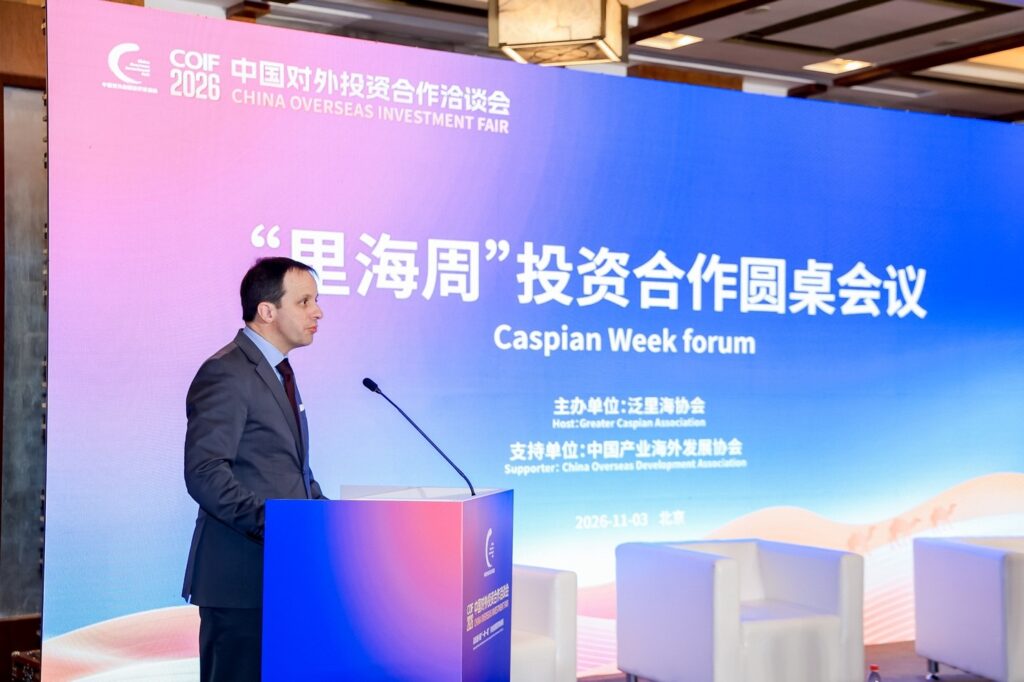
Ambassador Dr. David Fernández Puyana, Permanent Observer of the University for Peace to the United Nations Office at Geneva opens the Caspian Week Forum, held as a side event of the China Overseas Investment Fair (COIF 2026) in Beijing on 3 November.
For one afternoon on 3 November, the investment case for the Greater Caspian was made inside China’s flagship outbound investment fair. The Caspian Week Forum, organised by the Greater Caspian Association (GCA) and hosted by CODA, ran as a side event of the China Overseas Investment Fair (COIF 2026). Three panels and 16 speakers from China, Central Asia, the Gulf and Europe covered energy, critical minerals and Belt and Road connectivity.
Global Stratalogues, the independent forum and think tank, served as the forum’s intelligence partner. Its founder and chairman, Oscar Wendel, moderated two of the three panels, on energy and on critical minerals, and the organisation has published the event report. The backdrop is trade at record scale: China and Central Asia exchanged $106bn of goods in 2025, up 12% on the year before.
A host with reach into China’s outbound capital
CODA was founded in 2004 as a national non-profit administered by the National Development and Reform Commission. It co-founded COIF with China Development Bank in 2009, and the fair now draws participants from more than 110 countries and regions each year. More than 1,000 Chinese state-owned and private firms use the platform.
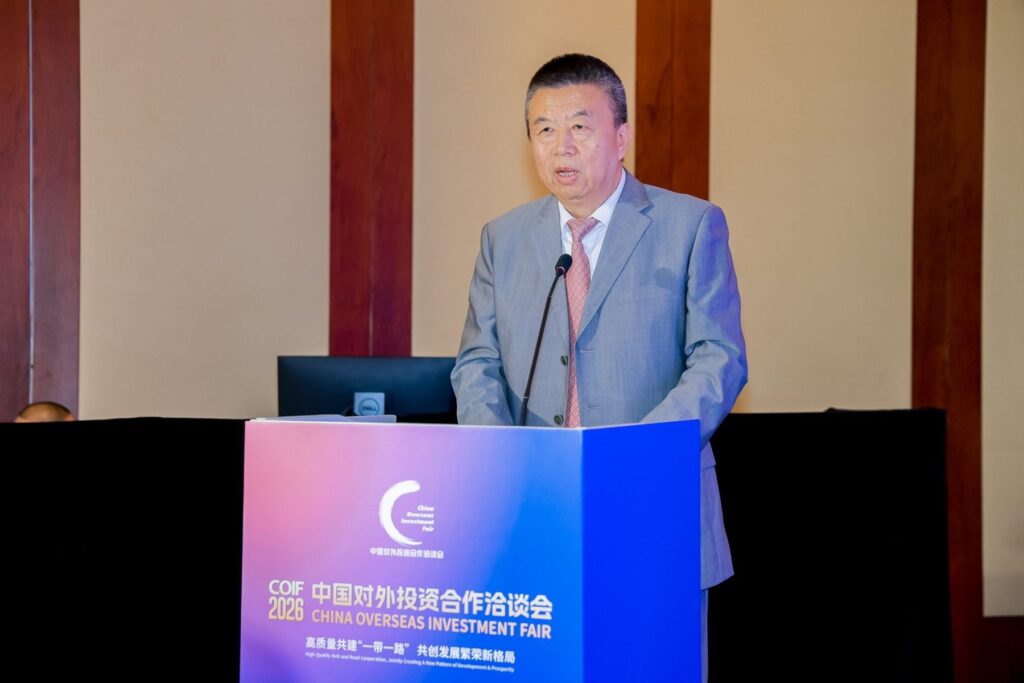
He Zhenwei, president of the China Overseas Development Association (CODA), gives opening remarks at the Caspian Week Forum.
Hosting Caspian Week inside COIF put the region directly in front of the companies and lenders that decide where Chinese capital goes next. CODA president He Zhenwei opened the forum, noting in his remarks that the China–Kyrgyzstan–Uzbekistan railway is moving ahead faster than planned. The event report identifies CODA as a natural channel for the follow-ups, including project pipelines and a pilot energy fund.
Eight countries, one investable region
Murat Seitnepesov, president of the GCA and chairman of ICC Tajikistan, has chaired Caspian Week since 2017. His presentation framed the Greater Caspian as 18 economies with a combined GDP of $12.8 trillion at purchasing power parity and more than 680 million people. Average growth of 4.5% a year between 2016 and 2025 compares with 3.1% for the world.
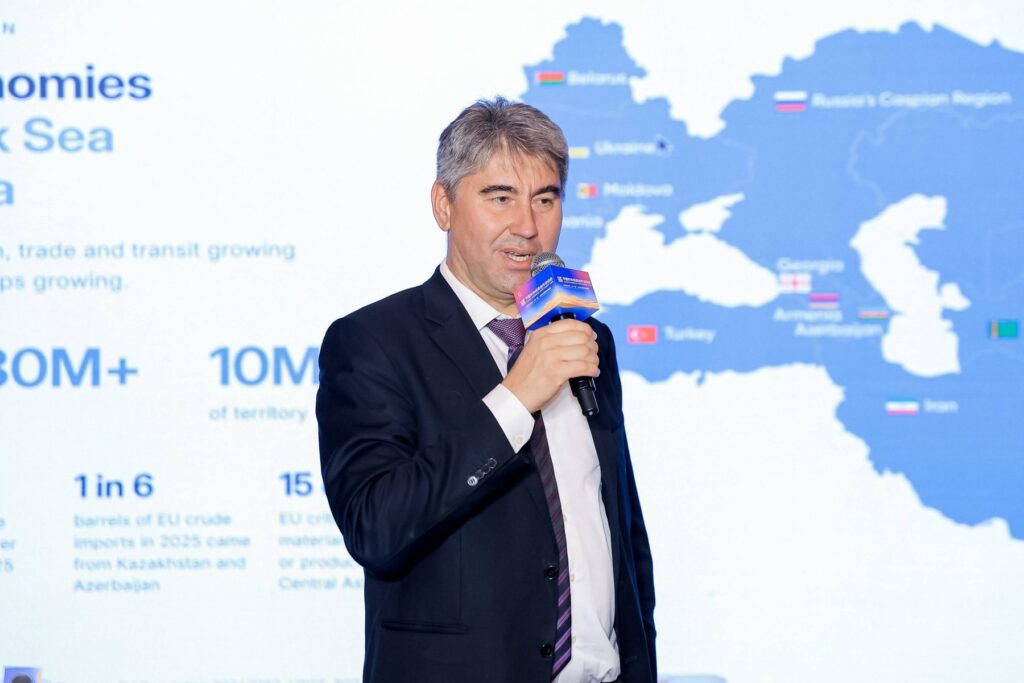
Murat Seitnepesov, president of the Greater Caspian Association, presents the investment case for a region of 18 economies.
He then narrowed the lens to Central Asia and the South Caucasus. “Let’s focus on these eight countries, not on geopolitics but on developing the economies and investment potential,” he told delegates.
The technology case ran through his country survey. Tajikistan, where about 60% of the region’s water originates, expects the Rogun hydropower plant at full capacity by 2028, which he said points to data centres and artificial intelligence. Uzbekistan he called “the rising star”, now “crowded” with investors after ten years of reform. His invitation to Chinese investors covered critical minerals and rare earths, hydropower-backed data centres, food processing equipment and rail-led logistics.
Energy security now means storage
Wendel opened the first panel, on energy security over land, with speakers from Peking University, Naseeh Invest, MegaRely New Energy Technology and Zhongjing Group. The discussion moved quickly from pipelines to batteries. China’s new-type energy storage in operation reached 153 GW by June 2026, from 9 GW in 2022.
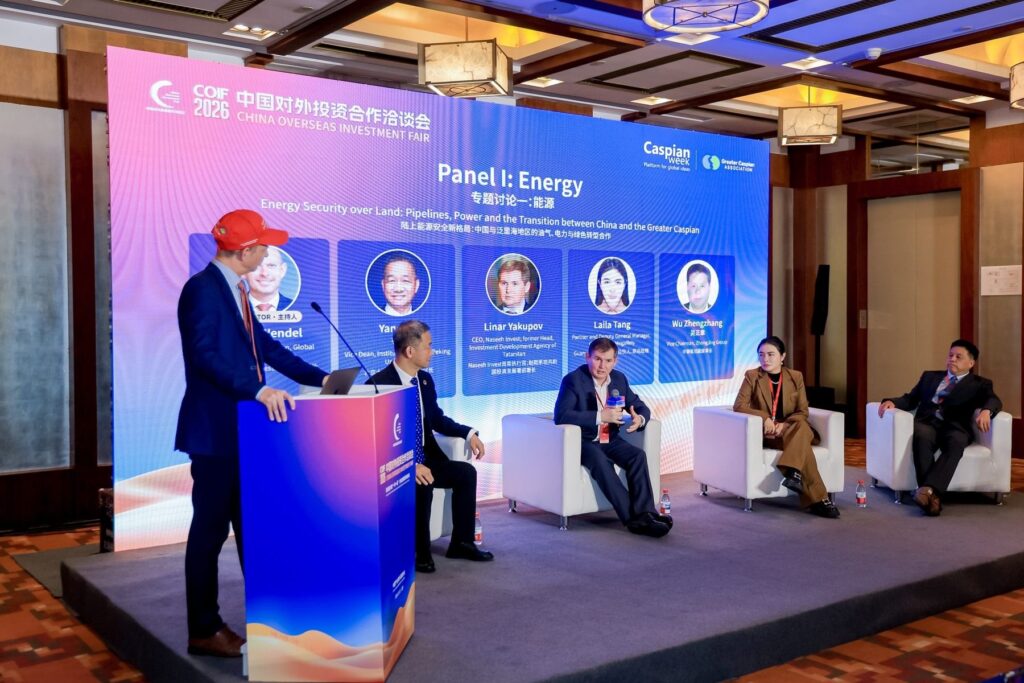
Oscar Wendel of Global Stratalogues (at the lectern) moderates Panel I on energy security with Yang Lei, Linar Yakupov, Laila Tang and Wu Zhengzhang.
Laila Tang of MegaRely argued that sodium-ion cells, which she said hold more than 80% of capacity at minus 40°C, suit remote mines, off-grid communities and data centre back-up. “Sodium battery is like a stabiliser and regulator of the renewables,” she said.
Linar Yakupov of Naseeh Invest pointed to Gulf capital arriving alongside Chinese partners, and to four Central Asian states legislating for AI and courting hyperscale data centres. Yang Lei of Peking University’s Institute of Energy called for shared policies and standards, without which lenders cannot price credit.
Wu Zhengzhang of Zhongjing Group named the gap. “The Caspian region does not lack resources, buyers, investors or capital. What is missing is a stable, predictable policy environment and flexible currency conversion.” He proposed a pilot Caspian Energy Fund within 12 months, with guarantee agencies and multilateral development banks taking the first layer of risk.
Critical minerals: beyond raw materials
Wendel also moderated the second panel, on processing, value chains and responsible investment. The stakes are material for clean technology supply chains. Kazakhstan produced about 40% of the world’s uranium in 2025, Uzbekistan has a $4.2bn critical minerals plan covering 120 projects to 2030, and the GCA counts 15 of the EU’s 34 critical raw materials as mined in the region.
Academician Zhai Mingguo of the Chinese Academy of Sciences said the region’s potential far exceeds its activity, and called for joint geoscience and partnership between equals. Gavin Yang of Beijing Dacheng Law Offices argued that investor and host interests meet when ore is processed near the mine. Konstantin Belotelkin of Overbest Group described large under-explored areas held back by gaps in logistics, energy and drilling services.
Wendel closed with three messages: science is critical, and so are finance and investment; timelines are long, so partnerships must be long-term and mutually beneficial; and deal structures must be thought through from the outset.
From transit route to trade hub
The third panel, moderated by Franz J. Marty of the Swiss Institute for Global Affairs, turned to the Middle Corridor. The Trans-Caspian route moved 76,900 containers in 2025, up 36%, yet 400 container trains ran westbound against 33 eastbound.
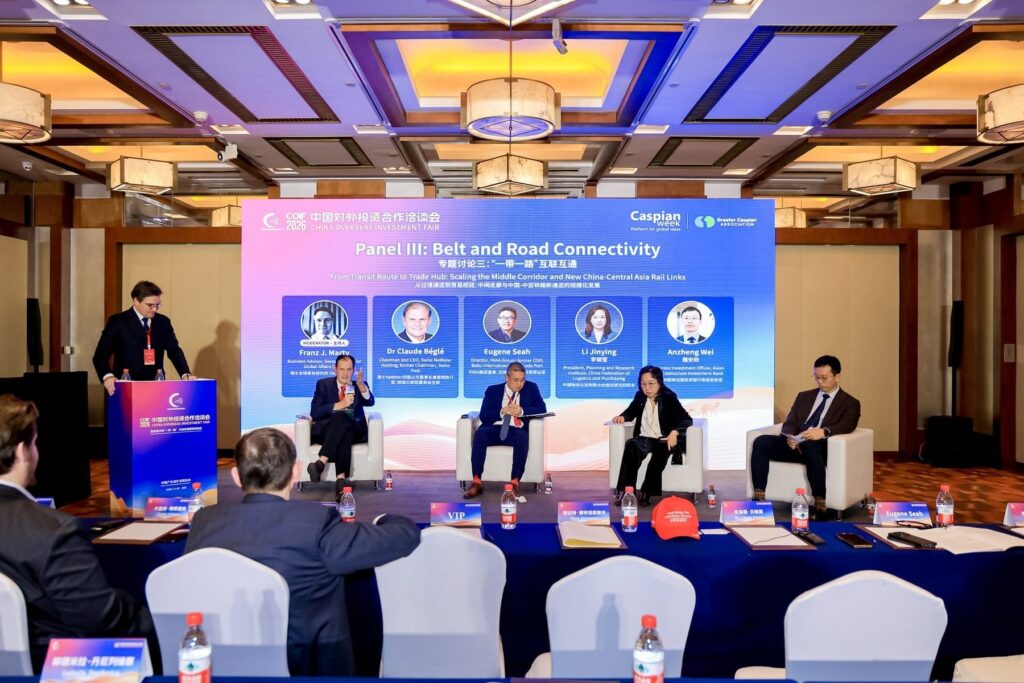
Panel III on Belt and Road connectivity examined how to scale the Middle Corridor and new China–Central Asia rail links.
Eugene Seah, former chief operating officer of the Baku International Sea Trade Port, located the problem at the transfer points, where a container is handled four times between ship and wagon. “A transit hub earns a transit fee. A trade hub earns from production along the route, and keeps earning,” he said. Li Jinying of the CFLP Planning and Research Institute offered to build a Middle Corridor Index with the GCA, covering cost, transit time, reliability and resilience.
The Report
The Global Stratalogues report sets out six practical moves for the next 12 months. They include the pilot energy fund, storage-plus-renewables projects at remote mines, mine-to-metal agreements, the corridor index and upgrades to ship-to-rail transfer on both shores of the Caspian.
One conclusion ran through all three panels. Capital, not resources, is the binding constraint, and host countries want value chains instead of ore exports and transit fees. The full event report is available at www.GlobalStratalogues.com and www.CaspianWeek.org
Previously in Press Release: Attorneys.org Unveils Redesigned Legal Directory Built for the AI Search Era