
The rampant success of Bitcoin in 2017 fast-tracked widespread investor interest in this cryptocurrency. As the leading cryptoasset by market capitalization and market dominance ($67.7 billion market cap and $3,856 per unit BTC), Bitcoin has transformed a niche sector into an industry worth an estimated $130 billion in total (March 1, 2019).
This figure pales in comparison to the total market capitalization of digital currencies at its apex (approximately $800 billion), but is substantial enough to warrant trader and investor attention. BTC price analysis indicates support around the $3,211, $2,918, and $2,122 levels (S1, S2, S3) while the resistance is hovering around $4,007 $4,510, and $5,306 levels (R1, R2, R3).
The extremely volatile nature of cryptocurrency is one of the reasons why fast profits and substantial losses are routine occurrences. From the moving averages perspective, Bitcoin’s SMA (5) is bullish, but the EMA (5) is bearish. The 20 and 30-day Simple and Exponential moving averages are all supportive of bullish action on Bitcoin.
What began as a fanciful idea for investors interested in blockchain technology has metamorphosed into a de facto alternative investment paradigm for thousands and thousands of global investors. One of the key protagonists in the legitimization process of Bitcoin is the CME Group. It launched a Bitcoin Futures product known as BTC H9.
Like any other futures option, this market offering is 100% legitimate with trading actively taking place on the Globex Futures Market. The CME Group is the premier derivatives marketplace with a wide range of unique financial instruments. It features DCM’s (designated contract markets) with product listings on reputable US exchanges.
While Bitcoin was writhing through the motions, institutional investors and management consultancies have been hard at work providing an alternative investment opportunity – a hedge – for Bitcoin. The concept itself is fascinating; it’s like playing a game of roulette with some of your chips on red and some of your chips on black to protect against an unfavorable outcome.
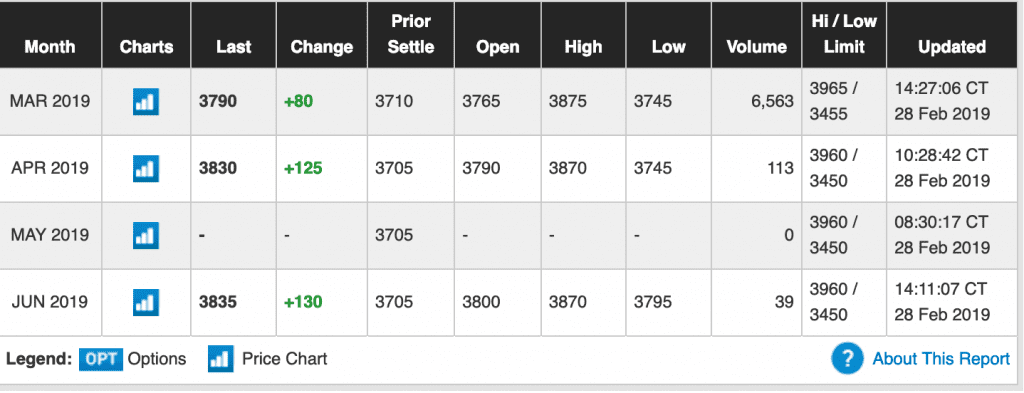
The futures markets are different however – they are legitimate training institutions where registered traders can extrapolate their price predictions and analytical prowess on a month-to-month basis. The objective is to determine a future price for Bitcoin. Based on the aforementioned contract data, is clear that the short-term trend between March 2019 and June 2019 indicates rising expectations. This can be perceived as a bellwether of Bitcoin’s bullishness.
Bitcoin Futures: Good or Bad for Bitcoin Traders?
It is difficult, at times impossible, to anticipate with any degree of accuracy which way the Bitcoin markets will go. The high levels of volatility experienced in the crypto assets arena have subsided to a degree as more people have opted for a holding job as opposed to a pump and dump scheme. The presence of futures markets for Bitcoin is widely perceived as a boon not a bane, for cryptocurrency trading. Here are some of the reasons why Bitcoin futures impact the decision-making processes of Bitcoin traders:
- Futures trading offers instant access to the bustling commodity markets.
- These are standardized contracts which can be used for buying/selling financial instruments
- Bitcoin futures trading can reduce your overall risk in Bitcoins (through hedging)
- Bitcoin futures are active around the clock, 6 days a week, and they offer significant liquidity with tight pricing and lower costs
- Bitcoin futures expose traders and investors to leveraged trading and oversized profit potential. However, this comes with a caveat since this increases your exposure to risk as well
- Bitcoin futures do not rely on Bitcoin price appreciation for traders to profit – traders can go either way with Bitcoin futures and generate profits in the process.
- Bitcoin futures have no annual management fees and do not confer ownership – they are derivatives trading instruments
Are Bitcoin ETFs Desirable Investments?
An ETF is an exchange traded fund. These are commonly traded in US and international stock markets, and for good reason. These funds clump together multiple stocks, or aggregate behavior of sectors, industries, or groups of stocks. In fact, an ETF brings together dozens, perhaps even hundreds of bonds or stocks into a single fund. It is the ‘safety in numbers’ mindset that drives investments in ETFs. Risking funds on a single stock or cryptocurrency such as Bitcoin is considered foolhardy by many seasoned investors.
However, an ETF spreads that risk across multiple different types of Bitcoin cryptocurrencies such as Bitcoin Cash, Bitcoin Gold, and Bitcoin, or includes other cryptocurrency assets as part of the ETF. The fact that an ETF is an exchange traded fund is significant. This should be considered a basket of individual assets, much like an index fund or a mutual fund. The diversification element is key to investing in ETFs.
What Are Potential Benefits of Investing in a Bitcoin ETF?
- Zero commissions at many brokerages per trade
- Decreased risk of loss, given that the ETF has pre-selected individual components to invest in
- Less time and management investment since fund managers take care of choosing the range of individual assets to invest in and manage
Some tech experts are gung ho about the potential benefits of a Bitcoin-style ETF. They believe that it would flood the crypto markets with additional capital from institutional investors which would drive up the price of this contrarian investment option. It makes sense at face value – institutional investors and fund managers have access to billions of dollars of client funds and can easily promote a Bitcoin ETF to their clientele. However, many people believe that demand is sentiment-based, rather than based on the availability of additional products like Bitcoin Futures or Bitcoin ETFs.
Meanwhile, the U.S. Securities and Exchange Commission (SEC) delayed plans for assessing the viability of Bitcoin ETFs and the government shutdown kicked the proverbial can further down the road. If the ETF proposals gain traction, it is quite possible that liquidity may enjoy an infusion of much-needed capital. If this happens, it could serve to fuel additional interest in Bitcoin and drive up investor sentiment.