
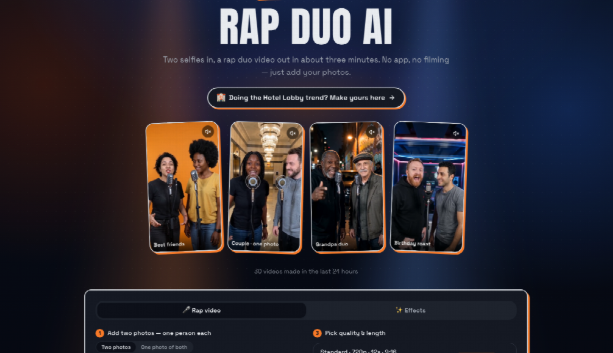
Mobile marketing teams frequently evaluate whether procedural generators can replace studio shoots for promotional hooks. Testing Rap Duo AI offers clear cost advantages when rapid campaign iteration matters more than bespoke cinematography.
Short-form video formats have transformed digital advertising from static display messaging into fast-paced entertainment. On channels like TikTok, Instagram Reels, and YouTube Shorts, promotional assets disguised as engaging music duets, playful roasts, and rhythmic trend challenges consistently generate higher comment volume and shares than polished corporate commercials. However, traditional media departments face severe resource constraints when trying to keep up with daily social media cycles using conventional filming methods.
Booking dedicated sound stages, hiring vocal talent, and coordinating multi-track post-production requires substantial financial investment and multi-week scheduling windows. For growth marketing teams testing dozens of campaign hooks each month, waiting two weeks for a single edited video asset creates intolerable lag. Exploring procedural generation on the Rap Duo platform provides an agile alternative, generating fully synchronized music videos from static portrait photography in minutes.
Evaluating The Shift Toward Automated Mobile Video Generation
The core challenge in contemporary social promotion is not merely producing high production value, but sustaining creative velocity. When a cultural audio trend captures public interest, marketing teams have a narrow window of several days to enter the conversation. Traditional production pipelines—burdened by talent contracts, camera rentals, and multi-round timeline reviews—are structurally incapable of moving at the speed of mobile feeds.
Automated video generators solve this latency problem by replacing manual keyframing with integrated neural synthesis. Instead of coordinating physical shoots across disparate geographic locations, marketers supply two frontal headshots and let procedural models handle lyrical generation, vocal synthesis, beat arrangement, and facial movement. This transition allows creative departments to test exploratory narrative hooks without committing thousands of dollars to unproven video concepts.
Comparing Production Workflows Speed Turnaround And Resource Needs
Comparing conventional physical studio production against browser-based procedural generation reveals stark operational trade-offs. While professional physical film sets deliver bespoke camera framing, customized prop staging, and nuanced human performance, they require extensive logistical preparation and substantial capital allocation. Automated generation prioritizes speed, standardized output consistency, and immediate turnaround.
| Operational Dimension | Traditional Studio Production | Browser Procedural Generation |
| Production Turnaround Time | 10 to 21 working days from script approval to final color export | 2 to 3 minutes from photo upload to final 720p vertical clip |
| Average Unit Cost | $2,500 to $8,000 per completed short-form video asset | $1.00 to $9.99 per generated video depending on credit plan |
| Talent Coordination | Requires physical actor staging, hair, makeup, and live audio capture | Requires two high-resolution frontal headshots with even lighting |
| Audio Engineering Pipeline | Manual beat composition, vocal tracking, pitch correction, and mixdown | Automated simultaneous lyrics, vocal performance, and beat generation |
| Re-shooting Flexibility | High financial penalty requiring studio re-booking and crew recall | Immediate iterative re-generation with updated topic prompts |
Analyzing Production Speed And Asset Turnaround Times
In high-velocity performance marketing, speed is often the deciding factor in creative testing. When testing promotional hooks for a seasonal promotion, marketing directors cannot afford multi-week production delays. A procedural browser workflow allows a growth team to generate five alternative concepts in a single afternoon, deploy them into paid test ad sets, and analyze audience retention before a traditional production agency would complete a preliminary storyboard review.
This acceleration fundamentally alters creative experimentation. When the marginal cost of producing a complete video drops from thousands of dollars to a few minutes of compute time, teams can embrace bolder, more playful messaging. Testing unconventional pairings, humorous internal shout-outs, or satirical product roasts becomes viable because failed creative experiments do not compromise the department’s monthly production budget.
Assessing Studio Rental And Audio Engineering Expenses
The budgetary contrast between both approaches is dramatic. Conventional studio recording involves sound engineer day rates, studio rental fees, camera operator equipment packages, and editing labor. Even a modest 15-second musical clip quickly accumulates substantial overhead, limiting production volume to a handful of hero assets each quarter.
Browser generation flattens these cost tiers entirely. Operating through structured credit packs or monthly subscription allowances eliminates capital expenditure, converting video production into a predictable operational expense. Marketers can produce dozens of synchronized music assets for the cost of a single hour of traditional studio sound editing, unlocking higher testing volume across demographic segments.
Examining Facial Animation Fidelity And Acoustic Synchronization Accuracy
For automated video generators to serve practical commercial purposes, output quality must satisfy mobile viewing standards. Audiences on vertical video platforms are exceptionally sensitive to unnatural facial distortion, disconnected mouth movements, and audio-visual lag. If a synthesized performance looks unconvincing or visually warped, viewers scroll away within seconds, damaging campaign retention metrics.
Deploying Rap Duo Video AI addresses these fidelity challenges by anchoring facial animation directly to acoustic waveforms. Rather than stretching a static facial texture over an arbitrary motion template, the neural network maps thirty-four structural landmark coordinates across both uploaded faces. As the generated hip-hop track plays, the engine calculates realistic jaw displacement, lip curvature, and head articulation that correspond strictly to phonetic accents.
Measuring Phonetic Lip Alignment Across Rapid Delivery
During our workflow evaluation, testing rapid sixteen-bar cadences revealed impressive synchronization precision. In earlier procedural video attempts, fast lyrical sequences frequently suffered from visual drift where mouth movements lagged noticeably behind vocal transients. The current pipeline prevents this desynchronization by processing phonemes and visual keypoints in unified temporal chunks, ensuring crisp lip closure on plosives and natural oral expansion on vowel holds.
This acoustic precision ensures that virtual performers maintain visual credibility throughout the 12-second clip. Viewers perceive the exchange as an authentic, energetic rap battle rather than an artificial still image with animated mouth cutouts. This distinction is critical for commercial engagement, as believable facial kinetics build viewer trust and encourage social sharing.
Evaluating Visual Atmosphere Across Predefined Stage Settings
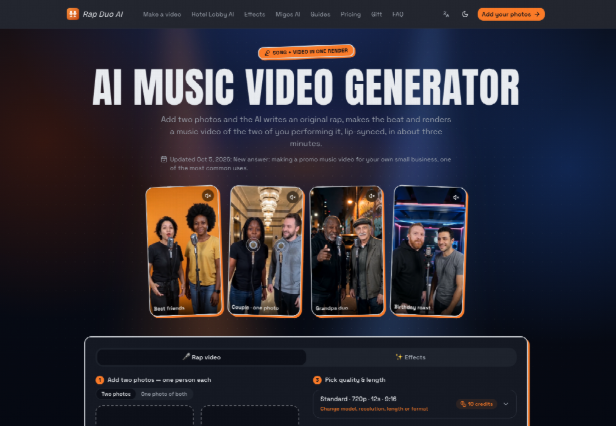
Visual context provides the framing necessary to make short clips feel complete. The Rap Duo environment offers several carefully calibrated stages, including the iconic orange Hotel Lobby booth inspired by viral hip-hop studio formats. Placing subjects in a warm, textured environment with defined background lighting focuses viewer attention on the performers while masking the artificiality of isolated portrait cutouts.
For more refined product narratives, the Luxury Lobby backdrop provides sophisticated architectural depth, while the Street Cypher setting delivers raw urban energy. By offering pre-rendered, lighting-balanced virtual stages, the platform eliminates the need for green-screen keying or manual compositing, outputting clean, ready-to-post 720p vertical video clips directly from the browser.
Analyzing Cost Efficiency And Credit Utilization Models
Evaluating commercial viability requires analyzing credit economics against publishing frequency. Marketing organizations typically operate with fluctuating production schedules, requiring billing models that do not penalize unpredictable creative calendars. The platform accommodates these variations by separating non-expiring credit packs from recurring high-volume subscriptions.
For agile campaign sprints or seasonal product drops, purchasing standalone packs—such as five songs for twenty-nine dollars or thirty-five songs for ninety-nine dollars—ensures that credits remain available indefinitely. Teams can purchase a bundle, test three creative iterations, and hold remaining balances until their next campaign window opens without fear of expiration penalties.
For continuous high-volume editorial operations, monthly subscription tiers reduce individual asset costs to approximately one dollar per video. Crucially, the platform enforces an automated no-charge policy on failed renders. If an unusual lighting angle or safety filter causes a generation failure, credits are immediately restored to the user’s account balance, ensuring that production teams only pay for usable creative deliverables.
Structuring Hybrid Production Pipelines For Social Campaigns
Rather than viewing procedural video generation and traditional studio production as mutually exclusive choices, leading digital marketing teams establish hybrid production models. High-stakes brand campaigns, major television commercials, and flagship product reveals continue to rely on physical production studios where bespoke artistic direction and human nuance remain indispensable.
Simultaneously, marketing departments integrate Rap Duo as an agile creative engine for everyday social channels. When testing promotional hooks, celebrating audience milestones, or launching participatory user challenges, procedural generation provides the speed and volume necessary to sustain organic momentum. Clean, watermark-free exports integrate seamlessly into secondary editing workflows, allowing post-production teams to add subtitles, branded overlays, and call-to-action cards in minutes.
This hybrid division of labor maximizes organizational resources. Production budgets remain focused on high-impact tentpole assets, while everyday engagement demands are satisfied through rapid, cost-effective procedural synthesis, maintaining a vibrant, culturally responsive brand presence across mobile video feeds.
Determining The Right Production Strategy For Your Team
Selecting the optimal video production pathway depends on clear campaign objectives, turnaround requirements, and budget constraints. When a project demands intricate multi-camera cinematography, narrative nuance, and custom physical set design, investing in conventional studio production remains fully justified.
However, when marketing priorities center on rapid trend responsiveness, iterative audience testing, and high-frequency short-form video output, procedural browser generation provides an unmatched competitive advantage. By transforming static portrait photography into dynamic, synchronized musical duets, creative teams can capture mobile attention efficiently and maintain a continuous, engaging presence across modern digital channels.