
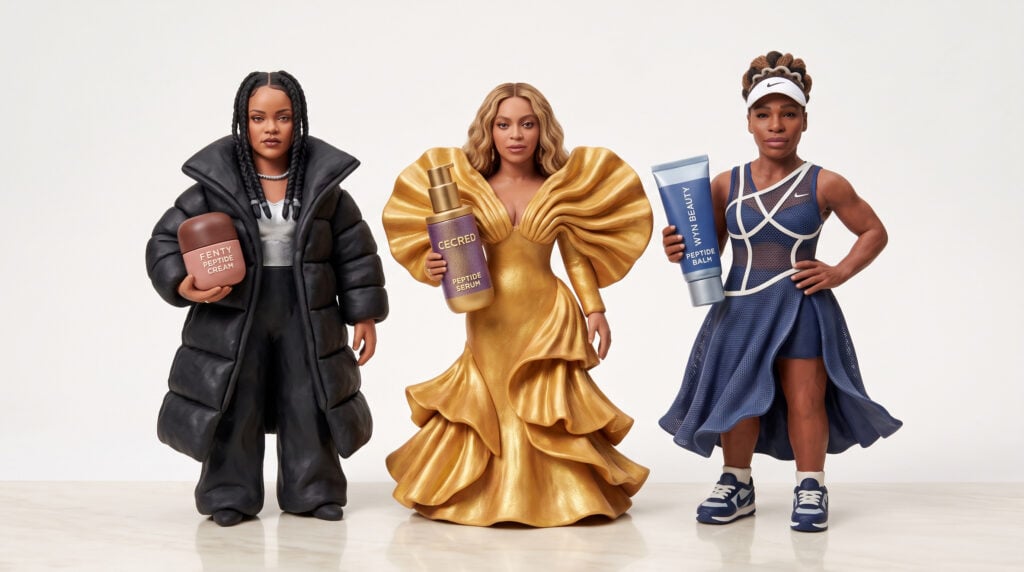
For decades, the global beauty, personal care, and wellness industries treated Black consumers as an afterthought. Products formulated for textured hair or rich, melanated skin tones were either chemically harsh, inadequately researched, or relegated to small, poorly stocked “multicultural” aisles. However, a seismic paradigm shift is currently underway. At the epicenter of this transformation are three of the world’s most influential cultural and financial powerhouses: Robyn “Rihanna” Fenty, Beyoncé Knowles-Carter, and Serena Williams.
Beyond their cultural cachet, these business titans are pioneering the integration of advanced biotechnology—specifically peptides—into everyday consumer products engineered specifically for Black skin and Black hair. Peptides, short chains of amino acids linked by peptide bonds, serve as fundamental cellular messengers. By signaling cells to synthesize structural proteins like collagen, elastin, and keratin, peptides offer targeted solutions for post-inflammatory hyperpigmentation, skin barrier compromise, traction alopecia, mechanical breakage in high-porosity coils, and physical recovery.
Through their respective brands—Fenty Beauty / Fenty Hair, Cécred, and WYN Beauty (alongside Serena’s wellness investments)—Rihanna, Beyoncé, and Serena are democratizing high-performance peptide science for Black America.
1. Rihanna: Redefining Melanated Skin Barrier Defense & Curly Hair Architecture
- Estimated Net Worth: ~$1.4 Billion
- Key Ventures: Fenty Beauty, Fenty Skin, Fenty Hair, Savage X Fenty
Robyn “Rihanna” Fenty revolutionized the cosmetic landscape in 2017 with the launch of Fenty Beauty, forcing the global beauty industry to adopt true inclusivity via her famous 40-shade (now 50-shade) foundation lineup—a phenomenon studied in business schools as the “Fenty Effect.” With an estimated net worth of $1.4 billion, built largely on her beauty and apparel empires, Rihanna has continuously expanded her vision into clinical skin and hair care.
Recognizing that melanated skin is particularly susceptible to post-inflammatory hyperpigmentation (PIH) and transepidermal water loss (TEWL) when the skin barrier is disrupted, Rihanna introduced specialized peptide technology across Fenty Skin and Fenty Hair.
Peptide Science & Function: Palmitoyl Tripeptide-1, Palmitoyl Tetrapeptide-7, and Hydrolyzed Peptides
In flagship skin formulations like the Fenty Skin Instant Reset Overnight Recovery Gel-Cream and Thicc Nectar Skin-Drenching Serum, Rihanna’s formulations utilize a synergized peptide blend of Palmitoyl Tripeptide-1 and Palmitoyl Tetrapeptide-7 (commonly referred to in cosmetic chemistry as Matrixyl 3000).
- Cellular Function in Melanated Skin: These extracellular matrix-signaling peptides mimic protein breakdown fragments. When applied topically, they signal fibroblasts to downregulate pro-inflammatory cytokines such as interleukin-6 (IL-6) while actively stimulating the synthesis of Collagen I, III, and Hyaluronic Acid. For Black skin, controlling inflammation is critical; by downregulating inflammatory cascades, these peptides directly prevent melanocytes from overproducing melanin, thereby tackling dark spots and uneven skin tone at the root cause.
In the 2024 launch of Fenty Hair—designed explicitly for Type 3 and Type 4 hair textures (coily, kinky, and curly)—Rihanna debuted her proprietary Replenicore-5 complex, heavily reliant on Hydrolyzed Vegetable and Rice Peptides.
- Function in Textured Hair: Textured hair possesses an elliptical cross-section and irregular cuticle scaling, making it prone to high porosity, mechanical breakage, and rapid moisture depletion. Low-molecular-weight rice and vegetable peptides penetrate past the outer cuticle layer into the inner cortex, forming ionic bonds with disrupted keratin chains. By filling internal cortical voids, these peptides increase tensile strength, restore natural bounce and elasticity, and protect fragile coils without causing stiff “protein overload.”
2. Beyoncé: Bio-Fermented Peptides for Textured Hair Repair and Scalp Longevity
- Estimated Net Worth: ~$760 Million
- Key Venture: Cécred (Parkwood Ventures)
Beyoncé Knowles-Carter, possessing an estimated net worth of $760 million built through music dominance, global stadium tours, film projects, and business investments, turned her focus to the sacred ritual of Black hair care with the launch of Cécred in 2024. Growing up working in her mother Tina Knowles’ hair salon, Beyoncé gained first-hand insight into the emotional and physical relationship Black women have with their hair, as well as the severe chemical and heat damage often sustained from protective styling, weaves, and chemical relaxers.
Rather than relying on traditional mineral oils and heavy waxes that merely coat the hair shaft, Beyoncé spent years in clinical research to engineer bioactive peptide solutions tailored for afro-textured hair.
Peptide Science & Function: Bioactive Keratin Ferment Peptides & Copper Tripeptide-1 (GHK-Cu)
At the core of Cécred’s line—most notably in the Fermented Rice & Rose Protein Ritual and the Reconstructing Treatment Mask—is a patent-pending Bioactive Keratin Ferment Peptide technology. This process uses microbial fermentation to break down bulky keratin proteins into microscopic, highly bioavailable peptide sequences.
- Cellular & Follicular Function: Human hair consists of over 85% keratin protein. Traditional keratin treatments rely on massive protein molecules that cannot penetrate the hair shaft without harsh chemical cross-linkers like formaldehyde. Cécred’s bio-fermented peptides feature a molecular weight under 1000 Daltons ($MW < 1000\text{ Da}$), enabling them to cross the cuticular barrier into the hair’s cortex. Once inside, they bind directly to damaged polypeptide chains, reconnecting broken disulfide bonds and restoring structural integrity.
Furthermore, scalp-focused treatments in the line explore the benefits of Copper Tripeptide-1 (GHK-Cu). Black women disproportionately experience hair thinning and traction alopecia due to tight braiding styles. GHK-Cu is a naturally occurring human peptide known for tissue repair and follicular angiogenesis (the creation of new blood vessels). When applied to the scalp:
- It stimulates microcirculation around dermal papilla cells.
- It increases hair follicle size, converting fine vellus hairs into thick, strong terminal hairs.
- It downregulates localized inflammatory markers, encouraging healthy, sustained hair growth.
3. Serena Williams: Dermal Resilience and Muscle Recovery Peptides for Active Lifestyles
- Estimated Net Worth: ~$340 Million
- Key Ventures: WYN Beauty, Serena Ventures, Will Perform
As one of the greatest athletes in history, Serena Williams has built an estimated net worth of $340 million through match prize earnings, endorsements, and her active venture capital firm, Serena Ventures. In 2024, Williams launched WYN Beauty to deliver high-performance, sweat-resistant, skin-nourishing cosmetics formulated for active, multi-hyphenate lifestyles.
Serena’s engagement with peptides spans both topical cosmetics and systemic recovery. Through her investment in recovery brands like Will Perform alongside her skin-first makeup line, she connects active physical recovery with daily dermal protection for Black consumers exposed to intense movement and environmental stressors.
Peptide Science & Function: Acetyl Hexapeptide-8 and BPC-157 / Recovery Peptides
In WYN Beauty formulations, such as the Featuring You Hydrating Skin Tint SPF 30, Williams incorporates Acetyl Hexapeptide-8 (popularly known as Argireline).
- Dermal Function: Widely recognized as a topical peptide alternative to neuromodulators, Acetyl Hexapeptide-8 targets expression lines formed during active movement and sun exposure. It mimics the N-terminal end of the SNAP-25 protein, competing for a position in the SNARE complex required for neurotransmitter release. By subtly attenuating muscle contractions under the skin, it reduces fine lines and keeps skin firm and hydrated without altering natural skin tone or requiring invasive procedures.
On the physical performance side, Williams’ focus on athletic recovery highlights the growing adoption of regenerative peptides like BPC-157 (Body Protection Compound-157) and TB-500 (Thymosin Beta-4 Fragment) among Black athletes and fitness enthusiasts.
- Recovery Function: BPC-157 is a synthetic 15-amino-acid peptide that accelerates tendon-to-bone healing, reduces joint inflammation, and promotes cell survival under oxidative stress by upregulating growth factor receptors ($VEGFR2$). As Black fitness culture increasingly adopts biohacking and longevity practices, Williams’ leadership helps bring these tissue-repairing peptides into mainstream wellness conversations.
Commercial Breakdown: Average Cost of Key Peptides
To understand the accessibility of these bioactive compounds for formulation or research purposes, the table below provides the average market cost for standard 5-gram or 10-gram quantities of the key peptides highlighted in this article:
| Peptide Name | Primary Function / Targeted Application | Typical Reference Mass | Average Cost Range (USD) |
| Palmitoyl Tripeptide-1 | Collagen synthesis, matrix repair, PIH prevention | 5 Grams | $180 – $260 |
| Palmitoyl Tetrapeptide-7 | Reductions in IL-6 inflammation, skin barrier defense | 5 Grams | $195 – $280 |
| Copper Tripeptide-1 (GHK-Cu) | Follicle angiogenesis, hair growth, scalp therapy | 10 Grams | $220 – $340 |
| Hydrolyzed Rice/Vegetable Peptides | Hair shaft reinforcement, porosity repair | 10 Grams (Raw Form) | $45 – $85 |
| Acetyl Hexapeptide-8 (Argireline) | SNARE complex inhibitor, fine line smoothing | 10 Grams | $140 – $210 |
| BPC-157 (Pentadecapeptide) | Tendon/muscle tissue repair & active recovery | 5 Grams (Bulk Lyophilized) | $350 – $550 |
Trusted sources for Peptide products can be found on Peptides Til link directory.