
Built from the ground up for AI workloads, the new serverless search engine promises dramatically faster performance, lower costs and a new approach to how developers and AI agents interact with data.
Artificial intelligence is changing nearly every aspect of enterprise computing, but one of the technologies most essential to its success has remained largely unchanged: search.
As businesses increasingly turn to AI agents, large language models and retrieval-augmented generation (RAG) to make sense of vast amounts of information, the demands placed on search infrastructure are growing exponentially. Applications need to retrieve information in milliseconds, understand the meaning behind queries rather than simply match keywords, and operate across enormous datasets without generating enormous infrastructure bills.
Yet much of today’s search infrastructure is built on technologies developed long before generative AI entered the picture.
That’s the opportunity that Big Data Boutique, a company with deep roots in the search industry, is targeting with the launch of WarpSearch, a new cloud-native search engine designed to challenge established platforms such as Elasticsearch and Apache Solr.
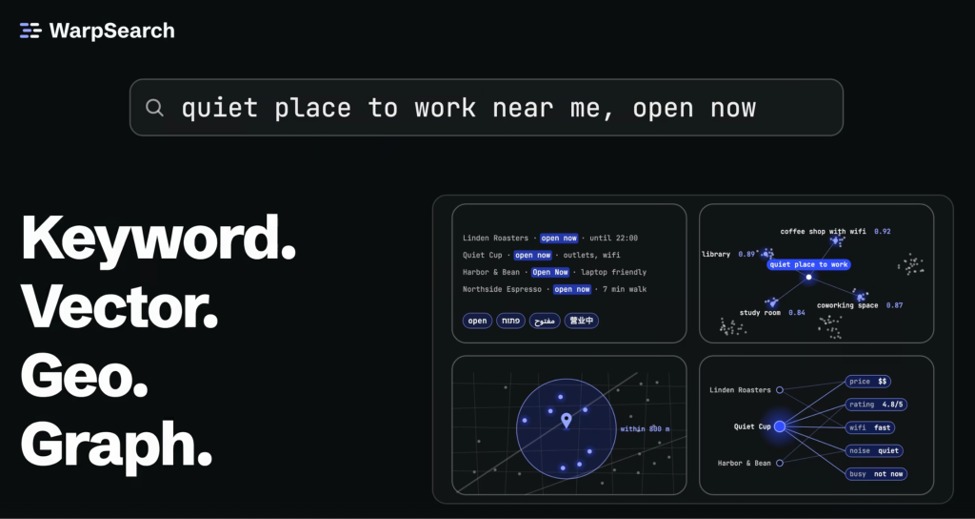
WarpSearch combines traditional keyword search with vector-based semantic search and other advanced retrieval capabilities in a fully serverless platform. The company claims it can deliver up to 50 times faster search performance and reduce costs by a similar factor, while maintaining compatibility with existing search APIs.
Behind the product is an intriguing proposition: that the infrastructure powering search needs to be fundamentally rebuilt for the AI era, rather than incrementally improved.
An Elasticsearch Expert Takes Aim at Elasticsearch
The company behind WarpSearch is no newcomer to the search industry.
BigData Boutique was founded by Itamar Syn-Hershko, a longtime search technology expert whose company has spent years helping enterprises deploy, manage and optimize large-scale data platforms, including Elasticsearch.
That experience has given Syn-Hershko a firsthand understanding of the strengths and limitations of existing search technologies. Now, rather than continuing to optimize those systems, he is betting that a new generation of applications demands an entirely different approach.
Elasticsearch and Apache Solr have been enormously influential in enterprise search, powering everything from e-commerce applications to security analytics and operational intelligence. But their underlying architectures were developed for a different computing environment, one in which traditional keyword search was the primary requirement and organizations were accustomed to provisioning and managing dedicated infrastructure.
AI has fundamentally changed that equation.
Modern AI applications increasingly rely on semantic search, which uses mathematical representations of information known as vectors to identify relationships between concepts. This allows applications to retrieve relevant information even when a query doesn’t contain the same words as the documents being searched.
The problem is that vector search can be resource-intensive, particularly when operating across hundreds of millions or billions of records. Combining it with traditional keyword search introduces additional complexity and potentially significant costs.
For organizations deploying AI at scale, those costs can quickly become a barrier.
WarpSearch is designed to eliminate that trade-off, delivering the sophisticated retrieval capabilities AI applications require without the infrastructure overhead associated with traditional search platforms.
Rebuilding Search From the Ground Up
Rather than building on an existing search engine, BigData Boutique developed WarpSearch using a new architecture optimized for speed, scalability and cost efficiency.
One of the most significant departures is its underlying programming language.
While Elasticsearch and Solr are built primarily in Java, WarpSearch is written entirely in C++, allowing its developers to work closer to the hardware and take advantage of low-level performance optimizations.
The engine uses techniques such as SIMD (Single Instruction, Multiple Data) processing, which enables processors to perform operations on multiple pieces of data simultaneously, alongside intelligent multilevel caching to accelerate search operations.
It also takes advantage of low-cost object storage, separating the economics of storing massive datasets from the more expensive computing resources required to search them.
This architectural approach is central to WarpSearch’s serverless model. Rather than requiring customers to provision and maintain dedicated search clusters, the platform manages infrastructure automatically and allocates resources based on demand.
AI also plays a role behind the scenes, helping optimize resource allocation so the platform maintains sufficient computing capacity without paying for unnecessary infrastructure.
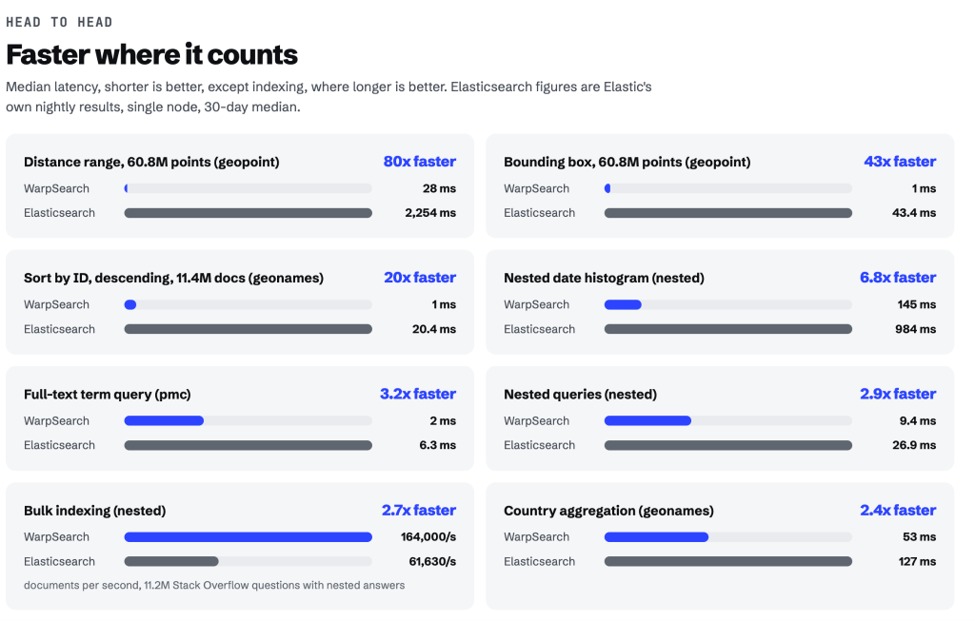
The company says this combination enables single-digit millisecond search latency for many workloads while dramatically reducing the cost of operating search infrastructure.
Its published benchmarks include median keyword-search response times of approximately 1 to 6 milliseconds on several datasets, although actual performance will depend on workload characteristics and deployment conditions.
Perhaps more importantly, the economic model is designed to make sophisticated search accessible to a much broader market.
WarpSearch offers usage-based pricing, with storage starting at $0.08 per gigabyte per month and search requests priced at $2 per million, alongside charges for data ingestion and certain additional resources. A free tier is available, while paid usage carries a $10 monthly minimum.
According to BigData Boutique, a small RAG application that might require hundreds of dollars per month using alternative infrastructure could potentially run on WarpSearch for approximately $10.
If those economics hold up across real-world deployments, they could significantly lower the barrier to building AI-powered applications.
Beyond Keyword Search: The Rise of Hybrid Retrieval
Cost and performance are only part of the challenge.
As AI applications become more sophisticated, developers increasingly need to combine different approaches to retrieving information.
Traditional keyword search remains highly effective for identifying exact terms, product names, identifiers and other structured information. Vector search, meanwhile, enables applications to identify semantically related content, making it particularly valuable for natural-language queries and RAG systems.
Neither approach is sufficient for every use case.
Hybrid search combines the strengths of both, enabling applications to retrieve information based on exact matches and contextual meaning within the same query.
WarpSearch brings these capabilities together in a single engine, eliminating the need for developers to maintain separate keyword and vector search systems.
BigData Boutique also sees graph-based retrieval, including techniques used in GraphRAG, as an important part of the future of search. These approaches go beyond retrieving individual documents to examine relationships between entities and information, potentially enabling AI systems to generate more contextually informed answers.
The larger vision is a unified search platform capable of supporting the increasingly diverse ways that AI systems access and reason over information.
Search Infrastructure Built for AI Agents
WarpSearch is also embracing another emerging trend in software development: the growing role of autonomous AI agents.
While most infrastructure platforms are designed primarily for human developers, WarpSearch is being built around the idea that AI agents will increasingly configure, deploy and manage software themselves.
The platform supports the Model Context Protocol (MCP), an emerging standard that allows AI assistants to connect with external tools and services.
In practical terms, this means a developer could instruct an AI assistant such as Claude to make a knowledge base searchable using WarpSearch, rather than manually creating accounts, provisioning infrastructure, configuring indexes and writing integration code.
The agent could handle much of that process, from setting up the environment to selecting collection settings and configuring search functionality.
This agent-first approach reflects a broader shift in software development, in which natural-language instructions increasingly replace manual configuration and repetitive engineering tasks.
For Big Data Boutique, the implication is that search infrastructure should not only power AI applications but also be designed to be operated by AI itself.
A New Challenger in an Established Market
WarpSearch enters an increasingly competitive market.
Elasticsearch, OpenSearch and Solr remain widely used, while other newer platforms are pursuing cloud-native approaches to vector search and AI retrieval.
WarpSearch’s strategy is to combine the performance and economics of modern serverless infrastructure with the broader functionality of a traditional search engine.
A key part of that strategy is API compatibility with Elasticsearch, OpenSearch and Solr, allowing developers to reuse existing clients and supported queries rather than rebuilding applications around a completely new interface.
There are limitations. WarpSearch does not currently support every Elasticsearch feature, including certain scripting, indexing and administrative capabilities. Organizations considering migration will need to evaluate whether their existing workloads are compatible.
Nevertheless, the approach could make WarpSearch attractive to organizations seeking to modernize their search infrastructure without undertaking a complete application rewrite.
The larger question is whether WarpSearch can deliver on its ambitious performance and cost claims as adoption grows and customers introduce more complex production workloads.
For Syn-Hershko, the bet is that the rise of AI represents an inflection point for an industry that has relied on the same foundational technologies for years.
Search is becoming more important than ever, but the requirements are changing. The next generation of applications will need to retrieve more information, understand it more intelligently and do so at a fraction of today’s cost.
With WarpSearch, BigData Boutique is betting that meeting those demands will require more than an incremental upgrade to existing technology.
It will require rethinking the search engine itself.