
Education has changed dramatically over the past decade. Students no longer depend only on classrooms, printed textbooks, or scheduled lectures to learn new skills. They now expect flexible, engaging, and personalized digital learning experiences that fit their pace, goals, and learning style.
Video lessons were one of the first major steps in this transformation. They made education more accessible by allowing learners to watch lectures anytime and anywhere. However, video-based learning alone does not always solve the biggest challenge in education: keeping every learner engaged and helping them progress according to their individual needs.
This is where AI-powered EdTech apps are making a difference. Instead of offering the same content to every learner, these applications can analyze learning behavior, identify strengths and weaknesses, recommend suitable lessons, and adjust difficulty levels in real time. The result is a more personalized learning journey that feels relevant, motivating, and effective.
In this blog, we will explore how AI is changing EdTech app development, the key features that make personalized learning possible, and how businesses can build education apps that go beyond basic video lessons.
Why Traditional Video Learning Is Not Enough
Video lessons have become a core part of online education. They are easy to produce, simple to distribute, and convenient for learners. Students can pause, rewind, and revisit lessons whenever they need. For many EdTech platforms, video content remains an essential foundation.
However, video learning has limitations.
A recorded lesson follows the same sequence for every learner. It cannot understand whether a student is confused, bored, falling behind, or ready for advanced material. It also cannot identify the exact point where a learner loses interest or struggles with a concept.
For example, two students may watch the same mathematics tutorial. One may understand the concept immediately, while the other may need additional practice questions, simpler explanations, or visual examples. A standard video course treats both learners exactly the same.
This creates several common problems:
- Learners lose interest when content feels too easy or too difficult.
- Students may complete lessons without truly understanding the topic.
- Educators find it difficult to track individual learning gaps.
- Platforms struggle to improve course completion rates.
- Learners receive generic recommendations instead of targeted guidance.
AI-powered EdTech applications address these issues by turning passive video watching into an active, adaptive, and personalized learning experience.
What Is an AI-Powered EdTech App?
An AI-powered EdTech app is a digital learning platform that uses artificial intelligence to improve how learners discover, consume, practice, and retain knowledge. It can analyze user data such as quiz scores, watch time, learning pace, mistakes, revision patterns, and engagement levels.
Based on this information, the app can make intelligent decisions such as:
- Recommending the next best lesson.
- Adjusting the difficulty of practice questions.
- Identifying weak subject areas.
- Suggesting revision material before assessments.
- Sending reminders based on learning habits.
- Creating personalized study plans.
- Providing instant feedback on quizzes and assignments.
The goal is not to replace teachers or trainers. Instead, AI acts as a smart learning assistant that supports both students and educators. It helps learners receive the right content at the right time, while giving teachers better visibility into student progress.
The Shift From One-Size-Fits-All to Personalized Learning
Traditional online courses often follow a linear structure. Learners move from Module 1 to Module 2, then Module 3, regardless of whether they have mastered the previous concepts. This approach may work for some students, but it can create frustration for others.
Personalized learning changes this model.
Instead of forcing every learner through the same path, AI-powered EdTech apps create individual learning journeys. A beginner may receive more foundational lessons, practice exercises, and revision prompts. An advanced learner may skip basic material and move directly to challenging topics.
For example, in a coding education app, one learner may struggle with JavaScript functions while another may already understand them. An AI-powered platform can detect this difference and recommend different lessons, exercises, or projects for each learner.
This approach improves learning outcomes because students spend more time on areas where they need help and less time repeating content they already understand.
Key AI Features in Modern EdTech Apps
Adaptive Learning Paths
Adaptive learning is one of the most valuable applications of AI in education technology. It allows the app to change the learning path based on each student’s performance and behavior.
If a learner answers several questions incorrectly in a particular topic, the system can provide simpler explanations, additional examples, or beginner-level practice. If the learner performs well, the app can introduce advanced concepts or more challenging assignments.
Adaptive learning paths make education feel less like a fixed course and more like a guided journey designed for the individual learner.
Intelligent Content Recommendations
AI can recommend lessons, quizzes, articles, videos, and practice tests based on a learner’s goals, interests, and previous activity.
For example, a student preparing for a competitive exam may receive recommendations based on weak subjects, upcoming test dates, and previous performance. A professional learning platform may suggest courses based on career goals, current skills, and industry demand.
These recommendations help learners stay focused and avoid feeling overwhelmed by too much content.
AI-Based Assessments and Instant Feedback
Traditional assessments often provide results only after completion. AI-powered assessment systems can provide instant feedback while a learner is answering questions.
The app can identify patterns in mistakes, explain why an answer is incorrect, and suggest relevant learning material. This immediate feedback helps students correct misunderstandings before they become bigger learning gaps.
For subjects such as mathematics, coding, language learning, and science, AI can also evaluate answers beyond simple right-or-wrong responses. It can analyze steps, logic, grammar, pronunciation, or coding structure.
Learning Gap Detection
One of the biggest advantages of AI is its ability to identify learning gaps early.
By analyzing quiz results, assignment performance, time spent on lessons, and repeated mistakes, the app can detect topics that a learner has not fully understood. It can then recommend revision material or additional practice before the learner moves ahead.
This is especially useful in subjects where concepts build on each other. For example, a student who struggles with basic algebra may find advanced mathematics difficult later. Early detection helps prevent such issues.
Personalized Study Plans
AI can create study schedules based on a learner’s availability, goals, exam dates, and current knowledge level.
Instead of asking students to follow a generic timetable, the app can suggest daily or weekly targets. It can also adjust the plan if a learner misses sessions, performs better than expected, or needs extra revision.
This makes learning more manageable and helps students stay consistent over time.
Gamification and Engagement Intelligence
Engagement is one of the biggest challenges in online education. Many learners start courses with enthusiasm but lose motivation after a few sessions.
AI can help improve engagement by analyzing when users are most active, which content keeps their attention, and where they tend to drop off. Based on this data, the app can send timely reminders, suggest shorter lessons, unlock rewards, or recommend interactive activities.
Gamification elements such as streaks, badges, leaderboards, challenges, and progress bars can also make learning more enjoyable. When combined with AI insights, these features become more meaningful because they respond to each learner’s behavior.
Essential Features of an AI-Powered EdTech App
Personalized Learner Dashboard
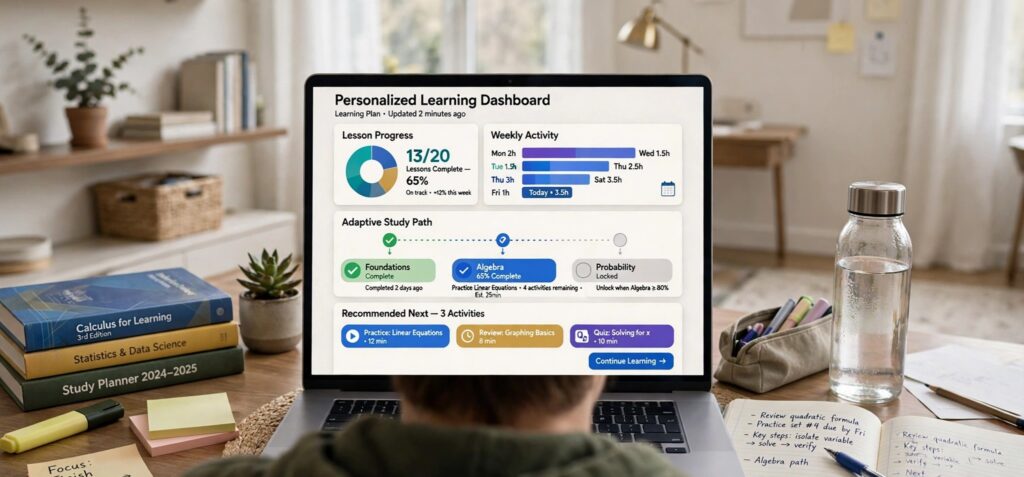
A interactive edtech application with personalized dashboard gives students a clear view of their progress, upcoming lessons, pending assignments, quiz scores, and recommended activities.
Instead of showing the same homepage to every user, the app can highlight the most relevant next steps for each learner. This reduces confusion and helps students understand exactly what they should do next.
Interactive Video Lessons
Video remains important, but it should not be the only learning format. Modern EdTech apps can make videos more interactive by adding quizzes, timestamps, notes, bookmarks, subtitles, and chapter-based navigation.
AI can also identify sections where learners pause, rewind, or rewatch frequently. This data helps educators improve content quality and identify confusing topics.
Practice Tests and Smart Quizzes
Practice is essential for learning. AI-powered quizzes can adjust question difficulty based on performance and provide targeted explanations for incorrect answers.
The app can also generate practice sets focused on weak areas, helping learners prepare more effectively for exams or certifications.
Offline Learning Mode
Many learners use mobile apps in places with limited internet access. Offline mode allows students to download lessons, notes, and practice material for later use.
Once the device reconnects, the app can sync progress and update recommendations. This feature is especially important for EdTech platforms targeting students in diverse geographic locations.
Notifications and Smart Reminders
Notifications should support learning, not annoy users. AI can determine the best time to send reminders based on a learner’s activity patterns.
For example, if a student usually studies in the evening, the app can send a reminder at that time. If a learner has an upcoming exam, the app can prioritize revision material and practice tests.
Educator and Admin Dashboard
An effective EdTech app should serve learners as well as educators. Teachers, trainers, and administrators need access to dashboards that show student progress, engagement levels, completion rates, and learning gaps.
This helps educators identify students who need support and improve course content based on real performance data.
How AI Improves Learning Outcomes
AI-powered personalization can improve learning outcomes in several ways.
First, it helps learners focus on relevant content. Instead of wasting time on material they already know, students can concentrate on areas that need improvement.
Second, it encourages active learning. Quizzes, instant feedback, practice exercises, and adaptive challenges keep learners involved rather than allowing them to passively watch videos.
Third, it builds confidence. When learners receive guidance suited to their level, they are more likely to understand concepts and continue progressing.
Fourth, it improves retention. Regular revision, spaced practice, and targeted recommendations help students remember information for longer periods.
Finally, AI gives educators actionable insights. Instead of relying only on final exam results, teachers can understand how students are learning throughout the course.
Challenges in AI-Powered EdTech App Development
Data Privacy and Security
EdTech apps collect sensitive information, including student performance, learning behavior, and sometimes personal details. Businesses must implement strong data protection practices and comply with relevant privacy regulations.
Secure authentication, encrypted data storage, role-based access, and transparent privacy policies are essential for building user trust.
Content Quality
AI can recommend content, but it cannot replace well-designed educational material. The success of an EdTech app depends on accurate, structured, and engaging content created by subject-matter experts.
AI should support the learning experience, not compensate for poor content quality.
Avoiding Over-Personalization
Personalization is valuable, but too much automation can make learners feel monitored or restricted. The app should give students control over their learning path while still providing helpful recommendations.
A balanced approach works best: AI suggests, but the learner decides.
Technical Complexity
Building an AI-powered EdTech app requires expertise in mobile development, backend architecture, cloud infrastructure, data processing, and machine learning. Businesses should start with a clear MVP and add advanced AI features gradually.
Steps to Build an AI-Powered EdTech App
Define the Learning Goal
Before development begins, businesses should define the core purpose of the app. Is it designed for school students, university learners, working professionals, test preparation, language learning, or corporate training?
A clear audience and learning goal will shape the features, content structure, and AI strategy.
Identify Core User Journeys
Map out how students will use the app from onboarding to course completion. Important journeys may include signing up, taking an assessment, watching a lesson, completing a quiz, receiving recommendations, and tracking progress.
Start With an MVP
Instead of building every feature at once, start with a minimum viable product. Include essential features such as user profiles, course content, quizzes, progress tracking, notifications, and basic recommendations.
Once real user feedback is available, add advanced AI capabilities such as adaptive learning paths, predictive analytics, and personalized study plans.
Choose the Right Technology Stack
The technology stack should support scalability, performance, security, and future AI integration. Businesses may use native mobile development, cross-platform frameworks, or progressive web apps depending on their audience and budget.
Cloud infrastructure is often useful for handling video content, user data, real-time updates, and AI-driven recommendations.
Test With Real Learners
Testing should go beyond checking whether features work. Businesses should test whether learners understand the app, stay engaged, complete lessons, and find recommendations useful.
Feedback from real users helps improve both the learning experience and the AI model.
The Future of AI in EdTech
The future of EdTech will be shaped by more intelligent, interactive, and human-centered learning experiences. AI will not simply recommend videos; it will act as a learning companion that understands individual progress and adapts to changing needs.
We can expect to see more AI tutors, voice-based learning assistants, real-time doubt solving, immersive learning through AR and VR, and deeper integration between learning platforms and career development tools.
However, the most successful EdTech apps will be those that combine technology with empathy. AI can analyze data and suggest next steps, but human guidance, strong content, and meaningful interaction will remain essential.
Conclusion
Video lessons made online education more accessible, but AI-powered EdTech apps are taking digital learning to the next level. By using adaptive learning paths, intelligent recommendations, instant feedback, learning gap detection, and personalized study plans, these applications create learning journeys designed for each student.
For businesses planning to enter the EdTech market, the opportunity is clear. Learners no longer want generic courses—they want experiences that understand their goals, adapt to their pace, and help them improve consistently.
Building an AI-powered EdTech app requires the right mix of education strategy, user experience design, technology, and data intelligence. When done well, it can transform passive video watching into an engaging, personalized, and outcome-driven learning experience.