
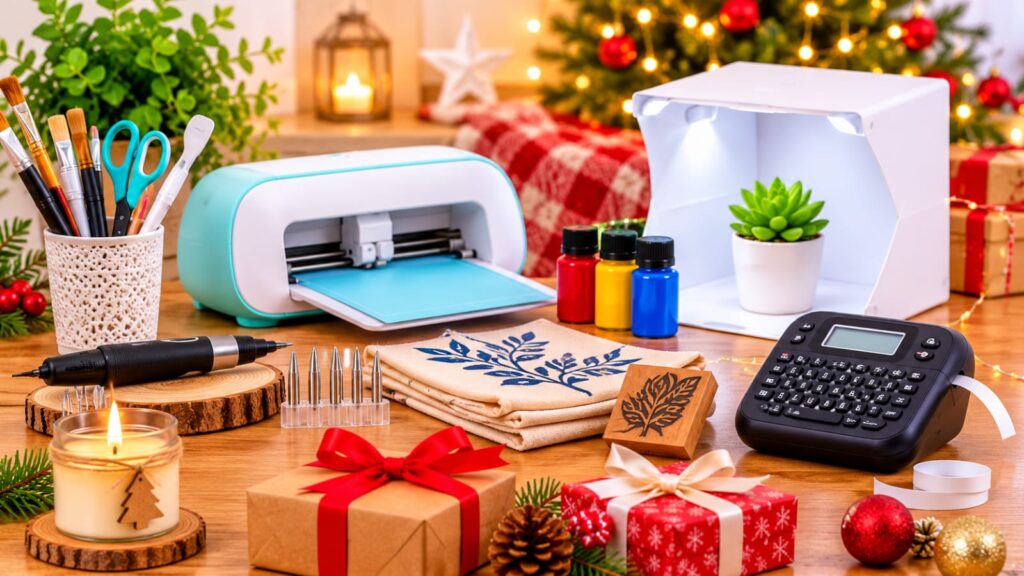
Someone who’s just started selling handmade goods usually handles more than making the products. They also need to take photos, organize supplies, and pack orders, often with a fairly basic setup. If you’re choosing a Christmas gift for them, think about which part of that routine is taking up most of their time. That can point you toward something they’ll use straightaway.
We’ve compared six gifts under $100 for those different tasks, including what each one comes with and anything extra they’ll need.
Gifts Matched to a New Maker’s Next Step
The table groups the gifts by the tasks they help with, so you can compare making tools with accessories for photography, packing, and organization. We’ve included potential follow-on costs as well. US item prices were checked in November 2026 and exclude tax, shipping, and replacement materials.
| Gift | Best for | Listed price | What else to budget for |
| Resparked Original Customizer Engraving Pen | Testing personalized hard-surface products | $69.99 | Compatible product blanks and safety supplies |
| Cricut Joy 2 Machine Only | Small decals, labels, cards, and cut designs | $99.00 | Materials and possible accessories/software features |
| Speedball Deluxe Fabric Block Printing Kit | Small-batch hand-printed textiles | $78.11 | Blank fabric items and replacement materials |
| Orangemonkie Foldio1 Lightbox | Photographing small handmade items | $29.99 | Camera or phone and photo workflow |
| Brother P-touch PT-D220 Label Maker | Organizing small inventory and supply bins | $44.99 | Replacement tape and power supply |
| Bramble Berry Vanilla Sandalwood Candle Starter Kit | Practicing a small product batch | $29.99 | Future wax, tins, testing, and compliant labeling |
How We Chose Gifts for New Handmade Sellers
We checked manufacturers’ descriptions, package contents, and listed prices. These are research-based comparisons, without claims of hands-on testing or proven business results. The main question was whether each gift could help with a real task without forcing a new maker into a large second purchase.
Our selection criteria were:
- Clear workflow fit: Does the gift help make, customize, present, or organize a product?
- Accessible entry price: Is the core item affordable without disguising major required extras?
- Repeatability: Can the recipient use the purchase beyond one demonstration project?
- Practical scope: What can the equipment genuinely do, and where would a growing business need something else?
Six Gifts for Someone Starting a Handmade Business
Someone testing product ideas may appreciate a tool that helps make a first sample. Once they’re filling orders, clearer product photos and organized supplies can become more pressing. The six options below suit different stages, so it helps to know what they’re working on next.
1. Resparked Original Customizer Engraving Pen: Best for Testing Personalized Products
Best for: Someone who wants to explore small personalized products on compatible surfaces before investing in larger equipment.
The Resparked Original Customizer Engraving Pen is an option for someone experimenting with personalized keepsakes on compatible wood, metal, glass, or other suitable surfaces. It’s cordless, weighs about 50 grams, and charges over USB-C, with three speed settings. The Original package was listed at $69.99 and includes 30 diamond bits, a carbide burr, guides, and practice surfaces for learning the technique.
Those practice pieces give a new maker room to work out how long a design takes and whether they can produce a neat result more than once. It’s worth finding that out before buying a stack of blanks for a product idea. The pen can still be useful for personal projects if they decide not to sell their work.
Manual engraving depends on steady technique, though, and a small handheld pen isn’t a substitute for equipment built for consistent high-volume production. The recipient will also need compatible blanks, eye protection, and dust control, plus a realistic understanding of material and labor costs. It’s a sensible experimental gift, not a promise of profit.
2. Cricut Joy 2 Machine Only: Best for Small Cut-Paper and Vinyl Projects
Best for: Someone making small labels, cards, decals, or vinyl designs who doesn’t mind using a digital design workflow.
The Cricut Joy 2 is designed for small cut-paper and vinyl projects such as labels, cards, and decals. A maker who’s already planning those products may appreciate the consistent cuts a compact digital machine can provide. The machine-only option was listed at $99, leaving little of the initial budget for materials.
Once a design is ready in Cricut’s software, it can be cut repeatedly with consistent outlines. That can help with card batches or vinyl packaging details, and the machine takes up little space. The design work does happen on a device, so it’s useful for someone comfortable with a digital workflow.
Paper, vinyl, tools, and some design assets or software features may cost extra. The Joy 2 also doesn’t engrave or print images. If the person you’re shopping for mostly works with leather or carved wood, find out whether they actually want to add cutting to their process before buying it.
3. Speedball Deluxe Fabric Block Printing Kit: Best for Small Runs of Printed Goods
Best for: A maker who wants to produce small batches of printed totes, patches, or other suitable fabric goods.
The Speedball Deluxe Fabric Block Printing Kit lets a maker carve a motif and print it repeatedly on suitable textiles. It includes two blocks, four fabric ink colors, a brayer, an inking surface, and carving tools. At a listed $78.11, it may suit someone preparing a small range of printed totes, patches, or fabric accessories.
Using the same block across several pieces makes it easier to develop a recognizable design. Hand-applied ink introduces some variation, and a short run will show the maker how much time they’re comfortable spending on each item. The tools remain useful for personal projects if selling doesn’t become part of the plan.
There’s work behind the repeatability. The maker needs separate textile blanks, must handle carving tools safely, and should test ink setting and wash durability before offering printed goods for sale. This can be a practical way to explore printmaking, but it isn’t an instant route to producing large quantities.
4. Orangemonkie Foldio1 Lightbox: Best for Photographing Small Products
Best for: Someone who already makes small products but can’t get consistent photos in their current workspace.
The Orangemonkie Foldio1 is useful when a maker already has small products to photograph. The foldable studio is about 10 inches across and includes two USB LED strips and four background colors. At a listed $29.99, it gives someone working at a shared table a more consistent setup for product photos.
With a lightbox, someone can photograph several similar items under steadier lighting and with the same backgrounds. It folds away after the session, which helps in a small home workspace. This may be more valuable than another production tool for a person who’s already making things they want to list.
The Foldio1’s size is the main limit: larger bags and wall pieces won’t fit, and reflective materials may still be difficult to photograph. The recipient will still need a phone or camera and some basic photo editing. It’s an addition to a product-photo workflow, not a complete photography solution.
5. Brother P-touch PT-D220 Label Maker: Best for Organizing Supplies and Orders
Best for: Someone whose materials and finished stock are beginning to outgrow an improvised drawer system.
The Brother P-touch PT-D220 helps a maker organize parts, supplies, and finished stock as the collection grows. It’s a keyboard-operated label maker for TZe tape up to about half an inch wide, with a sample black-on-white cartridge included. The listed price was $44.99.
A few clear labels can save time when materials are spread across bins and drawers. For someone keeping track of thread colors, packaging, and product blanks, knowing where everything lives can be genuinely useful during order preparation.
It won’t produce shipping labels or full-color product stickers, since this model is designed for narrow organization tape. Replacement cartridges add ongoing expense, and the buyer should check the power options for the chosen package. Someone still testing their first sample probably won’t need it yet, whereas a maker with shelves of supplies might.
6. Bramble Berry Vanilla Sandalwood Candle Starter Kit: Best for Testing a Small Batch
Best for: Someone curious about candle making who wants to learn the process before buying ingredients in bulk.
The Bramble Berry Vanilla Sandalwood Candle Starter Kit includes wax, fragrance, wicks, tins, accessories, and instructions for a batch of four. It was listed at $29.99 and gives someone curious about candle making a manageable first try before buying larger amounts of ingredients.
Making a small batch introduces the practical details of temperature, wick placement, cooling, and presentation. It also gives the maker a chance to see whether they enjoy the process enough to repeat it. There’s little reason to stock up on supplies before that first experience.
A four-candle practice batch isn’t automatically ready to sell. Proper burn testing, warnings, labels, and applicable local rules still matter, while additional scents and future batches require more supplies. Treat this kit as a way to learn a technique, not evidence that a candle business is ready to launch.
Choose the Gift That Solves Their Next Problem
Ask what the person is working on next. They might be testing a product, repeating a design, preparing listings, or trying to keep track of supplies. A useful gift helps with the work already in front of them.
- Still deciding what to make: An engraving pen or a small starter kit can support experiments without requiring major equipment.
- Trying to repeat a design: A cutting machine or reusable printing block can help within the materials each one supports.
- Ready to photograph products: A compact lightbox creates a more controlled setting for small items.
- Losing track of components: A label maker can bring order to bins, shelves, and supplies.
- Considering a safety-sensitive product: Testing and compliance deserve budget before samples are offered for sale.
Any new maker will still need to calculate material waste, packaging, labor, fees, and shipping. A tool can make part of the workflow easier, but it can’t establish demand or set a profitable price by itself.
A Useful Side-Hustle Gift Helps With One Real Step
Resparked’s Customizer suits someone exploring small personalized products, while Cricut and Speedball support repeatable paper, vinyl, or textile designs. A candle kit provides a first try at another technique. For someone already making products, a compact photo studio or label maker may be useful sooner than another crafting tool.
The best place to spend the gift budget is often the task they’re about to tackle. Find out what’s holding up their next sample or listing, and choose a tool that’s suited to that job.
Frequently Asked Questions About Gifts for Handmade Side Hustle Beginners
What should I buy someone who wants to start selling handmade products?
Buy something that fits the product they plan to make and the stage they’re in. A personalization tool can help test engraved goods, while a printing kit supports short runs of textiles. Someone already making products might benefit more from a small photo lightbox or storage labels. Ask what their next practical challenge is, and avoid specialized equipment until that need is clear.
Can you start a handmade side hustle for under $100?
You can sometimes test a product concept for under $100, but that is different from covering the full cost of selling. A starter kit or compact tool may allow someone to make samples, while materials, packaging, marketplace fees, shipping, safety tests, and replacement supplies add costs. Treat the initial budget as a way to learn, not evidence that a profitable business can be launched for a fixed amount.
Is an engraving pen useful for selling personalized gifts?
A small engraving pen can help someone experiment with names, patterns, and details on compatible objects. It is a particularly reasonable starting point for learning the technique and producing a few samples. However, handheld results depend on practice, and manual engraving takes time. Businesses needing repeatable, high-volume output may eventually need equipment with different capabilities, along with consistent quality and safety procedures.
What’s a useful gift if the person already has plenty of craft tools?
Look for a supporting workflow problem instead of buying another production tool. A tabletop lightbox can help photograph small products in a consistent setting, while an ordinary label maker can organize supplies and stock. Both are relatively inexpensive, but their usefulness depends on scale. A ten-inch photo studio won’t hold large products, and narrow tape labels won’t replace a commercial shipping-label printer.