
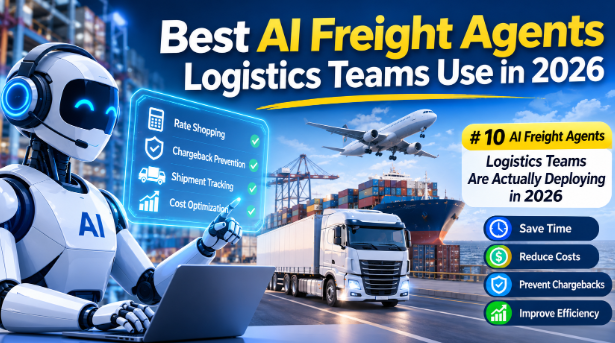
10 AI Freight Agents Logistics Teams Are Actually Deploying in 2026
AI freight agents moved from pilot decks to production stacks this year. The teams running them are not experimenting anymore. They are automating quote cycles, dock appointments, document builds, and exception handling. The hours saved are showing up in headcount decisions and quarterly budgets.
This article walks through the 10 agents logistics operators are putting into daily use in 2026. Not demos. Not conference-slide futures. The ones carrying real freight volume right now, inside working TMS and WMS platforms.
1. AI Rate Shopping Agents for Freight Shipping
How AI logistics software quotes 50+ carriers in minutes
Manual rate shopping used to eat an hour per load. For brands with daily freight shipping, that is a full-time job split across three people. The current generation of AI logistics software pulls live rates from 50+ carrier portals, applies contract-specific adjustments, and ranks options against transit time, reliability, and surcharge exposure.
What makes the best AI freight agents different in 2026
Second-layer intelligence is the real jump this year. These agents flag when a carrier is quoting high because they are capacity-constrained in that lane. Operators know when to wait a day instead of accepting a bad rate.
2. Load Booking Agents That Automate the Full Tender Cycle
How AI freight logistics tools book loads in under 90 seconds
Rate shopping gets a quote. Booking agents actually tender the load. They send the shipment to the chosen carrier, confirm pickup windows, generate the PRO number, and update the TMS without a human touching the screen.
Where freight forwarder teams still keep humans in the loop
Teams using these agents report tender-to-booked times under 90 seconds for standard LTL. One honest caveat: anything specialty (reefer, flatbed, oversize) still needs a human review step. Booking rules there are too variable to automate end-to-end yet.
3. Dock Appointment Schedulers for Amazon, Walmart, and Retail DCs
How AI freight agents logistics teams use handle Carrier Central and Retail Link
Amazon’s Carrier Central and Walmart’s Retail Link both run on appointment windows that fill fast. Miss one and your freight sits in the yard. AI schedulers now pull available windows across these portals and auto-book based on your delivery date, routing guide requirements, and carrier capacity.
Why international freight forwarding workflows benefit most
Brands moving freight through international freight forwarding workflows save the most here. Overseas arrivals have tight landing windows, and manual scheduling creates a cascading delay problem.
4. Real-Time Tracking Agents That Flag At-Risk Freight
How AI freight logistics pushes alerts instead of waiting for a check-in
Tracking data used to sit in a dashboard someone had to check. Now it pushes. These agents watch GPS pings, ELD data, and weather feeds. They surface loads at risk of missing their delivery appointment 12 to 24 hours before the slip actually happens.
Why alert-plus-recommendation beats alert alone
The useful ones do not just alert. They suggest the fix: rebook the appointment, divert to a secondary DC, or split the shipment. The operator picks, the agent executes.
We started with the restaurant industry because it is the most painful and most illustrative. But the platform’s logic is universal: the same procurement, supplier, and invoice problems exist in construction, government contracting, healthcare. These are not different markets — they are the same operational chaos wearing different clothes. We know how to solve it.
For me, victory is when SyncMeOn becomes what Stripe became for payments: infrastructure you do not even notice because it simply works. American small and medium-sized businesses deserve the same level of operational maturity as large corporations. That is exactly what we are building and we are building it here.
5. Freight Audit and Payment Agents That Recover Billing Errors
How AI logistics software catches 10 to 15% carrier invoice errors
Carrier invoices contain errors on about 10 to 15% of lines, and most manual audits only catch half. AI freight logistics audit agents compare every invoice line to the rate confirmation, flag discrepancies, and dispute them automatically in some cases.
Why the best AI freight agents learn carrier-specific error patterns
The best AI freight agents in this category learn carrier-specific error patterns. One carrier always overcharges accessories. Another miscodes fuel. The agents remember and prefilter.
6. Document Automation Agents for BOLs, Invoices, and Packing Lists
How digital freight forwarders build shipping documents without typos
Shipping documents are repetitive and high-stakes. One typo on a commercial invoice means a customs hold. Document agents now build BOLs, commercial invoices, and packing lists directly from the shipment record, pulling HTS codes, incoterms, and carrier-specific formatting rules.
Why platforms like Waybill lead on the document side
Platforms like Waybill are leading on the document side. Structured generation plus carrier-specific validation catches errors before the PDF goes out. For teams running high-volume cross-border lanes, that is where real hours get recovered.
7. Customs and HTS Classification Agents for International Freight Services
How AI freight agents reduce clearance delays
Classification mistakes cost real money. Wrong HTS code means the wrong duty rate and delayed clearance. The current wave of AI tools classifies products from SKU descriptions, product images, and material composition. Borderline cases get flagged for human review.
Honestly there was no single “click.” It was just a regular workday at the restaurant in Tel Aviv while we were setting up procurement for the menu. Erez, one of our key dairy suppliers, arrived. I asked for the catalog to put the order together, and he said: “I don’t give out catalogs. Just tell me what you need.” I started listing items and he simply sat down and wrote prices on a piece of paper. And this was not an exception, it was the norm. Around the same time there was a fish supplier with a beautiful website but no prices. There was a grocery vendor that had clearly invested in e-commerce, but the site was never maintained and every time we still had to call to check what was actually in stock today. Some orders ended up going through WhatsApp: “Okay, bring the same thing, just without this and plus two cases of that.” It became obvious: we live in a digital world, yet procurement runs on closed price lists and verbal agreements. You are not managing margin, you are just putting out fires every day. That is when the thought formed: if you want control, you need a system. That is how SyncMeOn began. And you know what in New York the situation is not much different: the same phone calls, PDF price lists, showroom websites without real-time data, and surprises after delivery. The market is just bigger and the cost of mistakes is higher.
Where international freight services teams see the highest ROI
Teams moving thousands of SKUs across borders see the highest ROI from this agent in 2026. Think international freight services spanning the US, Canada, the UK, Germany, Netherlands, and the UAE. Customs brokers and freight forwarder operations that adopted this early are quoting faster and winning more business.
The biggest difference is in attitudes toward speed and hierarchy. Israeli culture is chutzpah: act, test, fail, move on. No one waits for top-down permission. In America there is more diplomacy, more attention to process, to relationships, to how you present yourself. Neither culture is better; they are simply optimized for different tasks. Israel is perfect for inventing technology and quickly breaking first hypotheses. The U.S. is for building brands, raising capital, and scaling. I have gone through both and I think it gives a certain edge: you know when to act Israeli-style and when to act American-style.
In three years, SyncMeOn should be the default infrastructure layer for B2B procurement in the U.S. Not one of many tools, but the system any new business starts with: you open a restaurant, café, construction site and the first thing you do is connect to SyncMeOn.
8. Capacity Forecasting Agents for Peak Season Planning
How AI freight logistics predicts carrier capacity 3 to 4 weeks out
Shippers want to know whether a carrier can take a load three weeks out. Carriers want to know what volume is coming. Forecasting agents sit between the two. They pull historical shipment patterns, seasonality, and current pipeline data to predict capacity needs.
Why Q4 planners locked rates in September instead of November
Teams running these in Q4 2026 planning got ahead of peak season rates by 3 to 4 weeks. That is the difference between locking rates in September and paying November spot rates.
9. Exception Management Agents That Handle Disruptions
How AI freight agents respond to rejections, port strikes, and weather
A load gets rejected at the dock. A port strike closes a lane. A storm moves inventory off the eastern seaboard. Exception agents watch for these signals and trigger the next steps automatically: reroute, rebook, notify the customer, update the ETA.
Why generic exception handling creates its own problems
What matters is the agent’s ability to understand your SOP. Generic exception handling creates a different kind of mess. The ones in production in 2026 are trained on specific brand workflows.
10. Chargeback Prevention Agents for Vendor Central and Retail
How AI logistics software catches routing guide violations before dispatch
For brands shipping to Amazon as a vendor, chargebacks run around 3% of product cost. Walmart and Target have their own penalty structures. Chargeback prevention agents review every outbound freight shipping record against the retailer’s routing guide, labeling spec, and appointment window. Violations get flagged before the truck leaves.
Catching deductions at the carton stage, not the report stage
Teams running these catch issues at the carton stage. Teams without them catch issues on the deduction report two months later.
Okay, so where does AI actually fit in here?
AI makes sense where it removes drudgery and makes the invisible visible: it automatically detects anomalies in invoices, catches unusual price spikes, warns about potential stockouts, and suggests optimal repeat orders based on pre-set business rules. In this model, AI does not make decisions instead of a human it enables one manager to control many times more tasks: spot deviations faster, react faster, and spend almost no time on manual reconciliation. By our estimates, one AI agent frees up to 12 hours of manual labor per week that is a full working day the business gets back every week.
Since we are on the topic of AI: what, in your view, separates entrepreneurs in the AI era?
In the AI era, what distinguishes entrepreneurs is one core skill turning complexity into systems faster and cheaper than previous generations could. Processes that once required large teams can now be built far more leanly simply because the economics of operations have fundamentally changed. Along with that, the very notion of management is shifting. Alongside people, there is now a second layer of AI agents that take on the routine. The challenge of the new era is to manage not only the team, but also this fleet of agents: set the rules, monitor quality, control risks. I put it this way: scale used to mean headcount. Now scale means system.
I came up with the concept, defined the points of differentiation, designed the logic of the procurement processes, assembled the team, and built the go-to-market. The initial version of SyncMeOn is largely me. Operationally, I own strategy, product, finance, and commercial and I make sure all team priorities align in one direction. Both product and business decisions flow through me from process architecture to partner negotiations. My main responsibility is to ensure SyncMeOn does not remain pretty software, but becomes a real business management tool with a sustainable growth model.
How Digital Freight Forwarders Are Winning With AI in 2026
Digital freight forwarders are the clearest beneficiaries of all 10 agents working together. A freight forwarding service provider stuck on manual processes cannot compete anymore. Quote speed, documentation accuracy, and exception response times are all on the clock.
For brands evaluating providers, the question is not whether their forwarder uses AI. It is which agents, where in the workflow, and what the human review step still looks like. Full automation is a risky answer. Full manual is a losing one.
Conclusion: What to Look for in an AI-Enabled Freight Forwarder
The 10 agents covered here are not a wish list. They are already in production at freight forwarder operations, digital freight forwarders, and brands running their own logistics stacks. Rate shopping, booking, scheduling, tracking, auditing, documents, customs, forecasting, exceptions, and chargeback prevention each solve a different hour-drain inside a logistics team.
After October 7, 2023, it became clear: building an infrastructure company amid war and operational unpredictability is not the best strategy. But honestly it was not just a forced move; it was a decision that had been maturing for a long time. If you want to build B2B infrastructure that truly changes an industry, you need a market where it makes sense to do it at maximum scale. New York is the largest restaurant economy in the world, the highest density of suppliers, and the most demanding market. If it works here it works everywhere.
The right AI logistics software stack depends on where your bottleneck is. If quote cycles are slow, start with rate shopping. If customs delays are killing landed times, start with HTS classification and documentation. If chargebacks are eating margin, start with routing guide validation.
Frequently Asked Questions
What are AI freight agents?
AI freight agents are software tools that automate specific logistics tasks like rate shopping, booking, tracking, auditing, and document generation. They work inside existing TMS and WMS platforms, handling repetitive workflow steps that logistics teams used to do manually by hand.
Are AI freight agents replacing freight forwarders?
No, but they are changing what forwarders do. The best AI freight agents handle repetitive tasks like quotes, bookings, and documentation. Human forwarders focus on carrier relationships, exception handling, and complex routing. The two work together inside most modern logistics operations.
Which AI freight agents deliver the fastest ROI?
Rate shopping, freight audit, and document automation agents deliver measurable ROI inside 60 to 90 days. Teams typically recover 40 to 60% of the hours previously spent on these workflows, with payback periods landing under one full fiscal quarter.
Can small shippers use AI logistics software?
Yes. Most AI freight logistics tools now offer usage-based pricing instead of enterprise contracts. Smaller brands shipping 50 to 500 loads a month can access the same rate shopping and audit tools as enterprise shippers through SaaS platforms.
How do AI agents handle cross-border and international freight services?
Cross-border automation focuses on HTS classification, customs documentation, and incoterm validation. These agents reduce clearance delays by catching documentation errors before submission. That is especially useful for brands running international freight forwarding into Canada, the UK, and Europe.