
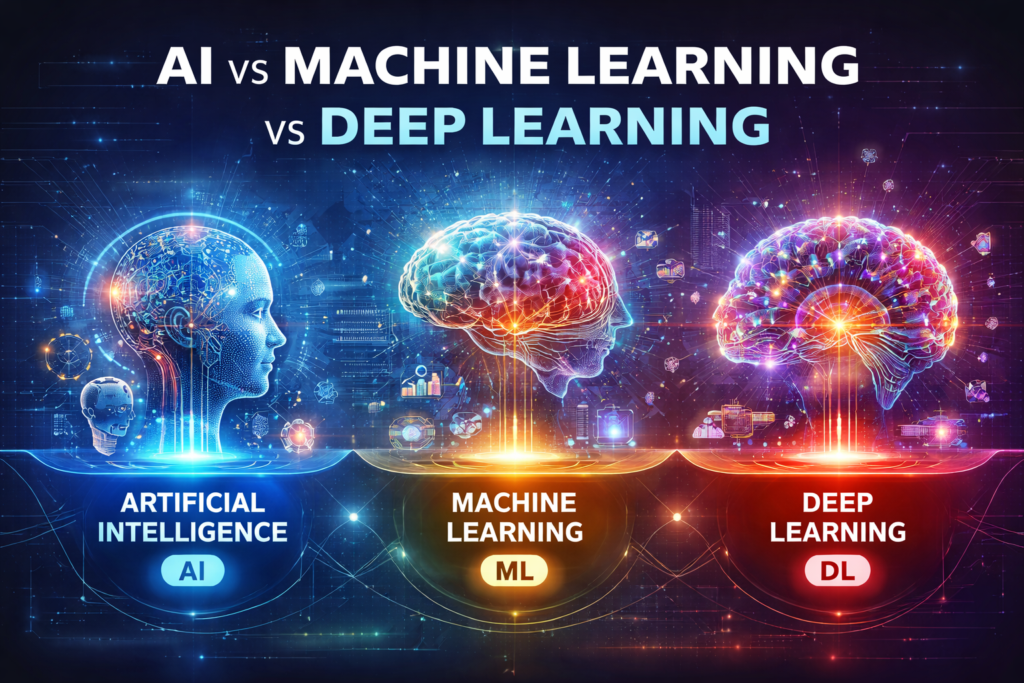
AI vs Machine Learning vs Deep Learning explained in simple terms. Learn key differences, use cases, and how each technology powers modern AI systems.
Artificial intelligence is no longer a futuristic concept—it’s powering everything from search engines to financial predictions and personalized recommendations. Yet, despite its widespread adoption, many people still confuse artificial intelligence (AI), machine learning (ML), and deep learning (DL).
Understanding the differences between these technologies is crucial for businesses, developers, and decision-makers looking to leverage data-driven solutions effectively. If you’ve ever wondered how these concepts relate—or which one is right for your use case—this guide will break it all down in a clear and practical way.
For a deeper foundational overview, you can explore this detailed guide on AI vs ML vs deep learning and a comprehensive AI vs ML comparison to strengthen your understanding.
What Is Artificial Intelligence (AI)?
Artificial Intelligence refers to the broader concept of machines performing tasks that typically require human intelligence. These tasks include problem-solving, reasoning, learning, and decision-making.
AI can be divided into categories such as:
- Narrow AI (Weak AI): Designed for specific tasks like voice assistants or recommendation engines
- General AI (Strong AI): A theoretical system capable of performing any intellectual task a human can do
Examples of AI in action include:
- Chatbots and virtual assistants
- Fraud detection systems in banking
- Autonomous vehicles
- Recommendation systems used by streaming platforms
In simple terms, AI is the umbrella under which both machine learning and deep learning operate.
What Is Machine Learning (ML)?
Machine Learning is a subset of AI that enables systems to learn from data without being explicitly programmed. Instead of following fixed instructions, ML models improve their performance as they process more data.
Types of Machine Learning
- Supervised Learning: Models learn from labeled data (e.g., predicting house prices)
- Unsupervised Learning: Finds patterns in unlabeled data (e.g., customer segmentation)
- Reinforcement Learning: Learns through trial and error using rewards and penalties
Machine learning powers many modern applications, including:
- Email spam filters
- Product recommendations
- Predictive analytics in finance and healthcare
In real-world deployments, ML models are part of larger systems involving machine learning pipelines, which manage data collection, preprocessing, training, and deployment efficiently.
What Is Deep Learning (DL)?
Deep Learning is a specialized subset of machine learning that uses neural networks inspired by the human brain. These networks consist of multiple layers, allowing systems to process complex data patterns.
Deep learning is particularly powerful in areas where traditional ML struggles, such as:
- Image and facial recognition
- Natural language processing (NLP)
- Speech recognition
- Autonomous driving systems
Unlike traditional ML models, deep learning systems require large amounts of data and computational power.
To understand this concept in more detail, check out this guide on deep learning explained.
AI vs Machine Learning vs Deep Learning: Core Differences
Although closely related, AI, ML, and DL differ significantly in scope, complexity, and application.
1. Scope
- AI: The broadest concept, encompassing all intelligent systems
- ML: A subset of AI focused on learning from data
- DL: A subset of ML using neural networks
2. Complexity
- AI: Can range from simple rule-based systems to advanced models
- ML: More complex, requiring algorithms and data
- DL: Highly complex, involving multi-layer neural networks
3. Data Requirements
- AI: May not always require large datasets
- ML: Requires structured data
- DL: Requires massive datasets and high computational power
4. Use Cases
- AI: Automation, chatbots, robotics
- ML: Predictive analytics, recommendation systems
- DL: Image recognition, speech processing, advanced AI systems
Relationship Between AI, ML, and Deep Learning
The easiest way to understand their relationship is through a hierarchy:
- AI is the overarching concept
- ML is a subset of AI
- DL is a subset of ML
Think of it like this:
- AI is the goal (intelligent machines)
- ML is the method (learning from data)
- DL is the advanced technique (deep neural networks)
In modern systems, these technologies often work together. For example, an AI-powered recommendation engine may use machine learning algorithms, while deep learning models analyze user behavior patterns at scale.
Emerging Trends: Self-Supervised Learning and Beyond
As AI evolves, new techniques are emerging to overcome the limitations of traditional models. One of the most promising developments is self-supervised learning.
Unlike supervised learning, which relies on labeled data, self-supervised learning allows models to learn from unlabeled data by generating their own labels.
This approach offers several advantages:
- Reduces the need for expensive labeled datasets
- Improves scalability
- Enhances model accuracy in complex tasks
Real-World Applications of AI, ML, and Deep Learning
These technologies are transforming industries across the globe.
Healthcare
- AI-powered diagnostics
- ML-based disease prediction
- DL-driven medical imaging analysis
Finance
- Fraud detection systems
- Algorithmic trading
- Credit risk assessment
E-commerce
- Personalized product recommendations
- Customer behavior analysis
- Dynamic pricing models
Autonomous Vehicles
- Deep learning for object detection
- AI decision-making systems
- ML-based route optimization
Content Creation
- AI-generated text and images
- Personalized content recommendations
- Automated video editing
How AI Systems Work in Practice
In real-world applications, AI systems are not standalone models—they are part of structured workflows.
A typical AI system includes:
- Data Collection: Gathering relevant datasets
- Data Processing: Cleaning and structuring data
- Model Training: Using ML or DL algorithms
- Evaluation: Testing accuracy and performance
- Deployment: Integrating into production systems
These steps are often organized into robust operational workflows that help teams move from experimentation to real-world deployment more efficiently.
Choosing the Right Approach for Your Business
Selecting between AI, ML, and deep learning depends on your specific needs.
Use AI when:
- You need automation or rule-based systems
- The problem is straightforward
Use ML when:
- You have structured data
- You want predictive insights
Use DL when:
- You’re dealing with complex data (images, text, audio)
- You have access to large datasets and computing power
Why Infrastructure Still Matters for AI Projects
Even the best AI strategy can fall short without the right infrastructure behind it. Training models, managing data workflows, and deploying production-ready applications all require speed, scalability, and reliability.
That is one reason many digital businesses prefer managed cloud environments instead of dealing with server maintenance on their own. Teams that publish, test, and scale data-heavy applications often look for platforms that simplify deployment while maintaining performance. For readers exploring reliable hosting options for content-driven and tech-focused projects, Cloudways is worth considering as a managed cloud hosting solution that helps reduce technical overhead.
Challenges and Limitations
Despite their potential, these technologies come with challenges:
- Data Dependency: High-quality data is essential
- Computational Costs: Especially for deep learning models
- Bias and Ethics: Models can inherit biases from data
- Complexity: Requires skilled professionals and infrastructure
Businesses must carefully evaluate these factors before implementing AI solutions.
Future of AI, Machine Learning, and Deep Learning
The future of AI is driven by innovation and accessibility.
Key trends include:
- Increased adoption of self-supervised methods
- Integration with cloud computing platforms
- Democratization of AI tools for businesses of all sizes
- Automation across industries
As these technologies evolve, the line between AI, ML, and deep learning will continue to blur, creating more powerful and intelligent systems.
Conclusion
Artificial intelligence, machine learning, and deep learning are closely connected yet fundamentally different technologies. AI serves as the overarching concept, ML provides the learning capability, and deep learning delivers advanced pattern recognition.
Understanding these differences is essential for anyone looking to build, invest in, or leverage intelligent systems. Whether you’re a business owner, developer, or tech enthusiast, mastering these concepts will help you stay ahead in an increasingly data-driven world.
As AI continues to transform industries, those who understand how to apply the right approach—whether AI, ML, or deep learning—will be best positioned to unlock its full potential.