
Ozone has a reputation that runs in two directions at once. It is one of the most effective water disinfectants available, and it is also a gas you do not want to breathe. Both of those things are true, and understanding why is the key to understanding the technology. The short answer to whether are ozone generators safe is a fair question with a clear reply: yes, when the system is engineered and monitored correctly, because the same properties that make ozone a strong oxidizer are the ones a well-designed system is built to manage.
Ozone is simply oxygen with a third atom attached. That extra atom is unstable, which is exactly what makes ozone such an aggressive oxidizer and also what makes it short-lived. It does its work and then breaks back down into ordinary oxygen. That instability is the whole story, both for how it treats water and for how it is handled safely.
How the water treatment works
An ozone water treatment system generates ozone on site rather than storing it, because ozone cannot be bottled and shipped like chlorine. It is made on demand from an oxygen source, used immediately, and allowed to revert to oxygen afterward. The process generally moves through a few clear stages, and anyone evaluating the technology benefits from seeing how does an ozone generator work laid out step by step rather than treated as a black box.
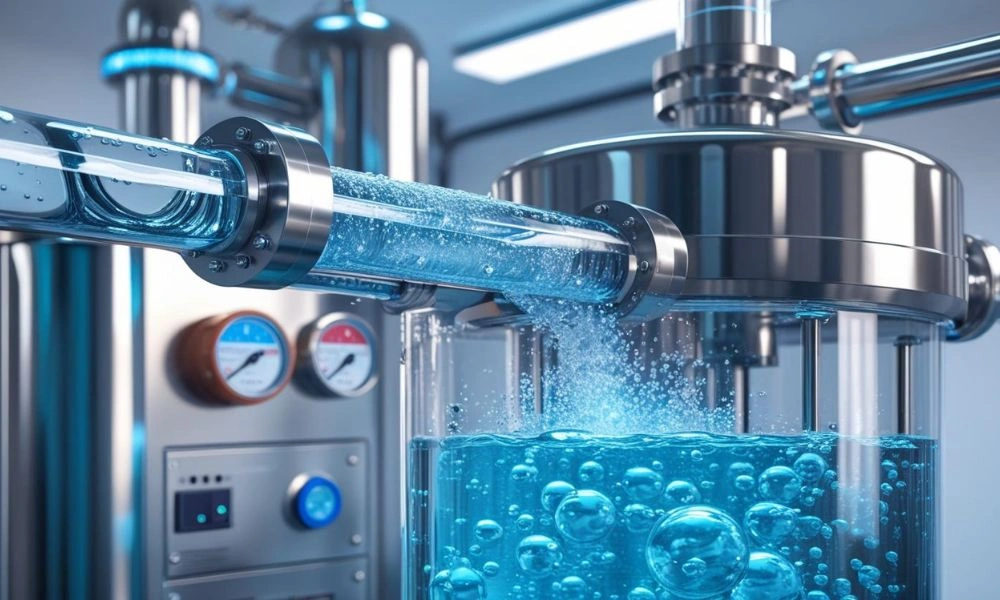
In broad terms, oxygen is fed into a generator where an electrical discharge splits and recombines oxygen molecules into ozone. That ozone is then transferred into the water, often on a side stream or through fine diffusion, where contact time lets it react with whatever is present. As it reacts, it inactivates pathogens, oxidizes dissolved contaminants like iron and organics, and attacks biofilm. What does not dissolve is captured and destroyed in an off-gas step so it does not escape into the room. By the time the water moves on, the ozone has largely done its job and reverted to oxygen, leaving no stored chemical and no lasting residual.
Where the safety comes from
The honest part of the safety question is that ozone is hazardous to breathe at elevated concentrations. A credible system does not ignore that. It designs around it. Safety in an ozone system comes from a handful of engineered features working together:
- Ambient ozone monitors that watch the air around the equipment and alarm or shut down if levels rise
- Off-gas destruction that converts undissolved ozone back to oxygen before it reaches the room
- Sealed contact vessels and piping that keep the ozone in the water, not the air
- ORP monitoring and automated control that dose to the water instead of running wide open
- On-site generation, so there is no tank of hazardous chemical to store or handle
That last point is often overlooked. One of ozone’s real safety advantages over stored chemicals is that there is nothing sitting on site waiting to leak. The ozone exists only while it is being used, and then it is gone. Compared with keeping drums of a reactive chemical on hand, generating a disinfectant on demand and letting it break down is a genuinely lower-risk way to run.
It is worth being clear about what the monitoring is actually doing. Ambient monitors are not a formality bolted on at the end. They are the piece that makes the whole system safe to stand next to, watching the air continuously and acting the moment anything drifts out of range. Paired with automated dosing that only produces what the water demands, the system is not running ozone wide open and hoping. It is making a controlled amount, using it, and destroying what is left. That control loop is the real reason a properly built ozone system is safe to operate day in and day out.
Safe for the water, not just the room
There is a second half to the safety question, which is the treated water itself. Because ozone reverts to oxygen and leaves no chemical residual, it does not build up in the water the way a dosed chemical does. In applications from food and beverage to irrigation, that clean breakdown is part of the appeal. The water is disinfected without carrying a persistent chemical load forward. This is also why the technology shows up across so many industries that care about what ends up in or on their product.
Common questions about ozone safety
Can ozone leak into the room? A correctly built system is sealed, and ambient monitors watch the air around the equipment. If levels rise, the system alarms or shuts down, and off-gas destruction converts undissolved ozone back to oxygen before it can escape. The monitoring is what makes the setup safe to be around.
Is treated water safe to use right away? Because ozone reverts to oxygen and leaves no residual, the treated water does not carry a persistent chemical load. Contact and off-gas steps are sized so the ozone has finished its work by the time the water moves on.
Is it safer than storing chlorine? In one real sense, yes. There is no tank of hazardous chemical sitting on site. The ozone exists only while it is being generated and used, so there is nothing stored waiting to leak or be mishandled.
What maintenance keeps it safe? Routine checks of the generator, the monitors, and the off-gas system. The safety features are only as good as their upkeep, which is why monitoring and service are part of running ozone, not optional extras.
The real answer
So are ozone generators safe? For the people running them, yes, when the system includes proper monitoring, off-gas handling, and automated control, because those features are not add-ons but the core of a correctly engineered system. For the water being treated, yes, because ozone does its work and then disappears back into oxygen. The caution people have about ozone is reasonable, and it points at exactly the features a serious system is built around. The danger is not the technology. It is an unmonitored, poorly designed setup. Engineered properly and watched continuously, ozone is one of the safer and cleaner ways to treat water, and the right design always starts with the specific application and water in front of it.