
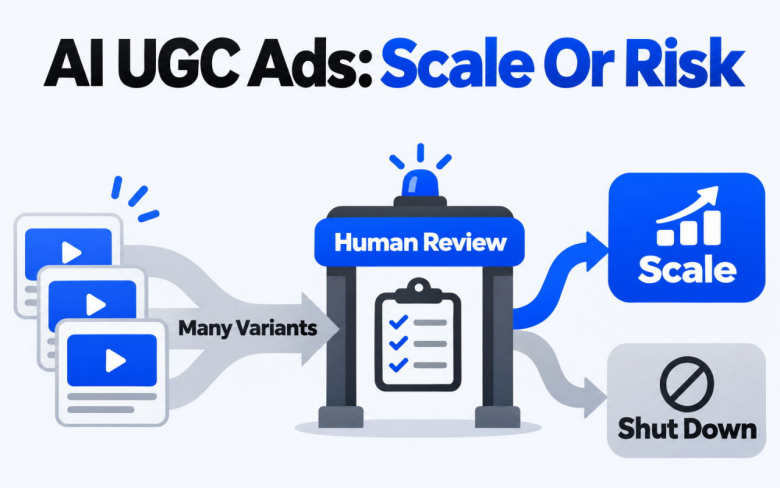
AI UGC ads are synthetic user-generated-content-style videos: a talking-head testimonial, a product-in-hand demo or a creator-style review, generated by AI instead of filmed with a hired creator. They have become the default way performance teams fill the creative pipeline on Meta and TikTok, because a concept that once took a week and a shoot budget can now be produced in an afternoon.
The harder questions rarely appear on a generator’s landing page. What do Meta and TikTok actually require in terms of AI labelling? When does an AI testimonial become a legal problem rather than a creative one? And how should a brand compare the cost of AI creative against human creators when a large share of generated clips are never usable? This explainer treats AI UGC as a creative-operations decision rather than a tool purchase.
Why AI UGC Took Over Meta and TikTok Creative Testing
The shift was driven by arithmetic, not novelty. Automated campaign products such as Meta Advantage+ and TikTok Smart+ take over most targeting and bidding decisions, leaving creative as the main lever marketers still control, and these systems work best when fed many distinct variants to choose between. AI generation collapsed the marginal cost of an extra variant to near zero, so teams now launch many cheap variants, kill most within days, and reinvest behind the few that hold. AI UGC video ads fit that rhythm because they are fast to produce, easy to version and cheap to abandon.
The point of AI UGC is not better creative. It is more attempts per unit of time and budget, which only pays off if the review process keeps the bad attempts from reaching the auction.
What Counts as an AI UGC Ad: Formats Brands Are Actually Running
Most AI generated UGC in the market today falls into four recognisable formats, each with a different job in the funnel.
- Synthetic actor talking-heads. A generated presenter delivers a scripted hook straight to camera, usually in a bedroom, kitchen or car setting. These are cheap to version, which makes them the workhorse for top-of-funnel hook testing: one script, fifteen openings, one winner.
- Product-in-hand demo shots. The product is composited into a hand, counter or bathroom shelf, often combined with real product footage. Best suited to mid-funnel consideration, where the viewer already knows the category and wants to see scale, texture and use.
- AI testimonials. A synthetic speaker describes a result, a before-and-after or a reason to switch. These carry the highest conversion potential and the highest legal risk, because they imitate the one format regulators scrutinise most closely.
- Hybrid real-plus-AI. Real footage from a human creator, with AI used to generate alternative hooks, captions, backgrounds or translated voiceovers. It behaves commercially like AI UGC but is usually easier to defend, because the underlying claim and person are real.
Platform Rules: Meta and TikTok AI-Content Labelling in 2026
Both platforms now treat realistic synthetic media as something viewers are entitled to know about, and both run a mix of self-disclosure and automated detection. The detail matters, because paid and organic are governed slightly differently.
On Meta, the labelling approach for paid placements is distinct from organic posts: ad images created or significantly edited with generative AI can carry an AI info label, and advertisers running ads about social issues, elections or politics are already required to disclose AI-created or AI-edited image, video or audio, according to Meta’s guidance on AI labelling in ads. Meta has also described a broader programme of labelling AI-generated content and adding context rather than removing it outright, in its published approach to labelling AI-generated media.
TikTok takes a more explicit route. The platform requires creators to mark synthetic or AI-manipulated content and surfaces an “AI-generated” label on the video itself, with rules first introduced in 2023 and tightened since, as summarised in this platform-by-platform AI disclosure guide. Detection is partly automatic: TikTok labels content made with its own AI effects and content carrying Content Credentials metadata, and a practical guide to TikTok’s disclosure policy notes that once the platform applies a label automatically it cannot be removed, while labelled content may reach fewer people who have chosen to see less AI content.
FTC Endorsement Rules: When an AI UGC Ads Testimonial Crosses the Line
Platform labelling is a transparency rule. Advertising law is a truth rule, and it is stricter. The core principle in the FTC’s Endorsement Guides is that an endorsement is an advertising message consumers are likely to believe reflects the opinions or beliefs of someone other than the advertiser, as set out in the FTC’s own explainer on the Endorsement Guides. A synthetic speaker reading a brand-written script is, by that definition, a message the viewer may reasonably read as someone else’s genuine opinion.
The FTC also issued a trade regulation rule on consumer reviews and testimonials, published in the Federal Register in August 2024 and effective from 21 October 2024, which addresses fake and misleading reviews and testimonials, per the published rule text. The practical reading for AI UGC ads is blunt: a testimonial that presents a fabricated customer experience as real is a problem regardless of how convincingly it was rendered.
Three rules of thumb keep teams out of trouble. Do not have a synthetic speaker claim a personal result that no real customer had. If an AI presenter is used to deliver brand copy, make the fictional or AI-generated nature clear rather than implying lived experience. And remember that claims substantiation does not depend on who delivers the claim: a weight-loss, income or health efficacy claim needs evidence whether a human, an actor or an avatar says it.
The Pre-Spend Compliance Checklist No Generator’s Landing Page Shows You
Most teams skip this step for a simple reason: the tool UX makes publishing instant, and there is no friction between “render” and “launch”. Adding a short pre-flight gate costs minutes per asset and prevents the two expensive outcomes, a rejected ad set and a complaint about a claim.
- Disclosure and labelling applied correctly per platform. Confirm whether the asset counts as realistic synthetic media on each platform, apply the self-disclosure toggle where one exists, and keep provenance metadata intact.
- Claims substantiation sign-off. Route any health, efficacy, safety, earnings or comparative claim to legal or compliance before render, not after.
- Consent and likeness-rights documentation. Store the licence for every synthetic actor used, plus signed releases for any real person’s face or voice.
- Realism and uncanny-valley QA pass. One human watches the full asset with sound on, at phone size, before anything goes live.
- Brand-safety review of implied endorsement. Read the script for sentences that imply personal experience (“I lost”, “it cured my”, “I made”) when no real person had that experience.
Realism Checks: Catching Uncanny-Valley Tells Before They Cost Spend
Audiences are now trained to spot synthetic footage, and the penalty is not only a worse click-through rate. Comments calling an ad fake sit under the creative where every future viewer sees them, which damages trust across the account. A human reviewer can catch most failures in under two minutes by looking for four tells.
- Lip-sync drift, where mouth movement slips behind the audio in the second half of a clip, especially after a cut or a long sentence.
- Blink rate and eye contact: too few blinks, mechanical blink intervals, or eyes that track slightly off-camera while the head stays locked.
- Hand and product interaction artifacts: fingers that pass through packaging, a label that changes between frames, a bottle that rotates without the hand moving.
- Audio and background errors: flat emphasis, breath in the wrong place, or shadows falling in two directions.
Consent, Likeness Rights and Claims Compliance
Right of publicity is the right of an individual to control commercial use of their identity, which can include a name, voice, photograph or other distinctive characteristic. That definition is broad enough to cover an AI-recreated face or a cloned voice, which is where synthetic actor libraries become a contracts question. Protection is not uniform: coverage and remedies differ between US states, and some jurisdictions, including several Canadian provinces, handle it through a statutory right of privacy instead. Brands running the same asset in the US, UK and EU should assume the rules are not interchangeable.
Industry practice is moving toward explicit, specific consent. The 2023 agreement between SAG-AFTRA and the studios requires clear and conspicuous consent before a digital replica of a performer is created or used, based on a reasonably specific description of the intended use. Congressional researchers analysing digital replicas have also noted that AI replicas used to promote products can raise false endorsement issues, which brings the question straight back to the FTC.
Hook Testing and Creative Fatigue Cadence for AI UGC
Most of the variance in short-form performance sits in the first three seconds. Structured hook testing isolates that: hold the body of the ad constant, change only the opening line, visual or on-screen text, and run enough variants to see a real separation rather than noise.
This is where the AI generation earns its place. Producing fifteen openings of one concept is a rendering task rather than a reshoot, so a team can test hook angles (problem, price, social proof, curiosity, objection) in parallel instead of sequentially. The winning hook then gets promoted into higher-production versions.
Creative fatigue follows a recognisable pattern. As frequency climbs within an audience, click-through rate tends to fall and CPM or cost per acquisition drifts upward while the creative itself has not changed. Those three signals moving together are the usual trigger to refresh rather than to raise budget.
A workable cadence for most ecommerce accounts: review fatigue signals weekly, have the next batch of variants ready before the current winner declines, and refresh the hook layer more often than the full concept. AI shortens the refresh cycle from the weeks a human shoot needs to days, which is the main reason creative fatigue in AI ads is a manageable problem rather than a crisis.
Cost Per Usable Ad: AI UGC vs Human Creators
Cost per generated video is a vanity metric. A generator that produces a clip for a few cents is irrelevant if most clips fail QA, need re-rendering, or burn a reviewer’s hour. The number that drives decisions is cost per usable ad: the fully loaded cost of one asset that passes compliance, passes realism QA and is fit to launch.
| Input | AI UGC | Human creator UGC | How to fill it in |
| Cost per attempt | Tool and credit cost per render | Creator fee, product cost, shipping, briefing | Use last quarter’s invoices |
| Rejection rate | Often high; many renders fail realism QA | Usually lower, but reshoots are slow and costly | Count discarded assets over 30 days |
| Review and compliance time | Realism QA plus labelling and claims check | Claims check plus usage-rights check | Log minutes per asset for two weeks |
| Performance half-life | Typically shorter, refreshed more often | Often longer for trust-heavy formats | Days of profitable spend before decline |
| Cost per usable ad | Attempt cost divided by pass rate, plus review time | Same formula, different inputs | Compare per usable asset, not per file |
Where AI UGC Still Loses to Human Creators
- Complex product demos. Anything requiring assembly, fit, multi-step use or genuine physical interaction, such as furniture, power tools, strollers or technical apparel. AI hands still fail the details viewers watch for.
- Trust-heavy categories. Health, supplements, financial services, insurance and high-ticket purchases, where testimonial claims face the most scrutiny and a viewer’s suspicion is most expensive.
- Markets that penalise synthetic content. Some audiences actively hunt for AI tells. In tight-knit niche communities, the reputational cost outweighs the production saving.
- Nuanced humour and long-form testimonial depth. Regional slang, timing and a sixty-second story with real hesitation and emotional texture still read better when a real person lived them.
Running a Hybrid AI UGC + Human Creator Programme
The operating model most mature teams converge on has three layers. AI handles volume discovery: many hooks, many angles, cheap and fast, with a hard QA gate. Human creators handle scale and trust: winning concepts get reshot properly for the placements that carry the most spend and the most risk. A small rotating creator roster covers the categories where AI reliably underperforms.
This split also tidies up compliance. Synthetic assets stay in exploratory ad sets with clear labelling and no personal-experience claims. Human assets carry the testimonials, backed by real releases and real substantiation.
Tooling is where the model lives or dies, because the bottleneck moves from production to triage. Platforms built around this workflow, such as Larven, an AI CMO platform for ecommerce brands, generate AI UGC video ads and static ads from brand and store data, launch them on the brand’s own Meta and TikTok accounts, and pause underperformers automatically, so the testing loop keeps running without someone watching the dashboard all day.
Whatever tooling is chosen, the governing rule stays the same: automation should speed up the testing loop, not the publishing of unreviewed claims. The checklist above is the part that cannot be delegated to a model.
Frequently asked questions
What is AI UGC?
AI UGC is advertising creative that imitates user-generated content but is produced with generative AI rather than filmed with a real creator. Typical formats include synthetic talking-heads, AI-composited product demos and avatar-delivered testimonials, used mainly for high-volume creative testing on Meta and TikTok.
Are AI UGC ads legal and do they require disclosure?
They are legal in most markets, but sit under both platform labelling rules and advertising law. Meta and TikTok expect realistic AI-generated content to be identified, and the FTC’s Endorsement Guides treat any message a consumer believes reflects someone else’s genuine opinion as an endorsement. Fabricating a customer experience turns a creative choice into a legal risk.
How much do AI UGC ads cost compared to hiring real creators?
Per rendered file, AI is dramatically cheaper. The honest comparison is cost per usable ad, which adds rejection rate, compliance review time and how long each asset keeps performing before fatigue. Calculate it with your own rejection rates rather than a vendor’s per-video price.
Can AI UGC ads convert as well as real user-generated content?
In low-consideration categories with simple products, well-made AI UGC often performs comparably, particularly for top-of-funnel hook testing. In trust-heavy categories such as health, finance and high-ticket purchases, human creators usually still convert better.
Does TikTok or Meta ban AI-generated UGC ads?
Neither platform bans AI-generated advertising outright. Both require disclosure or apply labels to realistic synthetic content, and both remove content that breaks other policies regardless of who or what made it. The realistic risk is rejection or reduced reach, not a blanket ban.
How do you make an AI avatar look and sound like a real person?
The gains come mostly from script and QA rather than the generator. Write conversational lines, keep clips short enough that lip-sync does not drift, and check blink rate and hand-product contact before launch. Any avatar based on a real person needs documented consent for commercial use.
What is the difference between AI UGC and AIGC?
AIGC is the broad umbrella term for anything a model produces, including text, images, audio and video. AI UGC is a narrower subset: synthetic creative styled to look like an ordinary person’s authentic post or review.
The Larven team
Written by the people behind Larven. Larven is an AI-powered advertising platform that acts like a CMO for performance marketers and ecommerce brands.