
To understand user perception and satisfaction with AI and machine translation tools, researchers at Lokalise compared customer insights from 2023 and 2024. They can now clearly state that advancements in AI technology are paving the way for better translation quality at a faster rate than expected, marking a year of remarkable progress. Let’s dive into the numbers and explore what this means for the future of global communication.
The 2023 landscape: AI hype & uncertainty
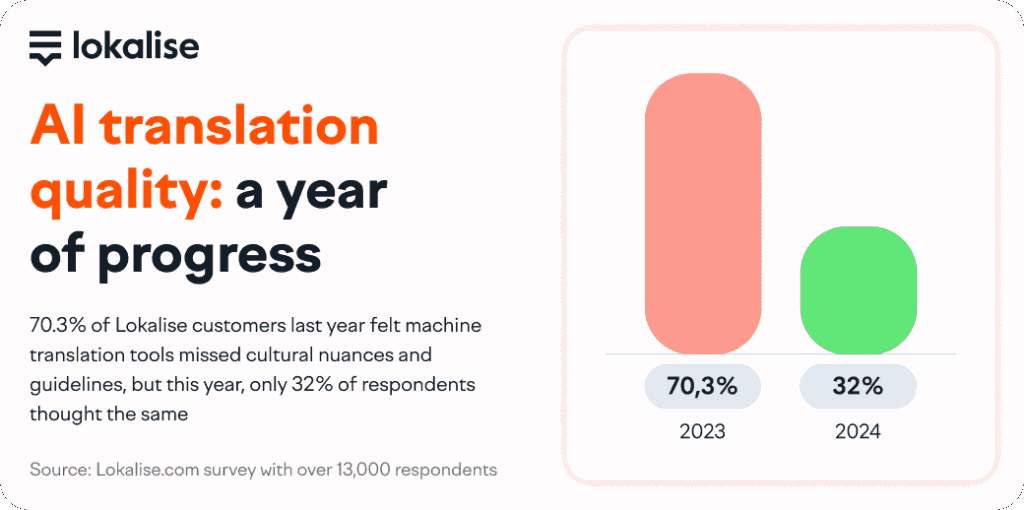
When generative AI translation tools first hit the scene last year, there was a lot of skepticism around accuracy. They were seen as just another machine translation (MT) tool — tools like Google Translate and DeepL that had come before and declared near-human accuracy, only to fall flat when faced with less common language pairs, idioms, slang, technical jargon, puns, or any other kind of non-standard dialect. A survey sent to13,000 Lokalise customers reflected this perception:
- 70.3% of respondents believed that machine translation tools often failed to capture nuances and cultural references in text
- Users frequently reported frustration with literal translations that missed the mark on context and tone
- Many still relied heavily on human translators for critical or culturally sensitive content
These findings weren’t surprising. Language is intrinsically tied to culture, filled with idioms, contextual references, and subtle nuances that even fluent human speakers sometimes struggle to navigate. The idea that a machine could grasp these complexities seemed very unlikely to many.
Fast forward to 2024: Yes to GenAI translation
Following the release of Lokalise AI, a generative AI (GenAI) translation tool, researchers at Lokalise decided to reach out to our customers again to see how their perception of ‘machine translation tools’ has changed — if at all. Their latest survey, though smaller in scale with 800 respondents, reveals a transformation that marks a significant turning point in the translation industry:
- Only 32% of respondents believe that ‘machine translation tools’ failed to consider context and guidelines when translating
- This represents a huge 38.3% improvement in just one year
To put it another way, in 2023, seven out of ten users were dissatisfied with AI’s ability to handle nuance and cultural context. Now, more than two-thirds of users are satisfied.

What’s behind changing perceptions of AI translation quality?
The dramatic shift in user perception of ‘machine translation’ quality comes down to several factors:
- Advanced language models: More sophisticated language models, trained on vast and diverse datasets, have significantly improved AI’s ability to understand context and nuance.
- Cultural training: AI developers are increasingly incorporating cultural knowledge bases into their translation tools, helping the AI grasp references and idioms that would have been lost in translation just a year ago.
- Context-aware algorithms: New algorithms are better at considering the broader context of a document or conversation, leading to more accurate and natural-sounding translations.
- User feedback loop: Many AI translation tools now incorporate user feedback mechanisms, allowing them to learn and improve in real-time based on user corrections and preferences.
- Industry-specific training: Some AI translation tools are now being trained on industry-specific content, allowing them to better handle technical jargon and specialized terminology.
The implications of GenAI translation tools
Machine-generated translations are closer than ever to human-like accuracy. With it comes far-reaching implications:
- Fewer barriers to communication: Companies can now more confidently expand into new markets, knowing that language barriers are becoming less of an obstacle
- Improved content localization: Companies can more easily adapt their content for global audiences, making it feel a lot more personalized.
- Changing roles for translation professionals: AI acts as an assistant for translators to fill any gaps in vocabulary or to bounce ideas off.
- Significant cost and time savings. When GenAI is used in the translation workflow, there are fewer post-edits needed and the turnaround time is significantly faster.
The future of machine-generated translations
While the progress is impressive, it’s important to note that AI translation still has room to improve. There are still challenges to overcome:
- Uncommon languages and language pairs: Many AI models still struggle with less common languages or dialects
- Highly contextual content: Some types of content, like humor and creative writing, remain difficult for AI to translate effectively.
- Ethical considerations: As AI gets better at understanding and replicating human communication, questions of privacy and data use become more pressing.
Looking ahead, you can expect continued improvements in AI translation quality, with a focus on these areas:
- Further refinement of context understanding
- Better handling of idiomatic expressions across languages
- More sophisticated integration of cultural knowledge
- Improved real-time translation capabilities
A giant step closer to a world without language barriers
The leap in the perception of AI translation quality in just one year is remarkable. It highlights a significant turning point in the translation industry and represents a giant step toward a world where choice isn’t limited by language — with new possibilities for global collaboration, understanding, and creativity.